
Were you ever curious about what temperaments are all about?
When it comes to temperament, we have all used the term, but have you ever thought about what it means?
Temperament is actually just one part of your personality, and while we use the word to describe someone’s way of being, the official definition is a bit limiting in scope.
Temperament is part of your innate personality and behavioral traits. Scientists and researchers describe it as being your natural propensity and that it will end up shining through the day in your mannerisms and interactions with others.
To put it in a simplified way, your temperament is a way to describe how your mind works.
While it is not a fixed science, professionals have identified the main four types of temperament, and you may find yourself more inclined to identify with one of them!
If you are curious about what they are all about, how we got to these four temperaments, and what characteristics are associated with each of them, make sure you keep reading!
Have you ever been told you are similar to one of the temperaments? Have you ever had to deal with a temperament that is different from yours? Let us know in the comments below!
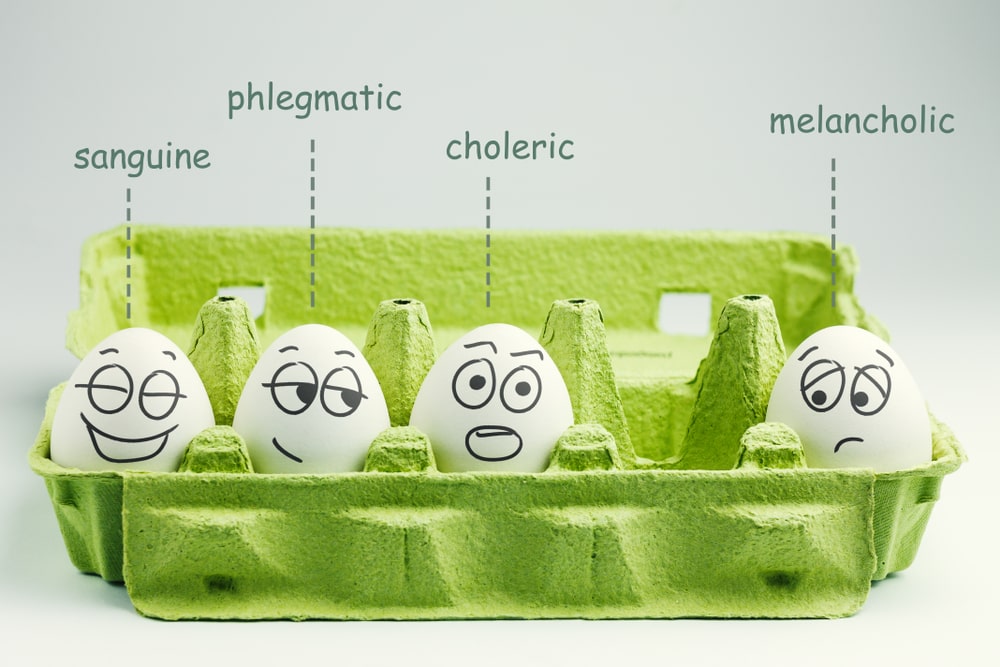
The types of temperament
Over the years, scientists and researchers have ended up observing and defining four distinct types of temperament that can be seen in people. These primary temperaments have been observed for hundreds of years, even dating back to ancient times.
Hippocrates, in Ancient Greece, was the first to suggest that a person’s behavior and personality could be determined by the four bodily humors.
Later, Galen of Pergamon used the bodily humors to come up with his theory on temperaments and what characteristics they have, which in turn has become the one that we still use today.
While these types of temperaments have their own specific characteristics, and we can all see certain ones overlap, they are not only innate to each person.
Your temperament can also be influenced by culture, gender, age, and the community you have been growing up in.
Keep on reading to discover the four temperaments and their particularities!
Sanguine
While the name of this personality may make you think of blood (since the origin word comes from the Latin word for blood), those who have been identified with this temperament are those who are more inclined to be sociable and extroverts.
They are known for their positive attitude towards life; they are more inclined to see the glass half full and to be chipper and easygoing.
You can expect people with a sanguine temperament to be positive, to love being around others, and to be energetic and talkative.
Social interactions come easily to them, and they feel at ease even in big crowds.
Sanguine people seem to have a lot of positive traits, but what makes them amazing social people can also put them in difficulty.
It may not seem like it at first, but since they are fun-loving people, they are likely to put themselves in danger’s way.
They are at times indecisive and impulsive, and in extreme cases, their excitement can manifest as thrill-seeking, making them susceptible to drug use and extreme alcohol consumption.

Melancholic
A lot of people confuse the melancholic temperament with a sad predisposition or even the fact that they are completely joyless. However, this is not part of this temperament, and it is just that people associate it with sadness rather than introversion.
Melancholic temperaments are sensitive and thoughtful, conscientious, and at times timid. They have analytical personalities and are methodical in their approach to life and work, and they are all about facts and starting private.
They more often than not excel at their work, but they do not make the best team players. They prefer to work alone, and when things aren’t going as planned, they can get anxious and moody.
Towards others, melancholic temperaments tend to be cautious, and this can impact their personal lives. Some weaknesses they have include the fact that they worry too much, focus on the negative, and struggle with self-love.
They can be overly critical and too sensitive, which can affect their lives and relationships negatively.
Choleric
The best way to define choleric temperaments is by being extroverted, assertive, and dominant. They can make very good leaders since they are goal-driven and oriented, strong-willed, visionaries, and energetic.
Choleric temperaments are high achievers in everything they set out to do, from school to work to their hobbies and personal lives. They are most likely to be seen in positions of leadership, be it in games and team exercises or workplace settings.
They are also active people who do not need much sleep to be able to maintain their energy levels.
While choleric people can be similar to sanguines, they are known to be more stubborn, impatient, and controlling than them.
Choleric people are more focused on their goals than being social, which can negatively impact their social relationships and connections.
They are also known to occasionally be inflexible and dominant in their approach, as they believe their way of doing things is the best one.

Phlegmatic
When it comes to phlegmatic temperaments, what comes to mind at first is the fact that they are laid-back and easy-going. These individuals are known to be easy to get along with, since they are friendly, peaceful, and collected, with many speaking highly of good and harmonious interactions with them.
People who have this temperament are known to be empathetic, patient, and dependable, so you know you can always count on them. They find comfort in routine and are overall attentive and observant, be it of the people around them or the task at hand.
Despite all the good qualities they have, phlegmatic people also end up coming across as distant or passive when it comes to social interactions, since they show little to no emotions. They can end up seemingly dependent on and distant from those around them, especially since, despite getting along well with others, they are introverted.
What’s more, they are known to hate conflict, which can put them in difficult situations since they try to avoid it at all costs, and it can cause them to miss out on opportunities, all because they cannot find it in themselves to assert their strengths.
Do you only have one temperament?
All humans are complex and diverse individuals, for a lot of different reasons. Because of this, it is very hard to be able to put everyone in neat little boxes and say that makes up their whole personality and identity.
Despite this, you can still end up being able to identify more with one of the temperament types.
The one that seems to be the closest to your temperament and personality would be your dominant temperament, while you could also be exhibiting traits and behaviors that belong to others, which would be your secondary one.
For example, you could be stoic, reserved, or introverted, which would indicate that you have a melancholic temperament, but you could also be assertive, goal-oriented, and dominant in your approach, which would also point to having some choleric traits!
If the four temperaments interest you and you want to read more about their history and get into the nitty-gritty of their characteristics, make sure you give this book a read!
Temperament can tell us a lot about a person, but so can personality! While it may not seem like we are all too similar, certain personality traits can be observed in multiple people who share the same similarity of being skilled liars. If you are curious about which personality traits are shared by people who are more inclined to lie, check out this article!









Leave a Reply