

When someone describes you as fiercely independent, a relentless perfectionist, or endlessly accommodating, it feels like a compliment about your character. Yet, many traits society applauds as innate personality quirks are actually sophisticated survival mechanisms. Trauma reshapes the nervous system, prompting adaptations designed to keep you safe from emotional or physical pain. Rather than reflecting who you truly are, these chronic behaviors mask unresolved wounds. By learning to distinguish between your authentic temperament and a learned trauma response, you can dismantle exhausting emotional armor. Recognizing these eight common adaptations allows you to stop treating your survival skills as a permanent identity and start healing the underlying nervous system dysregulation.

1. The “People Pleaser” (The Fawning Response)
If you constantly abandon your own boundaries to keep others comfortable, society might label you as exceptionally kind, selfless, or agreeable. However, chronic people-pleasing is frequently a manifestation of the fawning response. Psychotherapist Pete Walker coined this term to describe a survival strategy where an individual appeases a threat to avoid conflict or harm. When fighting back feels impossible, fleeing is not a viable option, and freezing leaves you physically or emotionally vulnerable, the autonomic nervous system learns that making yourself exceptionally useful or agreeable is the safest route.
Fawning often originates in childhood environments characterized by emotional neglect, unstable household dynamics, or unpredictable caregivers. You learn early on that prioritizing another person’s emotional state prevents volatile outbursts or abandonment. Over time, this adaptive behavior solidifies into what looks like a core personality trait. In relationships, this translates to hiding your true feelings and constantly putting your partner’s wants before your own. Over the long term, this pattern can chip away at your self-respect and lead to profound emotional exhaustion. You might struggle to identify your own needs because your psychological bandwidth is entirely consumed by managing the emotions of those around you.
- Actionable Insight: Healing a fawning response begins with somatic awareness. Notice the physical sensations in your body—such as a tight throat, a sinking feeling in your stomach, or shallow breathing—right before you agree to something you do not want to do. Practice inserting a time buffer by saying, “Let me check my schedule and get back to you.” This gives your nervous system a chance to regulate and exit survival mode before you commit.
2. The “Relentless Overachiever” (The Flight Response)
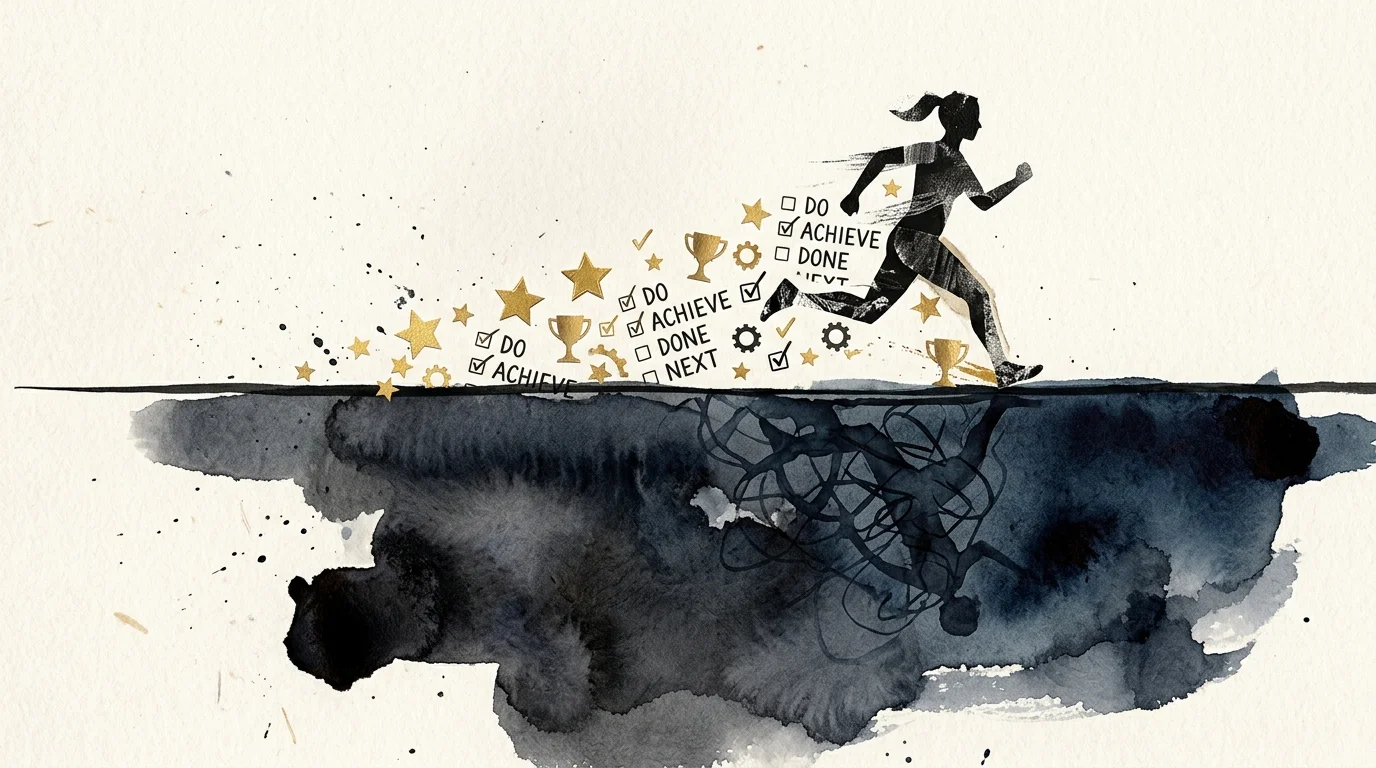
Perfectionism and a relentless drive for success are heavily rewarded in modern culture. You might be praised for your incredible work ethic and boundless energy, but chronic overachieving often acts as a socially acceptable form of the flight response. Instead of physically running away from a dangerous situation, you are using momentum to outrun emotional pain, feelings of inadequacy, or unresolved grief. If you are constantly moving, the trauma cannot catch up to you.
When you stay in a state of continuous action—chasing the next promotion, maintaining perfect grades, or striving for an immaculate physical appearance—you leave no quiet space for painful memories or anxiety to surface. Achievement becomes a highly effective form of emotional armor. Unfortunately, building your identity around constant output leaves you vulnerable to severe burnout.
“Owning our story can be hard but not nearly as difficult as spending our lives running from it. Embracing our vulnerabilities is risky but not nearly as dangerous as giving up on love and belonging and joy—the experiences that make us the most vulnerable.” — Brené Brown, PhD
- Actionable Insight: The distinction between authentic ambition and a trauma-driven flight response lies in the emotional aftermath. Authentic achievement brings genuine satisfaction and rest; trauma-driven achievement brings only a brief hit of relief followed by an immediate, anxious need to find the next goal. Begin decoupling your self-worth from your productivity by scheduling intentional pauses. Practice sitting completely still for five minutes a day without a screen, a task, or a distraction, simply allowing yourself to exist without earning your worth.

3. The “Fiercely Independent” (Hyper-Independence)
Many adults pride themselves on never needing help. If you operate under the absolute belief that you must handle everything alone, you might be experiencing hyper-independence. Mental health professionals recognize this as a common trauma adaptation, frequently stemming from childhood parentification—a dynamic where a child is forced to take on adult emotional or logistical responsibilities due to a caregiver’s physical absence or psychological immaturity.
When the people who were supposed to protect and support you consistently failed to do so, your nervous system internalized a harsh but protective rule: relying on others is inherently dangerous. Hyper-independence is not true autonomy; it is an emotional defense mechanism designed to prevent the intense pain of future disappointment. You might excel at managing logistical crises alone, but this protective isolation ultimately creates rigid barriers to genuine intimacy. According to resources from Verywell Mind, adults with trauma-induced hyper-independence often experience profound loneliness, even when surrounded by people, because they fundamentally refuse to let anyone support them.
- Actionable Insight: Unlearning hyper-independence requires micro-delegation. You do not need to drop your walls completely and share your deepest vulnerabilities right away. Start by allowing someone to do a small, low-stakes task for you—like letting a partner cook dinner or asking a coworker for a minor piece of advice. Teach your nervous system that receiving help does not inevitably lead to betrayal.
4. The “Flaky” or “Forgetful” Friend (Dissociation and Freeze)
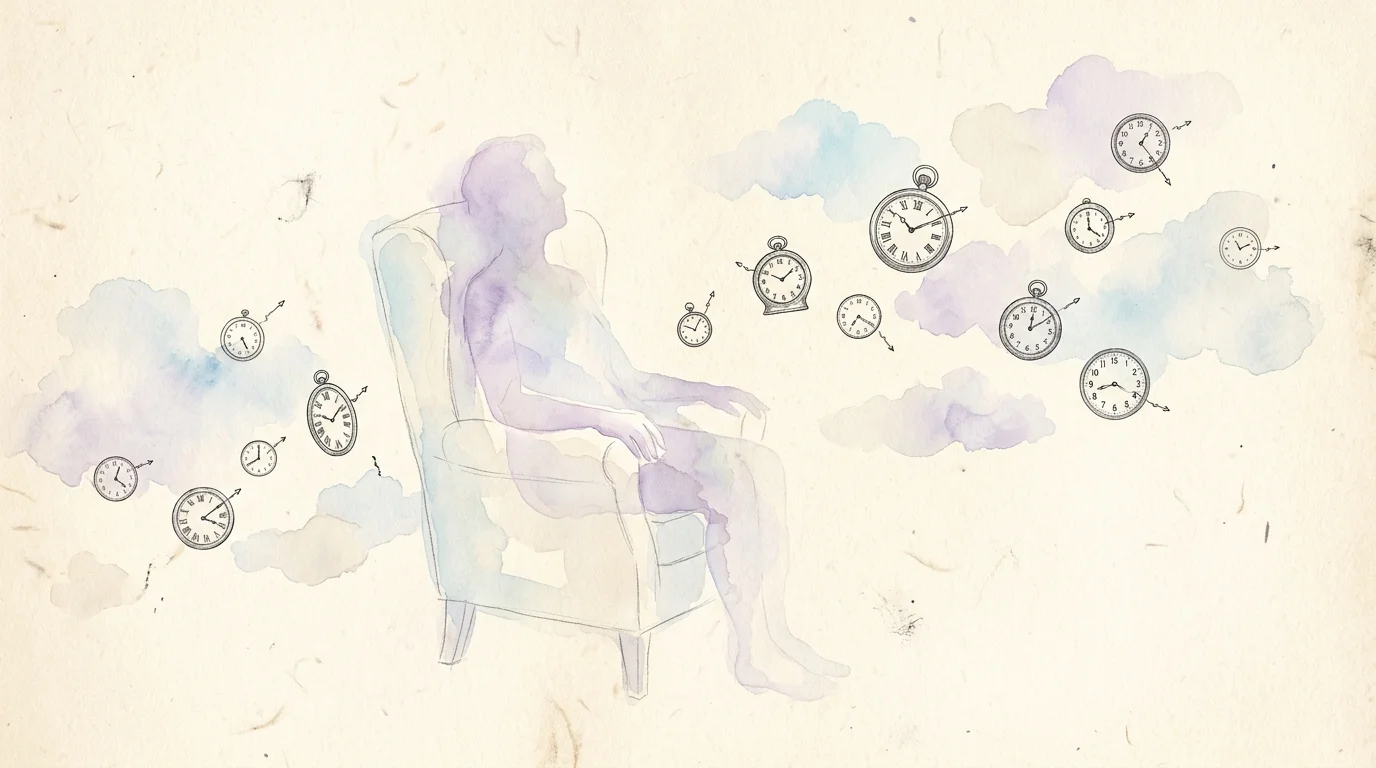
If you are frequently told that you are “zoning out,” forgetful, or flaky, you might have internalized the belief that you are simply scatterbrained or naturally unorganized. In reality, checking out mentally is often a symptom of dissociation, a core component of the freeze response. When a situation feels emotionally unsafe, the brain provides a chemical escape hatch.
When the nervous system becomes overwhelmed by stress, conflict, or sensory input, and neither fighting nor fleeing is viable, the brain chemically disconnects from the present moment to tolerate the distress. The National Institute of Mental Health notes that dissociation is a recognized way the brain protects itself from overwhelming traumatic material. In daily life, this can look like losing track of time (time blindness), going entirely blank during a minor argument, or feeling emotionally detached from your physical surroundings. Society often mislabels this trauma response as laziness or apathy, failing to recognize that a dissociative brain is actually working overtime to shield itself from perceived unbearable emotional weight.
- Actionable Insight: When you feel yourself floating away or shutting down during a stressful moment, utilize sensory grounding techniques to pull your nervous system back to the present. The 5-4-3-2-1 method (identifying five things you can see, four you can touch, three you can hear, two you can smell, and one you can taste) effectively interrupts the dissociative loop. Holding an ice cube or splashing cold water on your face can also provide a strong somatic reset.

5. The “Over-Explainer” (Fear of Misunderstanding)
Do you find yourself providing a detailed, unprompted defense for your most basic choices? The compulsion to Justify, Argue, Defend, and Explain (often referred to by the acronym JADE in clinical circles) is frequently mistaken for a talkative, highly detailed, or overly analytical personality trait. You might exhaust yourself drafting a five-paragraph email just to call in sick to work.
Over-explaining is a common adaptation for individuals who survived environments where minor misunderstandings resulted in severe punishment, or where psychological manipulation and gaslighting were prevalent. If your reality was constantly questioned or invalidated by caregivers or past partners, you learned to build an airtight, bulletproof case for your actions to establish safety. You over-communicate because your nervous system anticipates being misunderstood, blamed, or attacked at any moment.
- Actionable Insight: Unlearning this response requires practicing the “period” at the end of a sentence. Your choices do not always require a courtroom-level defense. Start with low-stakes communications. If you cannot attend a social event, practice saying, “I won’t be able to make it tonight, but I hope you have a great time.” Resist the urge to follow up with three paragraphs explaining why. Tolerate the temporary anxiety that arises when you leave things unexplained.

6. The “Highly Observant” One (Hypervigilance)
You might consider yourself highly empathetic or pride yourself on your innate ability to “read the room.” You instantly notice when a partner’s breathing pattern changes, when a colleague’s tone shifts slightly, or when the energy in a social setting drops. While emotional intelligence is a genuine and valuable trait, compulsive, anxious environment scanning is a physiological state known as hypervigilance.
Hypervigilance develops when you grow up or live in an unpredictable, volatile environment. Your developing brain learned that accurately anticipating a caregiver’s mood swings could give you crucial seconds to hide, appease, or prepare for conflict. Today, your nervous system remains stuck in threat-assessment mode, continuously monitoring micro-expressions, sighs, and body language. What feels like an innate superpower of perception is actually an exhausting, chronic state of physiological arousal that leaves your adrenal system thoroughly drained by the end of the day.
- Actionable Insight: Practice cognitive reframing. When you notice a shift in someone’s mood and feel the immediate urge to fix it or manage it, pause. Remind yourself silently: “I observe that they are upset, but I am not responsible for regulating their emotions.” Learning to tolerate another person’s bad mood without interpreting it as an immediate threat to your safety is a vital step in healing hypervigilance.

7. The “Over-Apologizer” (Pre-emptive Appeasement)
Saying “I’m sorry” when an inanimate object falls, when someone else bumps into you in the hallway, or apologizing simply for asking a clarifying question is often dismissed as a quirk of extreme politeness or low self-esteem. However, compulsive apologizing is a distinct survival tactic known as pre-emptive appeasement, which operates slightly differently than fawning.
If you were raised in a dynamic where anger was weaponized and punishment was doled out unpredictably, taking the blame became the fastest, most effective way to de-escalate tension. You apologize for existing, for taking up space, and for having basic human needs because your nervous system closely associates conflict with danger. By pre-emptively absorbing the blame before anyone else can assign it, you attempt to neutralize a potential threat before it erupts.
- Actionable Insight: Challenge this trauma response by swapping “I’m sorry” with “Thank you.” If you arrive five minutes late to a meeting, instead of rushing in and saying, “I am so sorry I’m late, traffic was terrible,” shift your phrasing to, “Thank you so much for your patience.” This minor linguistic shift helps rewire the brain, moving you away from a posture of constant guilt and toward a posture of mutual respect.

8. The “Unflappably Logical” (Emotional Numbing)
Some individuals are celebrated by their peers for being the “rock” in a crisis, appearing completely stoic and detached from emotional chaos. While the ability to stay calm under pressure is valuable, an absolute inability to access emotions during profoundly sad or joyful events is not a naturally stoic personality trait—it is emotional blunting or numbing.
When trauma deeply overwhelms the nervous system’s capacity to process feelings, the brain may sever the conscious connection to emotional pain as an act of psychological mercy. You learn to intellectualize your feelings instead of actually experiencing them in your body. This adaptation keeps you highly functioning during a crisis, but it also severely blunts your capacity for joy, connection, and intimacy. Relationship experts at The Gottman Institute frequently note that unresolved trauma can create enduring vulnerabilities that make emotional attunement with a partner incredibly difficult, as the numbing response systematically blocks genuine repair and connection.
- Actionable Insight: Reconnect with your emotions through somatic check-ins. When faced with an emotionally charged situation, before you jump to creating a five-step logical action plan, ask yourself: “What am I feeling physically in my body right now?” You might notice a tightness in your chest or a heaviness in your limbs. Honoring the physical sensation of an emotion is the first step toward safely feeling it again.
Comparing Trauma Responses vs. Personality Traits
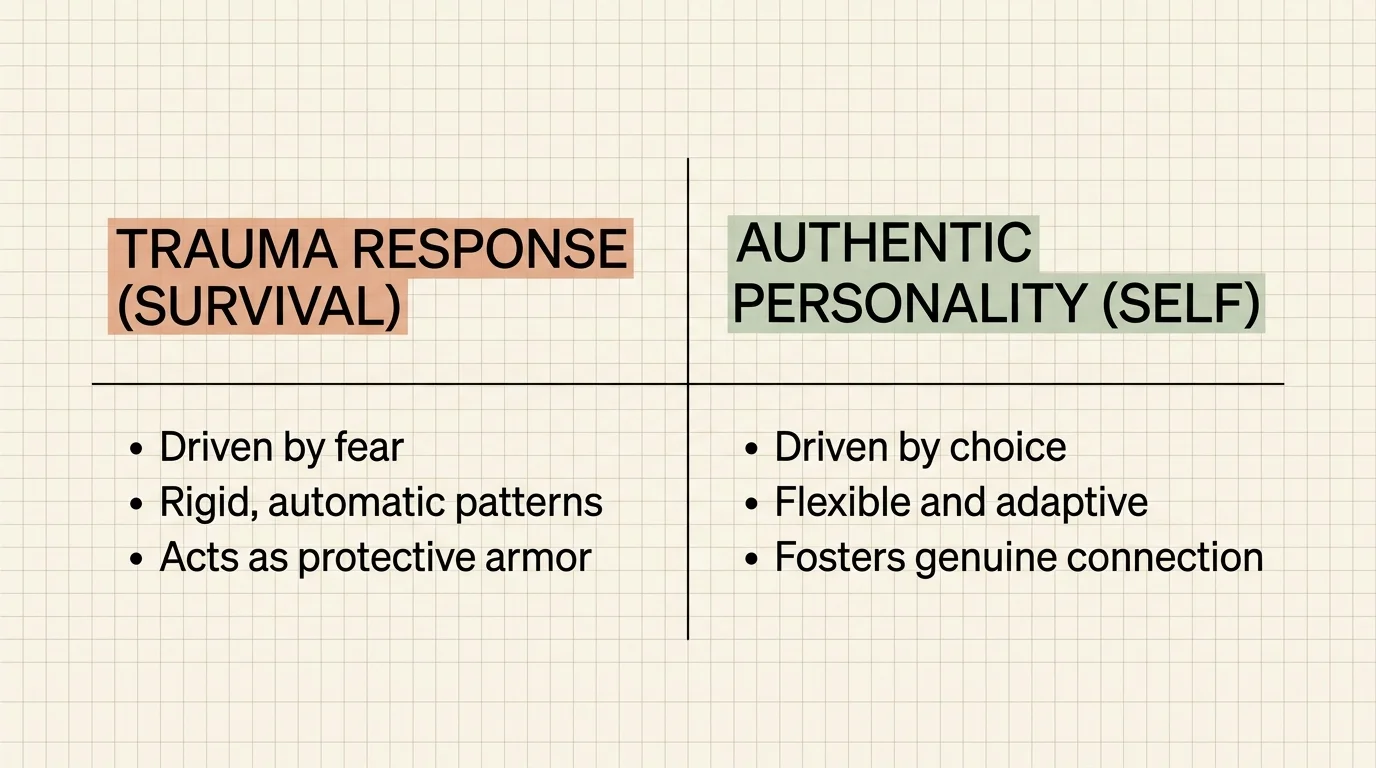
Differentiating between an authentic personality trait and a trauma response requires looking closely at the internal motivation behind the behavior. Authentic traits operate from a place of choice, ease, and alignment with your values. Trauma responses are driven by underlying fear, compulsion, and a subconscious need to establish safety.
| Behavior / Trait | Authentic Personality Trait | Trauma Response |
|---|---|---|
| Accommodating Others | Helping out of genuine generosity; feeling energized and happy after giving. | People-pleasing (Fawning); helping out of fear of rejection, abandonment, or anger. |
| High Achievement | Pursuing goals for personal fulfillment and joy; ability to rest when tired. | Overachieving (Flight); pursuing goals to prove basic self-worth; extreme guilt when resting. |
| Independence | Enjoying autonomy and self-trust while remaining entirely open to asking for help. | Hyper-independence; refusing help due to a deep, generalized mistrust of others. |
| Being Observant | Noticing environmental details out of curiosity and genuine interpersonal interest. | Hypervigilance; scanning the room constantly to predict mood shifts and avoid danger. |
| Logical Thinking | Approaching problems analytically while still being able to feel and express emotions. | Emotional numbing; exclusively intellectualizing situations because feeling is perceived as unsafe. |

What Can Go Wrong: The Danger of Praising Trauma
One of the most significant barriers to emotional healing is society’s tendency to reward our trauma responses. When your survival mechanisms are consistently praised as exceptional character traits, you receive powerful positive reinforcement for abandoning your own emotional needs.
For instance, calling a parentified, hyper-independent person “so incredibly strong” validates their isolation and makes it harder for them to ask for help. Praising an overachiever for their “relentless hustle” actively masks the reality that their nervous system is burning out. When these underlying roots are ignored, you might spend years treating your nervous system dysregulation as a point of pride. This societal validation delays healing, as it subconsciously convinces you that losing these protective traits means losing your core identity or your ultimate value to others. Unpacking these behaviors requires stepping back from societal praise and giving yourself permission to be ordinary, rested, and occasionally reliant on others.

When to Seek Professional Support
Unlearning deep-rooted survival adaptations is complex and difficult to navigate alone. Your nervous system has relied on these tools for a long time. Professional support from a trauma-informed therapist can be a transformative step. Consider seeking support from a licensed professional if you experience the following:
- Severe physical burnout: Your overachieving, hypervigilance, or people-pleasing has led to chronic fatigue, severe insomnia, or unexplainable physical health symptoms.
- Relationship breakdown: Hyper-independence or emotional numbing is actively preventing you from forming secure, intimate connections, leading to chronic isolation.
- Inability to rest: You experience intense anxiety, panic attacks, or overwhelming guilt whenever you attempt to relax, set a boundary, or take time away from productivity.
- Intrusive symptoms: You are experiencing flashbacks, intense emotional dysregulation, or severe periods of dissociation that negatively impact your daily functioning and quality of life.
Frequently Asked Questions
Can a trauma response eventually become my permanent personality?
While trauma responses can deeply influence your behavior and choices for decades, they do not have to be permanent. Because these behaviors are learned physiological adaptations rather than innate genetics, they can be unlearned. Through neuroplasticity and targeted therapeutic approaches like Eye Movement Desensitization and Reprocessing (EMDR), Somatic Experiencing, or trauma-focused Cognitive Behavioral Therapy, you can retrain your nervous system. Your authentic, core personality remains fully intact beneath the protective armor.
How do I stop fawning or people-pleasing without ruining my relationships?
Healing a fawning response starts with establishing small, highly manageable boundaries. Begin by pausing before you automatically say yes to requests. As you start prioritizing your own needs, the dynamics of your relationships will inevitably shift. Healthy, reciprocal relationships will adapt and respect your new boundaries. However, relationships that were built solely on your total compliance and self-abandonment may fracture. While losing those connections can be painful, it is a necessary part of making room for genuinely supportive people.
Is it possible to have multiple trauma responses at once?
Absolutely. The human nervous system is incredibly adaptable and will immediately deploy whichever response it deems most likely to ensure psychological or physical survival in a given moment. You might exhibit a flight response (overachieving) in your professional life, a fawning response (people-pleasing) with your extended family, and a freeze response (dissociation) when overwhelmed by personal conflict.
Acknowledging that your defining traits might actually be survival mechanisms can feel destabilizing and emotionally heavy. Be exceptionally gentle with yourself during this realization. Your nervous system developed these complex adaptations to protect you when you needed it most, and they successfully kept you safe. You do not need to forcibly strip away your emotional armor overnight. Instead, thank your survival skills for getting you this far, and slowly begin teaching your body that it is finally safe enough to put them down.
The information in this article is meant for educational purposes and general guidance. It does not replace individual therapy, counseling, or medical treatment. If you or someone you know is in crisis, contact the 988 Suicide & Crisis Lifeline by calling or texting 988.
Last updated: July 2026. Psychology research evolves continuously—verify current findings with professional sources like the American Psychological Association (APA).








Leave a Reply