

You stay in an unhappy relationship not because you lack willpower, but because complex psychological mechanisms actively work to keep you rooted in place. When a relationship drains your energy yet feels impossible to leave, your brain is often running invisible scripts—from the sunk cost fallacy to intermittent reinforcement—that override your conscious desire for happiness. Human beings are biologically and psychologically wired to maintain attachments, making the act of leaving feel like a threat to survival rather than an avenue to freedom. Understanding the specific cognitive traps and emotional loops holding you back is the first necessary step toward untangling yourself. Once you name the psychological forces keeping you stuck, you can finally begin charting a realistic path forward.
1. The Sunk Cost Fallacy: Protecting Your Investment
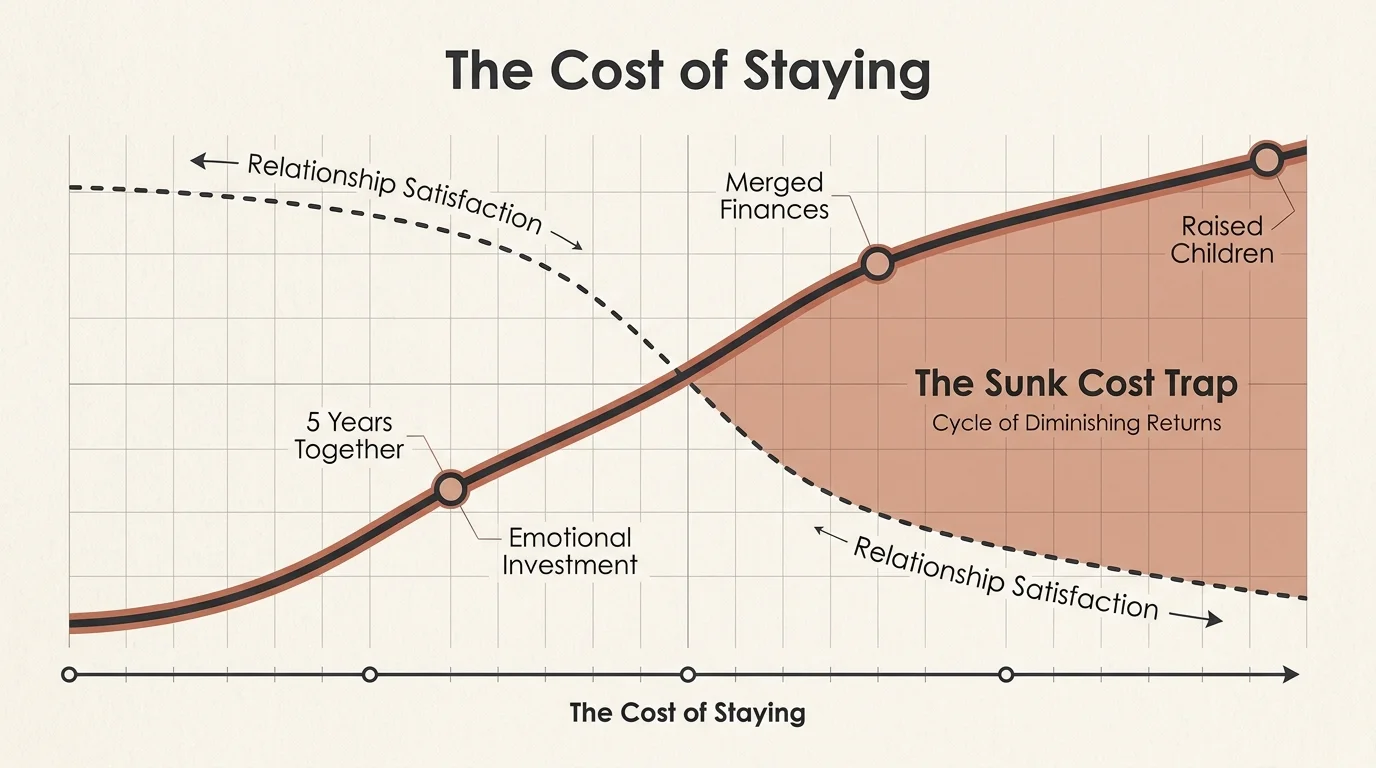
The sunk cost fallacy is a cognitive bias where you continue investing time, money, or emotional energy into a losing endeavor simply because you have already invested so much. In relationships, this translates to staying with a partner because you have spent five years together, merged your finances, or raised children. You convince yourself that walking away means all your previous efforts were wasted.
Behavioral psychology shows that the human brain is highly averse to loss. Rather than cutting your losses and starting over, you hold on to the hope that your past investment will eventually yield a return. Imagine you have spent the last three years trying to help your partner communicate better. You have read the books, gone to therapy, and compromised your own needs. Walking away now feels like admitting defeat and losing all the “work” you put in. This keeps you locked in a cycle of diminishing returns, prioritizing the past over your future well-being.

2. Pro-Social Staying: The Fear of Hurting Your Partner
You might assume that people stay in unfulfilling relationships purely out of self-interest or fear of being alone. However, a 2018 study led by psychology researcher Samantha Joel and published in the Journal of Personality and Social Psychology revealed a completely different motive: altruism. The research found that people are significantly less likely to initiate a breakup when they believe their partner is highly dependent on the relationship.
This phenomenon, known as pro-social staying, occurs when you prioritize your partner’s emotional needs above your own. If you sense that leaving would devastate them, your guilt and empathy override your desire to leave. You become a relationship martyr, sacrificing your own happiness to protect someone else from pain. You might tell yourself, “They wouldn’t survive without me,” or “I cannot do this to them right now because they are stressed at work.” While empathy is a beautiful human trait, using it to justify your own prolonged suffering is a trap. Sacrificing your well-being for someone else’s comfort does not build a healthy partnership; it builds silent resentment.
3. Intermittent Reinforcement: The Slot Machine Effect
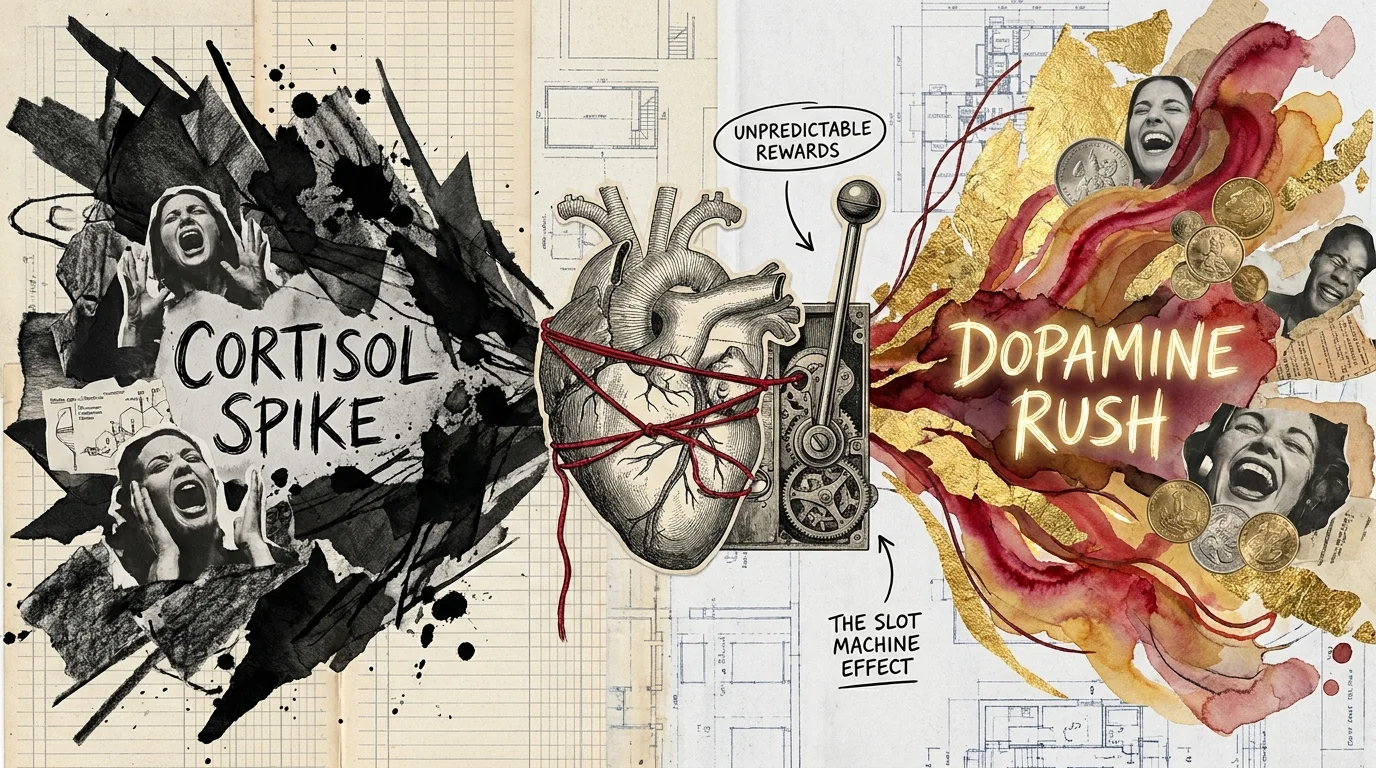
Intermittent reinforcement is one of the most powerful psychological principles keeping people tethered to unhappy relationships. Discovered by behavioral psychologist B.F. Skinner, this concept explains how unpredictable rewards create highly addictive behaviors. Think of a slot machine—you do not win every time you pull the lever, but the occasional, unpredictable payout keeps you playing.
In a relationship, this looks like a partner who is mostly distant, critical, or unkind, but occasionally showers you with affection, praise, or apologies. When your partner ignores your boundaries, your cortisol (stress hormone) spikes. When they finally apologize and act lovingly, you receive a massive dopamine rush. You stay because you are constantly waiting for the next “win,” convinced that the loving version of your partner is their true self. This hot-and-cold neurochemical rollercoaster creates an intense attachment, making the relationship feel impossible to quit.

4. Anxious Attachment and the Fear of Abandonment
Your early childhood experiences shape how you attach to romantic partners in adulthood. If you developed an anxious attachment style, you likely have a deep-seated fear of abandonment. When your relationship becomes unhappy, your instinct is not to leave, but to cling tighter.
For someone with an anxious attachment style, the thought of being alone feels emotionally catastrophic. You might tolerate poor treatment or emotional distance because your brain equates connection—even a dysfunctional one—with emotional survival. You constantly monitor your partner’s moods, try to fix the unfixable, and convince yourself that you just need to be “better” to earn their consistent love. Acknowledging your attachment style, a concept widely discussed by the American Psychological Association (APA), allows you to separate past childhood fears from present-day reality.

5. The Fear of the Unknown (The Devil You Know)
Human beings crave certainty. The brain views the unknown as a potential threat, which is why you often prefer a predictable, unhappy situation over an unpredictable, potentially happy one. You know exactly how your current partner will disappoint you; you have adapted your life around their flaws. The “devil you know” feels safer than the vast, intimidating landscape of being single.
Psychologists refer to this as a negativity bias. Your brain will catastrophize the future—imagining endless loneliness, financial ruin, or societal judgment—to convince you to stay in the familiar safety of a bad relationship. Leaving requires stepping into a void. You have to face questions about where you will live, how you will manage your finances, and whether you will ever find love again. You convince yourself that the relationship is “not that bad,” settling for a baseline of misery just to avoid the anxiety of change.
6. Identity Enmeshment: Losing “Me” to “We”
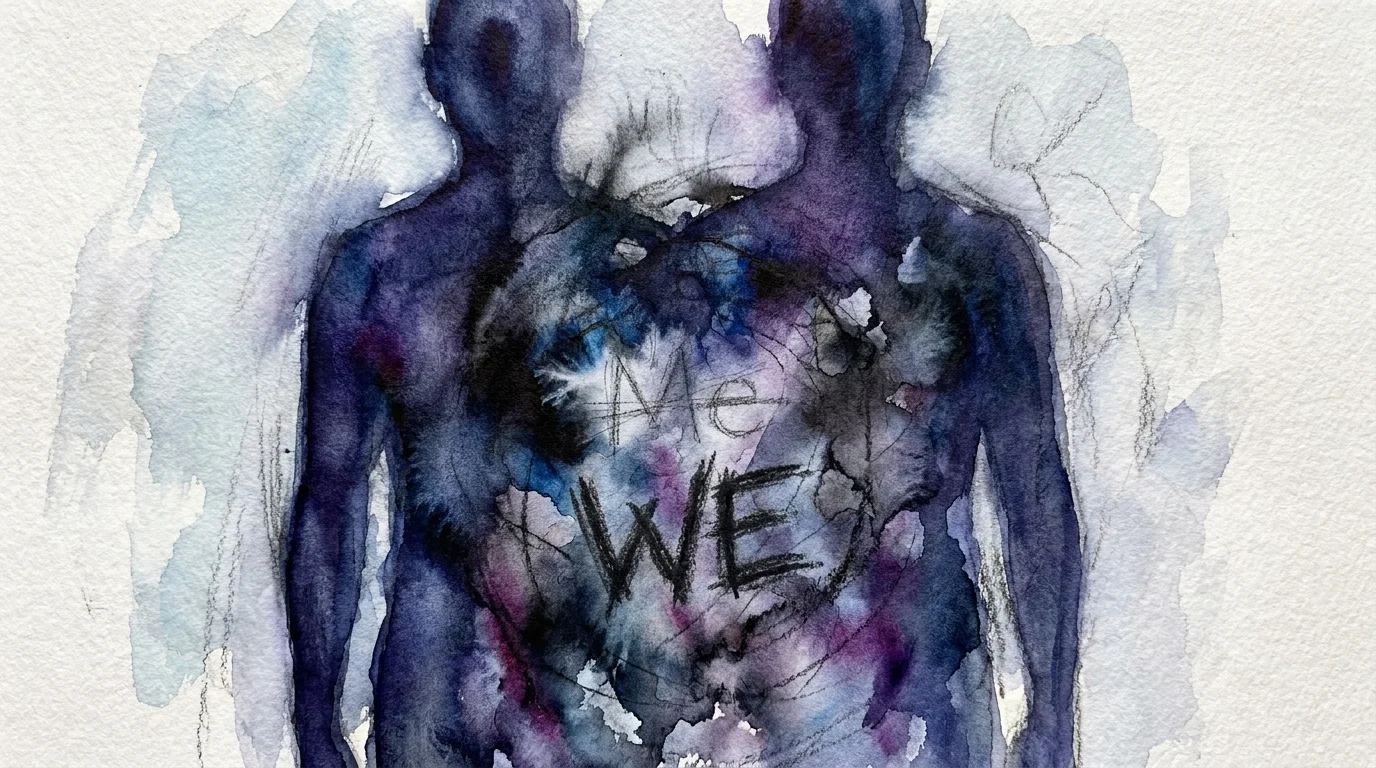
Over years of being in a relationship, your sense of self naturally merges with your partner’s. You share a social circle, a daily routine, and a vision for the future. In healthy relationships, you still maintain your individuality. In unhappy ones, however, the boundary between “me” and “we” can blur so completely that you no longer know who you are outside the partnership.
This identity enmeshment makes leaving feel like a psychological amputation. When you leave, you often lose mutual friends, shared in-laws, and the societal privilege that comes with being part of a couple. The task of rebuilding a solo identity feels overwhelmingly exhausting. Untangling a shared life requires grieving not just the partner, but the version of yourself that existed within the relationship. Many stay simply because the cognitive load of figuring out their autonomous self is too heavy to bear.

7. The Fixer Fantasy: Believing You Can Change Them
Many empathetic, highly sensitive people fall into the trap of the “fixer fantasy.” You see your partner’s potential rather than their reality. You believe that with enough love, patience, and support, you can heal their childhood wounds, cure their destructive habits, or unlock the wonderful person hiding beneath their toxic behavior.
This mindset often stems from codependency—the belief that your value lies in your ability to be useful or to save others. It gives you a false sense of control. If their happiness and growth depend on your effort, then you just need to try harder. You fall in love with their potential rather than the person standing in front of you. You must ask yourself: If your partner never changes, could you be happy in this relationship exactly as it is today? If the answer is no, you are dating an illusion.

8. Trauma Bonding and Normalized Dysfunction
A trauma bond forms in relationships characterized by a cycle of abuse, devaluation, and positive reinforcement. If your relationship involves emotional volatility, gaslighting, or manipulation, your nervous system becomes habituated to chaos. The intense highs and devastating lows mimic the biochemical rush of addiction.
Over time, you normalize the dysfunction. Your baseline for acceptable behavior drops so low that you feel grateful when your partner is simply not yelling or ignoring you. You might defend their toxic behavior to your friends, isolate yourself to hide the reality of the relationship, and feel physically ill at the thought of leaving. You stay because your reality has been warped; you lose the ability to accurately assess the toxicity of the situation. Breaking a trauma bond often requires professional intervention, as the psychological tether is incredibly strong.

9. Low Self-Worth: Accepting What You Think You Deserve
Perhaps the most heartbreaking psychological reason people stay in unhappy relationships is the internal belief that they do not deserve better. If you struggle with low self-esteem, you might internalize your partner’s poor treatment as a reflection of your own value. You tell yourself that no one else will want you, or that you are too damaged, too old, or too difficult to love.
This self-fulfilling prophecy keeps you trapped. We accept the love we think we deserve. If deep down you hold a core belief that you are fundamentally unlovable, you will subconsciously seek out partners who validate that belief. Elevating your self-worth requires challenging those deeply ingrained narratives and recognizing that basic respect is a prerequisite for a relationship, not a luxury.
Myths Worth Debunking
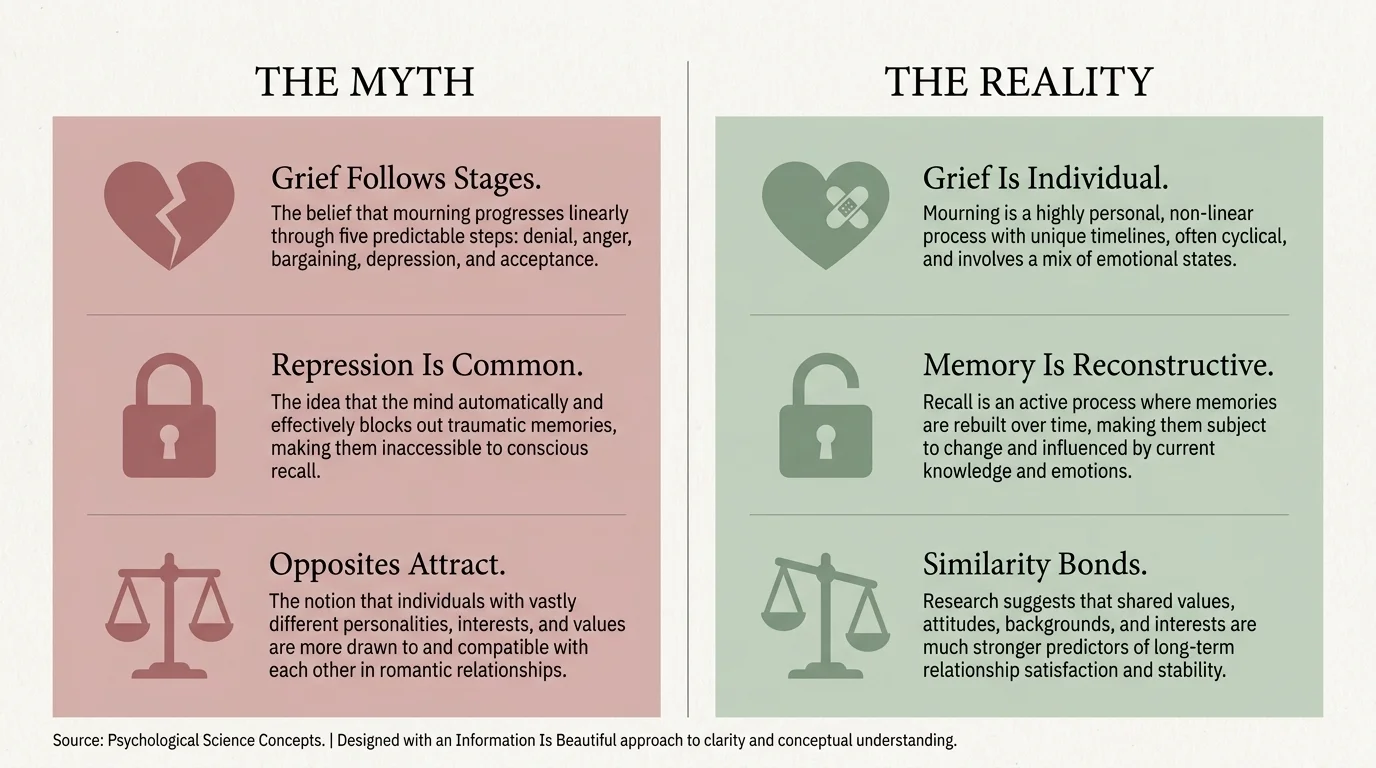
When you are grappling with whether to stay or go, societal myths can heavily influence your decision. It is crucial to separate cultural narratives from psychological realities.
- Myth: Leaving means you failed. The idea that a successful relationship must last until death is a cultural construct. Recognizing that a relationship has run its course and choosing to leave with dignity is an act of courage, not a failure.
- Myth: Couples counseling can fix any relationship. While therapy is highly effective for couples willing to do the work, it requires two committed participants. If one partner refuses to take accountability or change their behavior, therapy cannot save the relationship. Resources from The Gottman Institute emphasize that mutual emotional investment is non-negotiable for success.
- Myth: You should stay for the kids. Research consistently shows that children are more negatively impacted by growing up in a high-conflict, emotionally cold home than by their parents divorcing. Children learn what love looks like by watching you; modeling a healthy, happy life is often the best thing you can do for them.
“Relational Ambivalence—those contradictory thoughts and feelings of love and hate, attraction and disgust, excitement and fear—makes us constantly wonder: should I stay or should I go? The resulting whiplash is exhausting.” — Esther Perel, Psychotherapist and Author
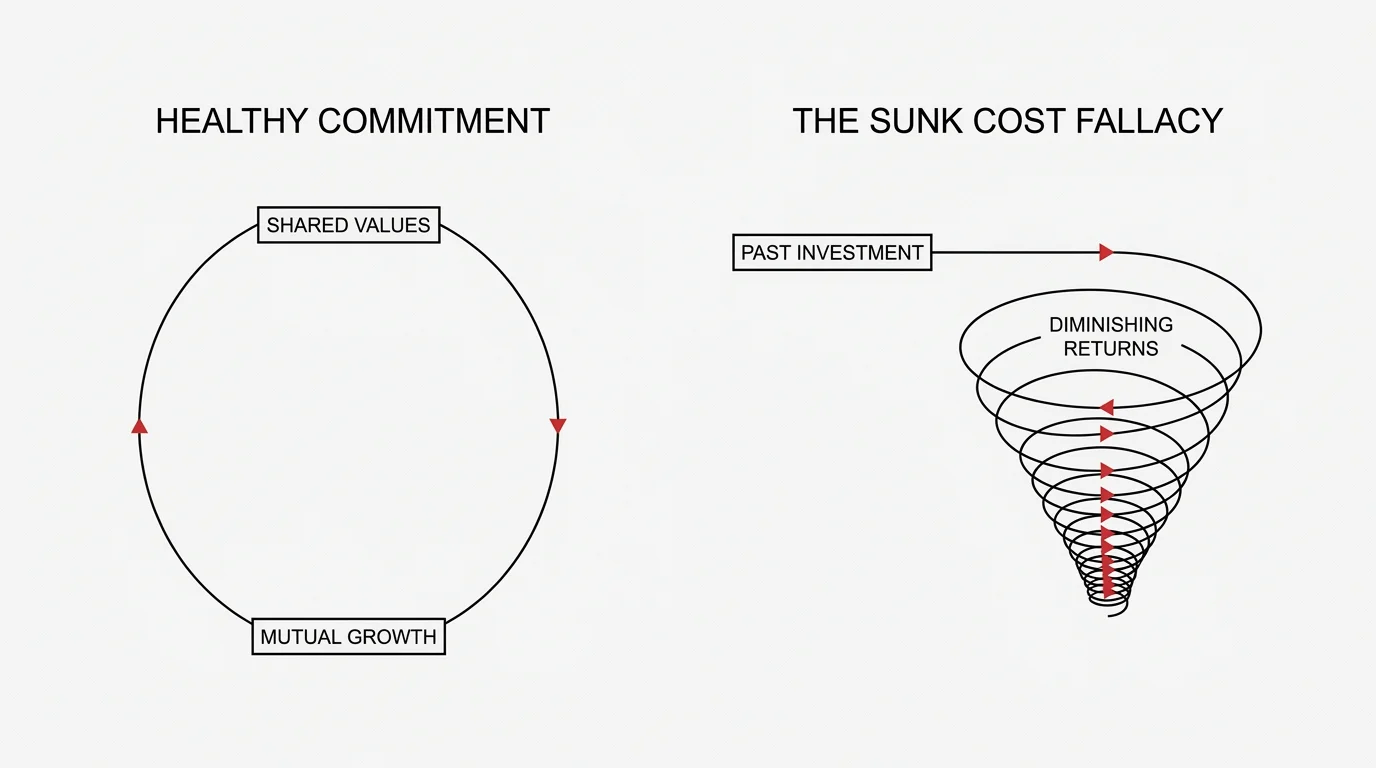
Healthy Commitment vs. The Sunk Cost Fallacy
It can be difficult to distinguish between a relationship that is going through a normal rough patch and one that you are only staying in due to the sunk cost fallacy. The following table highlights the key differences:
| Factor | Healthy Commitment | Sunk Cost Fallacy |
|---|---|---|
| Motivation | You stay because you genuinely enjoy the person and see a shared future. | You stay because you have already invested years of your life and do not want to “waste” them. |
| Conflict Resolution | Disagreements lead to productive conversations and behavioral changes. | Arguments are circular, unresolved, and swept under the rug. |
| Focus | You are focused on building a better future together. | You are focused on recovering past investments and justifying your choices. |
| Emotional State | You feel secure, respected, and emotionally safe, even during tough times. | You feel anxious, drained, and emotionally empty most of the time. |

Signs It’s Time to Talk to a Therapist
Untangling the psychological threads of an unhappy relationship is incredibly difficult to do alone. If you find yourself stuck in a loop of indecision, speaking with a licensed therapist can provide clarity. Consider checking resources on Psychology Today or Verywell Mind to find a professional if you experience any of the following scenarios:
- Your physical health is declining: Chronic stress from an unhappy relationship often manifests physically as insomnia, digestive issues, autoimmune flare-ups, or unexplained pain.
- You feel entirely disconnected from yourself: If you no longer recognize the person you have become, or if you have abandoned your hobbies, friends, and values to keep the peace, you need support to rebuild your identity.
- You are experiencing abuse: If there is physical, emotional, sexual, or financial abuse, prioritize your safety. A therapist can help you create a safe exit plan.
- You are paralyzed by anxiety: When the thought of staying fills you with dread, but the thought of leaving triggers panic attacks, a professional can help you regulate your nervous system and process your fears.

Moving Forward with Clarity
Recognizing the psychological reasons keeping you in an unhappy relationship is a profound moment of self-awareness. You are not broken, weak, or foolish for staying; your brain has simply been doing what it evolved to do—protecting your attachments, avoiding perceived threats, and minimizing immediate loss. By identifying these cognitive traps, you strip them of their power. You can begin to separate your genuine feelings from the biological and psychological static holding you back.
Take your time as you navigate this realization. You do not have to make a life-altering decision today. Start by gently observing your relationship dynamics, seeking support from trusted friends, and possibly consulting a mental health professional. The information in this article is meant for educational purposes and general guidance. It does not replace individual therapy, counseling, or medical treatment. If you or someone you know is in crisis, contact the 988 Suicide & Crisis Lifeline by calling or texting 988. You deserve a relationship that adds to your life, not one that constantly demands you subtract from yourself.
Last updated: May 2026. Psychology research evolves continuously—verify current findings with professional sources.








Leave a Reply