

Humor is widely celebrated as an emotional release, but it often functions as a sophisticated shield against vulnerability. When someone repeatedly uses a punchline to derail a difficult discussion, they are actively managing their anxiety by keeping intimacy at arm’s length. Recognizing this defense mechanism is the first step toward restoring genuine emotional connection. While healthy joking bridges the gap between two people during a conflict, avoidant humor builds an invisible wall. If your partner or family member constantly diffuses tension with laughter when you need an honest dialogue, understanding their behavior can help you shift the dynamic. Here is how to identify when comedy is being weaponized as a barrier rather than used as a tool for connection.
The Psychology Behind the Punchline
To understand why people use jokes to deflect, we have to look at how the brain processes emotional threats. For someone who struggles with vulnerability, an intimate or serious conversation can feel identical to a physical threat. Their nervous system activates a fight-or-flight response. Because literally running out of the room is rarely socially acceptable in adult relationships, they use humor as a verbal escape route. It is a socially rewarded method of distancing.
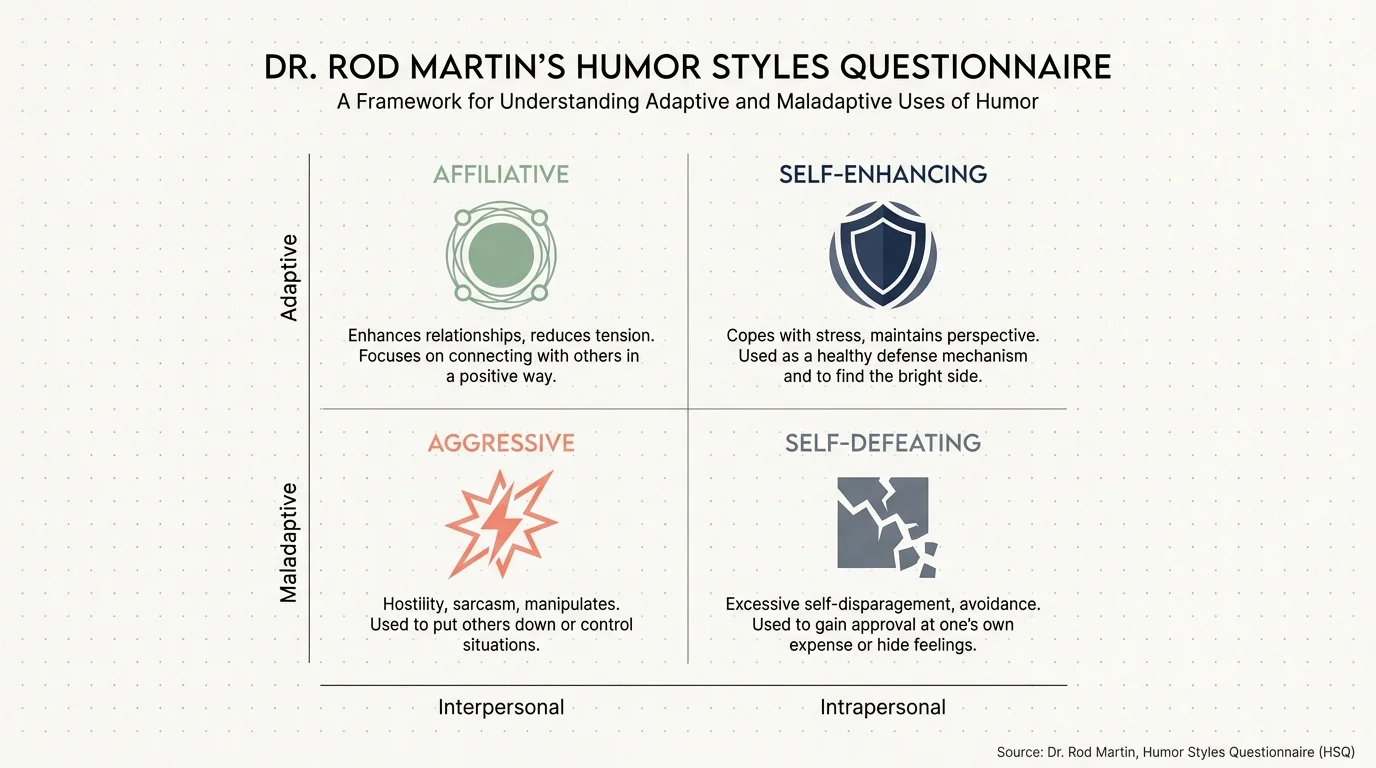
In the realm of psychology, researchers utilize frameworks like the Humor Styles Questionnaire to understand these complex behaviors. Developed by Dr. Rod Martin, this framework identifies four distinct styles of humor, two of which—aggressive and self-defeating—are deeply intertwined with emotional avoidance. While affiliative humor brings people together, these maladaptive styles serve to distance the user from their own feelings and from the people who are trying to connect with them. Understanding these patterns is essential for navigating complicated emotional behavior.

1. They Deflect Direct Questions With a Pivot
One of the most obvious signs of avoidant humor is the conversational pivot. You ask a direct, emotionally significant question, and they respond with a quick-witted remark that completely changes the subject. If you ask your partner where they see the relationship going, they might say, “Well, hopefully to a restaurant soon because I’m starving.”
This tactic is highly effective because it forces an immediate, uncomfortable choice upon you: either laugh and let them off the hook, or press the issue and risk looking like the “fun police.” The pivot allows them to maintain strict control over the conversation’s depth. By redirecting the energy of the interaction toward a laugh, they successfully bypass the discomfort of introspection. Over time, the partner asking the questions is left holding the emotional weight of the relationship alone.

2. Sarcasm is Disguised as Playfulness
Sarcasm can be harmless banter when both people feel safe, but during moments of tension, it often acts as a vehicle for hidden hostility. If you express a genuine grievance and your partner responds with a sarcastic quip, they are not trying to lighten the mood; they are actively invalidating your concern.
Relationship research heavily underscores the danger of this dynamic. According to the Gottman Institute, hostile humor and sarcasm are primary components of contempt, which remains the single greatest predictor of relationship failure. Contempt creates an artificial hierarchy where one person positions themselves morally or intellectually above the other. When someone masks a critique or dismissal in a sarcastic joke, they are sidestepping the vulnerability required to express a direct need—or the empathy required to listen to yours.
“Contempt is the sulfuric acid of love.” — Dr. John Gottman, Psychological Researcher

3. They Self-Deprecate to Block Your Comfort
Self-deprecating humor is incredibly common, and in small doses, it demonstrates humility and self-awareness. However, when used defensively, it becomes what clinical researchers classify as a self-defeating humor style. This occurs when someone relentlessly makes themselves the punchline, especially regarding their own trauma, deep insecurities, or mistakes.
Imagine telling a friend that you are worried about their recent drinking habits, and they reply, “Hey, at least I’m overachieving at something!” This response preempts your concern. If they make fun of their own struggles first, they strip you of the opportunity to offer genuine empathy. It is a preemptive emotional strike. They control the narrative of their pain by turning it into a spectacle, keeping your genuine support locked out. It prevents the mutual intimacy that comes from being comforted.

4. Incongruent Smiling or Laughing During Painful Topics
Have you ever watched someone smile or chuckle while telling you a deeply traumatic or upsetting story? This phenomenon is known clinically as incongruent affect. It happens when an individual’s outward emotional expression completely contradicts the content of what they are sharing.
This type of laughter is rarely about actual amusement. Instead, it is a physiological response to nervous system arousal. The body attempts to down-regulate intense stress by triggering a smile or a laugh, essentially confusing the nervous system’s social engagement pathways. From a relational standpoint, this behavior sends a highly conflicting signal to the listener. The speaker is essentially saying, “I am telling you something painful, but my smile means you do not need to comfort me.” It allows them to share information while avoiding the heavy, messy emotional reality that usually accompanies it.

5. They Use Digital Escapism to Change the Subject
In modern relationships, emotional avoidance often takes a digital form. You might send a thoughtful, vulnerable text message expressing how much you miss someone, or asking to resolve a lingering argument from the night before. Instead of a meaningful reply, you receive a funny TikTok, a relatable meme, or a random GIF that has nothing to do with your message.
Digital deflection allows the avoidant person to acknowledge that they received your message without actually engaging with its contents. It is a technological sleight of hand. By sending a meme, they maintain contact and keep the relationship feeling “friendly,” but they completely sidestep the emotional labor required to have a real conversation. This form of asynchronous communication leaves you feeling acknowledged but fundamentally unheard.

6. They Turn Your Vulnerability Into a Caricature
When you take the risk of opening up about something sensitive, a defensive person might respond by exaggerating your point until it becomes completely ridiculous. If you say, “I feel really anxious when you don’t call me back,” they might throw their hands up and joke, “I guess I’m just the worst partner in the world, someone call the police and have me arrested!”
This is a manipulative tactic of minimization, often referred to as “straw-manning” your emotions. By turning your valid emotional need into an absurd caricature, they shift the focus from your feelings to the extremity of their joke. You are suddenly forced to backtrack and comfort them, saying, “No, I don’t think you’re the worst, I just wanted a text.” The original issue vanishes entirely, replaced by a theatrical distraction.

7. Accusing You of Being “Too Sensitive”
When an avoidant humor strategy fails to derail the conversation, the person utilizing it often resorts to shifting the blame onto you. If you refuse to laugh at their deflection and insist on staying on topic, they might accuse you of lacking a sense of humor, being “too sensitive,” or trying to start a fight.
This is a defensive posture that borders on gaslighting. Rather than taking accountability for their emotional avoidance, they pathologize your desire for sincerity. They frame their emotional distance as normal and your desire for connection as intense or dramatic. Over time, this dynamic forces you into a position of constantly defending your own emotional reality, completely sidetracking the initial serious conversation and eroding your trust in your own perceptions.
Healthy Coping vs. Avoidance
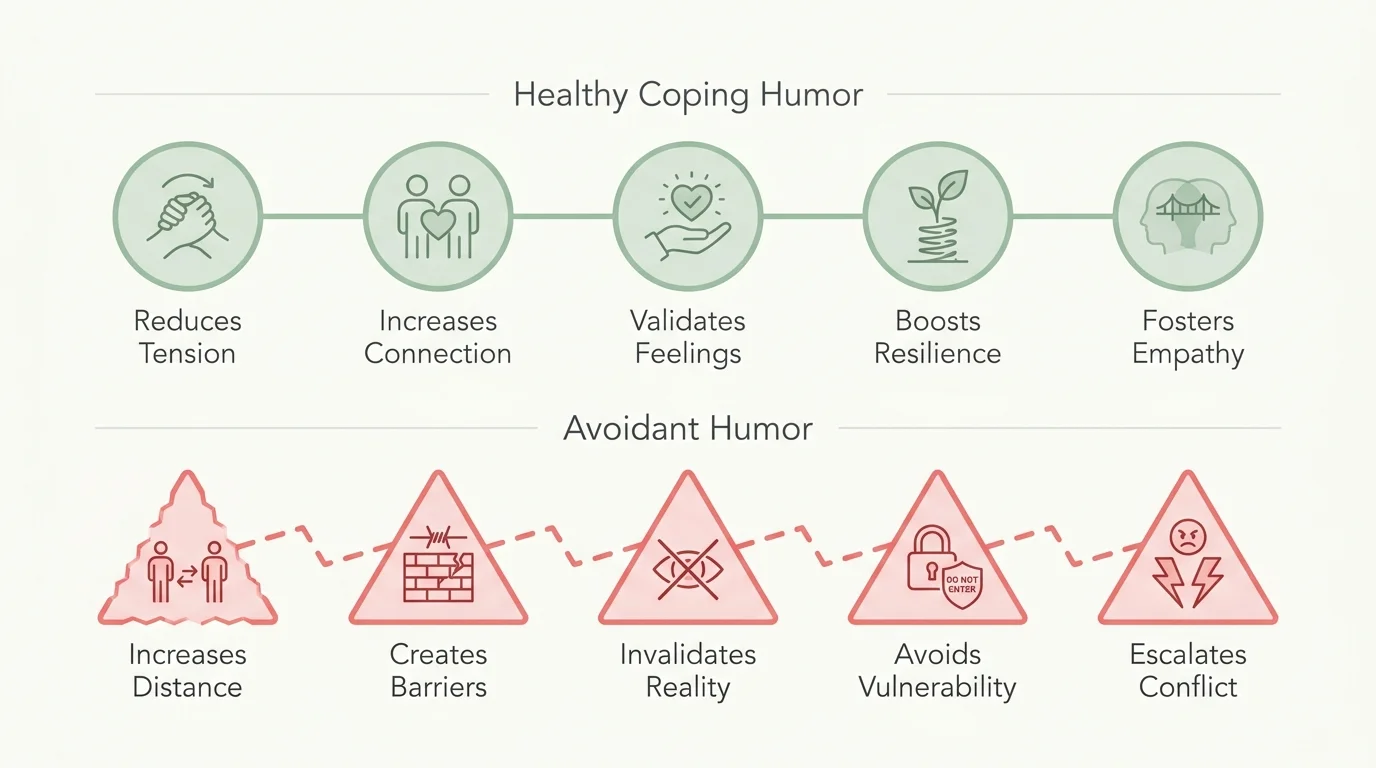
Understanding the distinction between beneficial humor and avoidant behavior is crucial for navigating intimate relationships. Healthy humor acts as a lubricant for difficult conversations, keeping partners united against a problem. Avoidant humor, on the other hand, acts as a roadblock.
| Characteristic | Healthy Relationship Humor | Avoidant Defense Humor |
|---|---|---|
| Timing | Used after a conflict is resolved, or gently to de-escalate mutual tension. | Used precisely when the other person is trying to be vulnerable or direct. |
| Target | Focuses on shared experiences or outside absurdities (a “we” perspective). | Targets the other person’s feelings, or relies on harsh self-deprecation. |
| Aftermath | Leaves both partners feeling closer, relieved, and mutually understood. | Leaves one partner feeling dismissed, frustrated, or deeply confused. |
| Accountability | Does not replace apologies or taking responsibility for actions. | Used as a direct substitute for apologizing or changing hurtful behavior. |

What Can Go Wrong: The Long-Term Impact of Avoidant Humor
When left unchecked, the chronic use of humor to avoid serious conversations creates a shallow foundation for any relationship. Over time, the partner who is continually stonewalled by jokes begins to experience emotional starvation. They learn that their deeper needs will not be met with sincerity, which inevitably leads to emotional withholding.
This dynamic breeds silent resentment. You may find yourself laughing along in the moment just to keep the peace, only to feel a deep sense of isolation once the interaction ends. The relationship becomes a performance rather than a genuine partnership. When major life stressors inevitably arise—such as financial hardships, health crises, or parenting disagreements—the couple lacks the baseline communication skills required to navigate them as a united front.
“Vulnerability sounds like truth and feels like courage. Truth and courage aren’t always comfortable, but they’re never weakness.” — Dr. Brené Brown, Research Professor

When to Seek Professional Support
While everyone occasionally uses a joke to lighten a heavy mood, persistent emotional avoidance can damage your mental health and well-being. Consider seeking professional support from a licensed therapist or couples counselor if you observe the following patterns:
- The humor turns consistently hostile: If jokes frequently devolve into mockery, name-calling, or mean-spirited sarcasm that deeply damages your self-esteem.
- You feel chronically lonely: You experience a profound sense of isolation despite being in a long-term, committed relationship.
- Your boundaries are dismissed: When you explicitly state, “I need to talk about this seriously,” and your partner flatly refuses to drop the comedic persona.
- Life progression is stalled: The inability to have serious conversations prevents you from making vital decisions about finances, living arrangements, or family planning.

Shifting the Dynamic
If you recognize these signs in your relationship, you have the power to change how you respond. The next time a serious conversation gets deflected with a joke, pause. Do not offer a courtesy laugh. Instead, meet the humor with calm, grounded silence for a brief moment. Then, gently but firmly redirect the conversation by saying, “I know it’s heavy, but I really need us to talk about this sincerely right now.”
By refusing to engage with the distraction, you hold space for the vulnerability that your partner is desperately trying to escape. Change will not happen overnight; dismantling emotional armor requires immense patience and consistency. Focus on creating an emotionally safe environment where serious conversations are treated with respect rather than panic, allowing true intimacy to take root.
This article provides general educational information about psychology and relationships. It is not a substitute for professional therapy or medical advice. Everyone’s situation is unique—if you’re struggling, please reach out to a licensed mental health professional.
Last updated: May 2026. Psychology research evolves continuously—verify current findings with professional sources.







Leave a Reply