
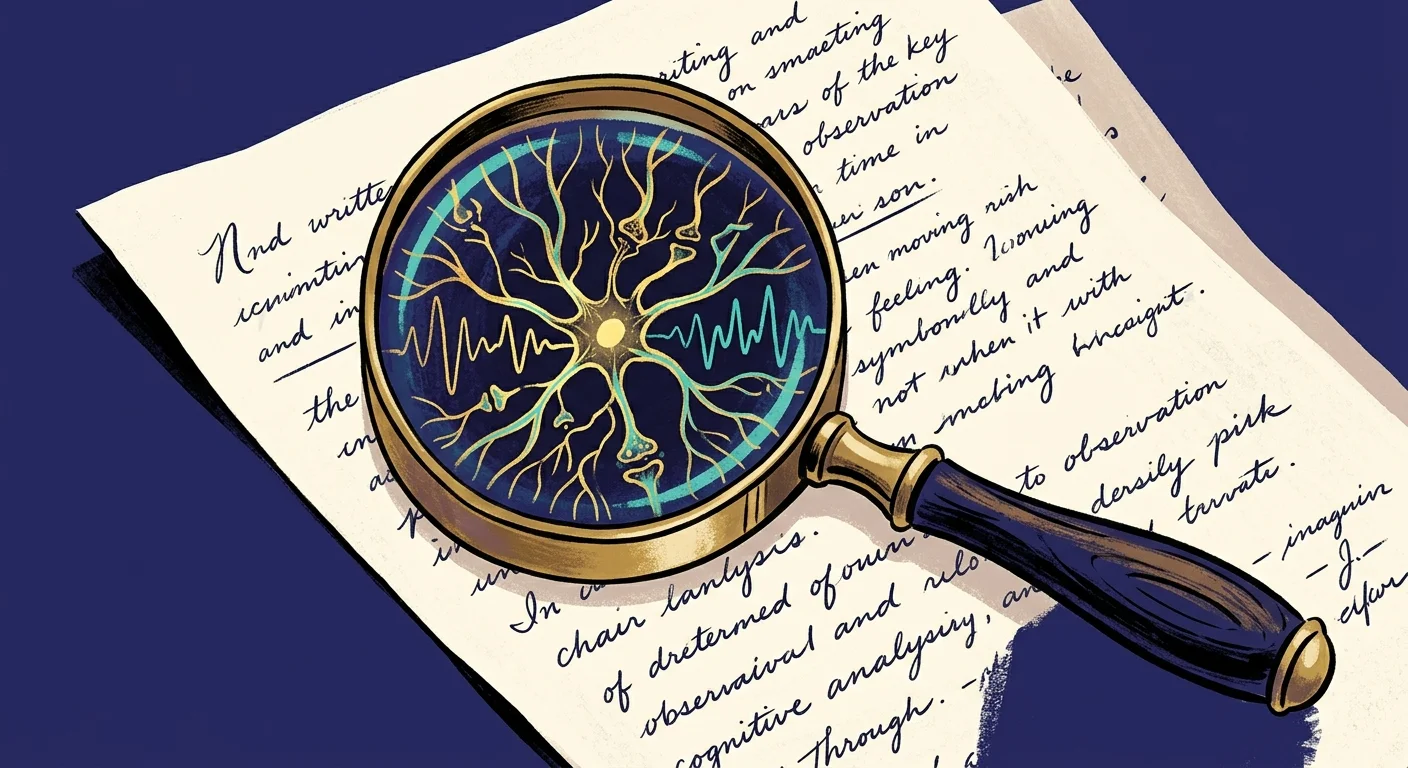
Your handwriting serves as a direct window into your central nervous system, requiring precise coordination between your motor cortex, basal ganglia, and peripheral nerves. When subtle changes alter how you form letters or grip a pen, your brain may be signaling an underlying neurological transition long before other physical symptoms appear. While minor shifts can stem from simple fatigue or arthritis, persistent changes—such as letters shrinking, lines wavering, or strokes stalling—warrant careful medical evaluation. Understanding these physical shifts empowers you to seek early diagnostic care, track subtle motor changes accurately, and take proactive steps toward protecting your long-term neurological health.
Understanding Graphomotor Control: How Your Brain Writes
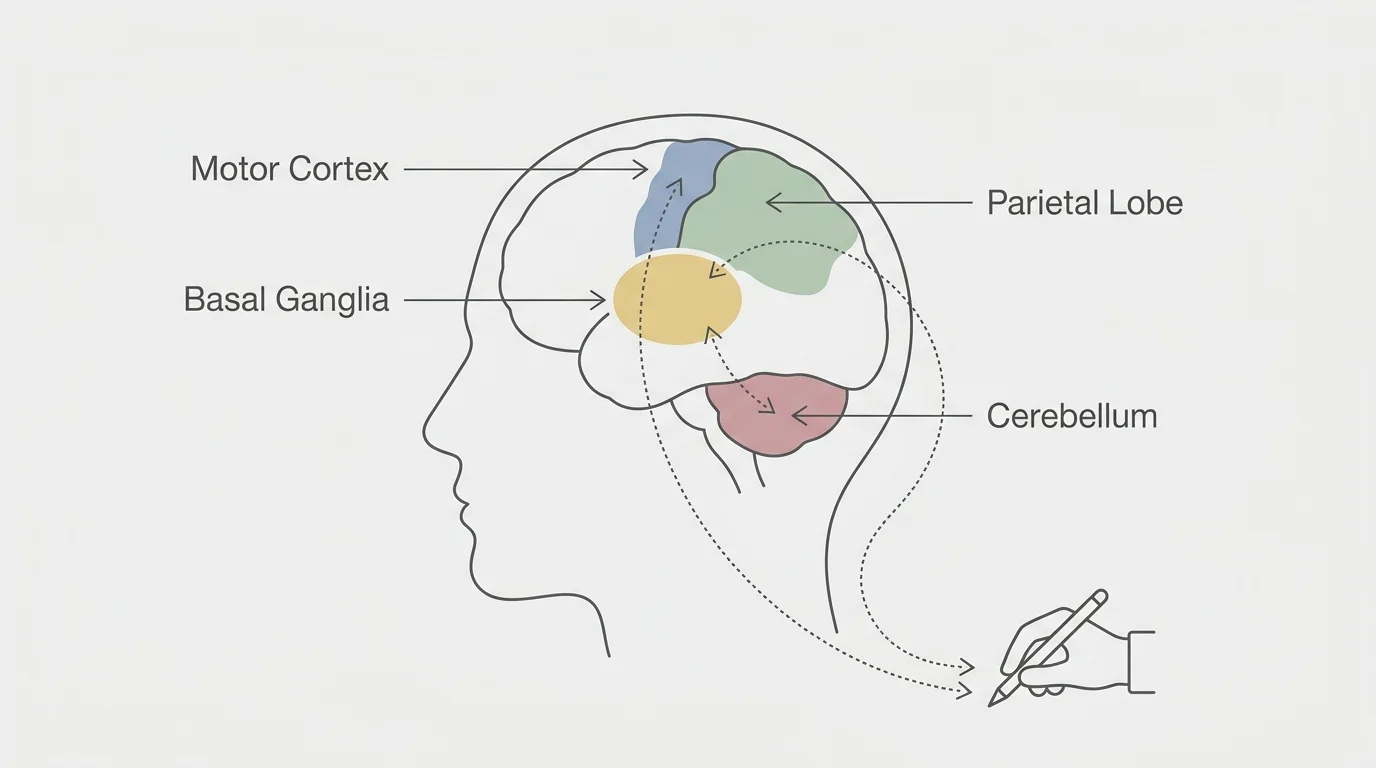
Writing by hand seems effortless when you do it every day, yet it represents one of the most complex motor activities your brain executes. Clinicians refer to this intricate process as graphomotor control. To produce a single legible word, your brain must synthesize cognitive planning, spatial processing, linguistic recall, and fine motor execution within milliseconds.
Multiple central structures govern this process:
- The Motor Cortex: Plans and directs the exact muscular contractions in your shoulder, arm, wrist, and fingers.
- The Basal Ganglia: Regulates movement amplitude, automaticity, and force balance so your writing remains consistent in size and speed.
- The Cerebellum: Fine-tunes timing, fluidity, and motor coordination, ensuring that lines remain smooth rather than shaky.
- The Parietal Lobe: Manages visual-spatial awareness, helping you keep script aligned on a straight line and correctly spaced across a page.
Because writing demands seamless communication across these distributed neural networks, subtle disruptions in brain chemistry or structural integrity often show up in penmanship first. Monitoring handwriting changes and neurological signs offers a unique, accessible method for tracking central nervous system health over time.
8 Signs a Change in Handwriting Could Signal a Neurological Issue
While an occasional messy shopping list is no cause for alarm, distinct structural changes in how you write can highlight underlying motor or cognitive shifts. Here are eight key handwriting signs that warrant professional attention.
1. Micrographia (Progressively Shrinking Script)
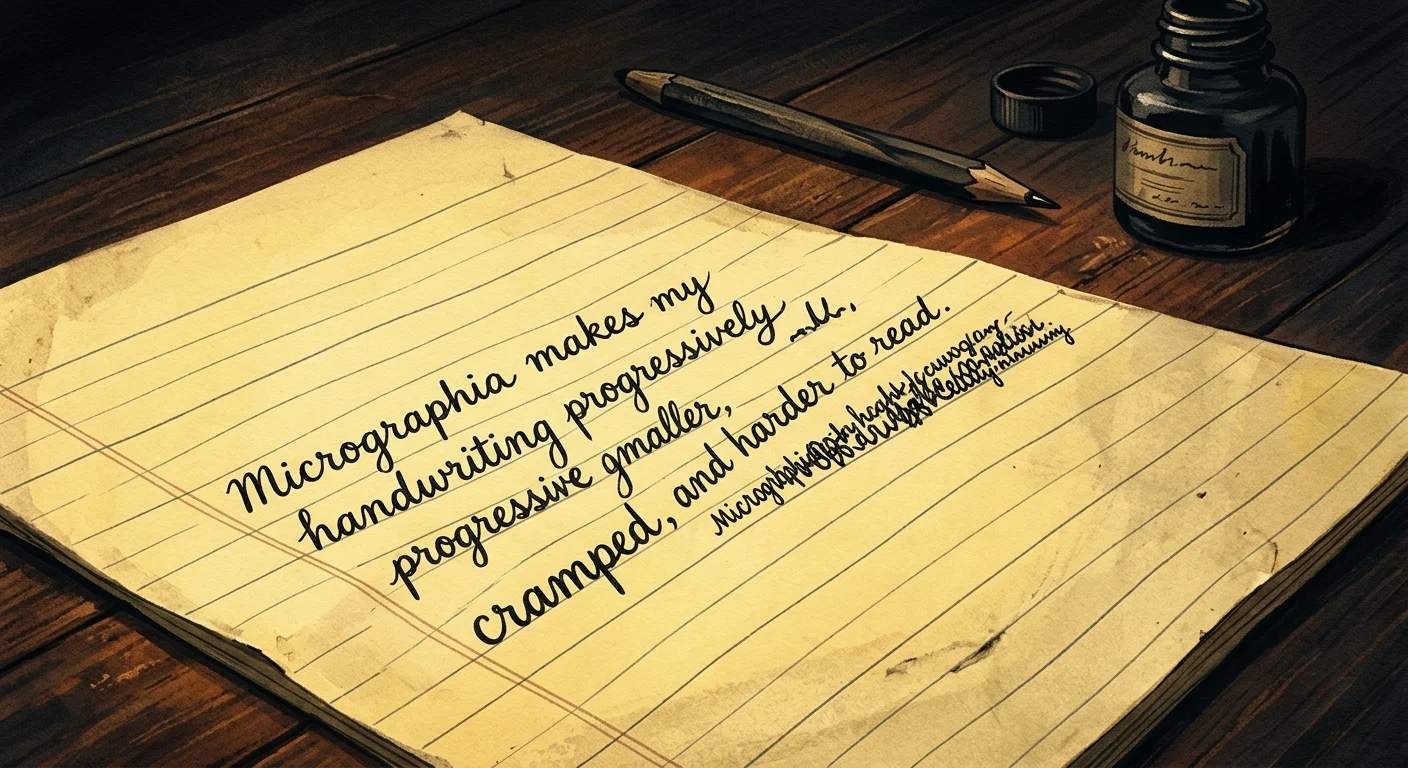
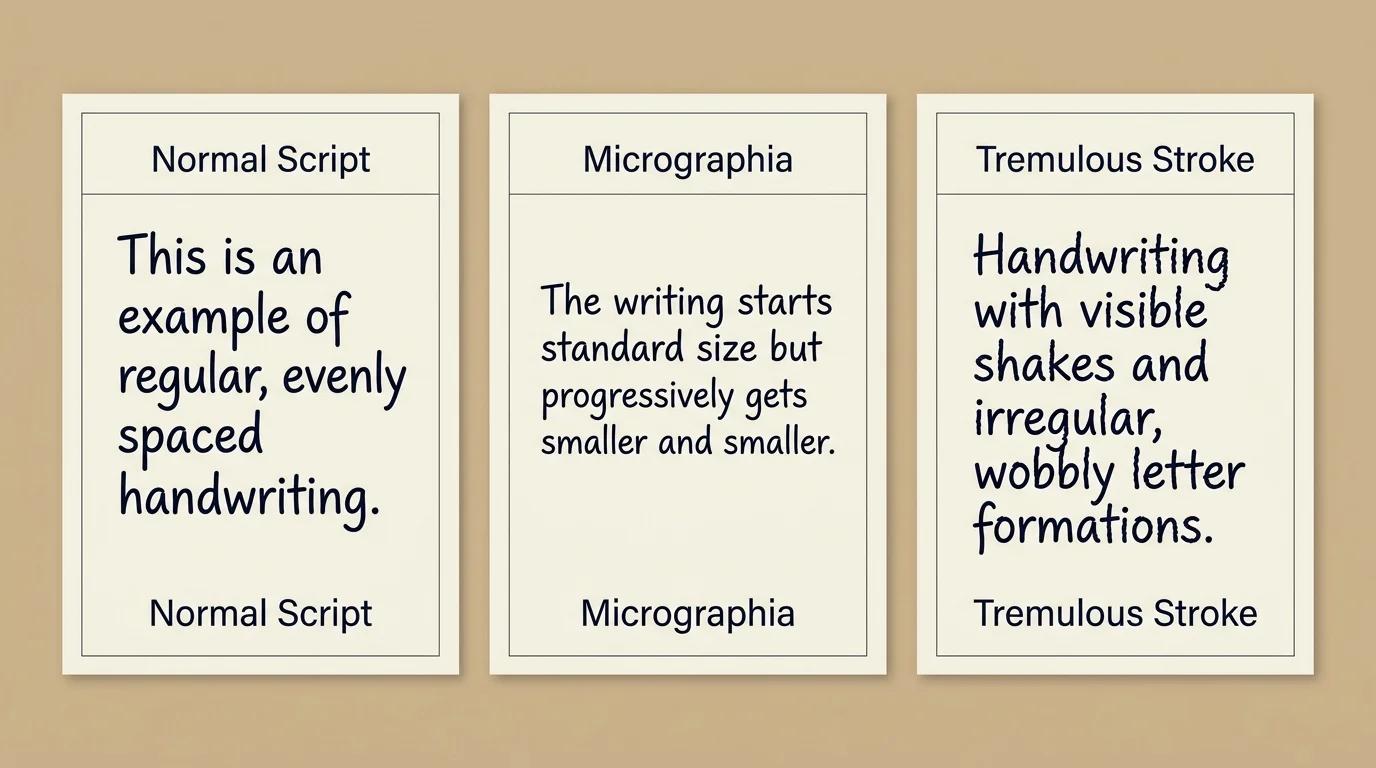
Micrographia occurs when your writing starts at a normal size but becomes progressively smaller, cramped, and crowded as you move across the page. In many cases, the script shrinks so dramatically by the end of a sentence that it transforms into an illegible, squiggly line.
This pattern serves as a classic early indicator of basal ganglia dysfunction, specifically the dopamine depletion associated with Parkinson’s disease. According to clinical research, micrographia affects an estimated 63% to 65% of individuals diagnosed with Parkinson’s disease, with broader medical literature reporting prevalence rates between 9% and 75% depending on measurement criteria. The National Institutes of Health notes that approximately 90,000 Americans receive a Parkinson’s diagnosis each year, making early recognition through symptoms like micrographia vital for timely intervention.
2. Jagged, Tremulous Strokes and Oscillating Letters
If your handwriting displays shaky, wavy, or jagged lines—particularly on long horizontal strokes or rounded loops in letters like o, g, and m—you may be experiencing an involuntary tremor. This shift often makes loops look serrated or broken.
Neurologists typically differentiate between two major causes of writing tremors:
- Action Tremor (Essential Tremor): Appears actively while holding the pen and making strokes. Essential tremor affects an estimated 10 million Americans, making it roughly eight times more common than Parkinson’s disease.
- Resting Tremor (Parkinsonian Tremor): Occurs primarily when the hand rests in the lap, but can briefly disrupt the initiation of a writing stroke.
3. Severe Movement Slowness and Loss of Fluency (Bradykinesia)
When writing requires immense physical effort and feels unusually slow, your nervous system may be experiencing bradykinesia, or generalized movement slowness. You might notice that your pen stalls on the page, or that connecting continuous letters in cursive feels like dragging a heavy weight.
Clinical review data indicates that dynamic handwriting metrics—specifically movement velocity and stroke fluency—demonstrate statistically significant differences between healthy individuals and those with neurodegenerative conditions in roughly 80% of published handwriting analysis studies. Recognizing this slowness early serves as a valuable handwriting changes health warning.
4. Spatial Disorganization and Erratic Alignment
Spatial dysgraphia occurs when you can no longer keep your writing on a straight horizontal baseline. Your words may drift dramatically upward or downward across the paper, overlap with adjacent lines, or feature erratic, unpredictable spacing between words and margins.
This disorganization points toward spatial processing deficits originating in the parietal lobe or visual-motor integration pathways. Research published in Frontiers in Human Neuroscience highlights digital handwriting features—such as spatial scaling, stroke trajectory, and motor initiation—as reliable early markers for detecting subtle cognitive decline and spatial orientation shifts in adults aged 60 and older.
5. Excessive Pen Pressure or Extremely Faint Strokes
A sudden shift in how hard you press your pen onto paper reflects impaired force regulation within motor control loops. You might notice that you press down so forcefully that pen tips break or paper rips. Alternatively, you might produce strokes so light and feathery that ink barely registers on the page.
Excessive pressure often stems from task-specific dystonia or compensatory strategies for hand weakness. Conversely, faint, barely visible strokes frequently align with profound bradykinesia or sensory loss in peripheral nerves.
6. Letter Transpositions, Omissions, and Syntax Distortions
When changes in writing extend beyond physical stroke mechanics into spelling and word structure, the primary driver is often cognitive-linguistic rather than purely motor. You might omit letters from familiar words, transpose syllables, repeat letters involuntarily (perseveration), or mix uppercase and lowercase letters chaotically within a single word.
These signs of neurological issues in handwriting point to potential disruptions in working memory, executive function, or language centers in the brain. They frequently accompany early stages of mild cognitive impairment, Alzheimer’s disease, or vascular dementia.
7. Sudden Degradation of Cursive and Loss of Automated Flow
If you have written in smooth, connected cursive for decades but suddenly find yourself unable to remember how to form or connect fluid loops, you may be experiencing ideomotor apraxia. This condition disrupts the brain’s ability to access stored motor programs for complex physical tasks.
People facing this issue often stop mid-word, unable to complete continuous script, and switch to a slow, deliberate print style. The underlying cause frequently involves structural or vascular changes in the premotor cortex or parietal regions.
8. Involuntary Hand Cramping and Muscle Spasms (Writer’s Cramp)
Severe, painful twisting of the fingers, wrist flexion, or thumb tucking that occurs specifically while gripping a pen signals task-specific focal hand dystonia, historically known as writer’s cramp. Your hand may feel locked in a tight, uncomfortable posture after writing just a few words.
Task-specific dystonia arises from sensorimotor cortex miscommunication, where the brain sends conflicting signal commands to opposing muscle groups simultaneously. Understanding micrographia and health alongside focal dystonia helps clarify how localized brain signaling shifts alter fine motor tasks.
Comparison of Neurological Handwriting Indicators
To help you distinguish between various physical writing shifts, the table below outlines the primary features, mechanisms, and potential underlying conditions associated with key handwriting changes.
| Handwriting Feature | Primary Visual Trait | Underlying Neurological Mechanism | Commonly Associated Conditions |
|---|---|---|---|
| Micrographia | Script shrinks progressively across a sentence | Basal ganglia dysfunction; dopamine deficiency | Parkinson’s disease, Progressive Supranuclear Palsy |
| Action Tremor | Jagged, oscillating horizontal/vertical strokes | Cerebellar-thalamic circuit instability | Essential Tremor, Cerebellar Ataxia |
| Bradykinesia | Extremely slow, deliberate, labored execution | Impaired motor initiation and velocity control | Parkinsonism, Corticobasal Degeneration |
| Spatial Dysgraphia | Words drift off baseline; erratic spacing | Parietal lobe impairment; spatial awareness loss | Early Cognitive Decline, Mild Cognitive Impairment |
| Task-Specific Dystonia | Fingers curl involuntarily; hard gripping | Sensory-motor cortex mapping dysfunction | Focal Hand Dystonia (Writer’s Cramp) |

What Can Go Wrong: Misinterpretations and False Alarms
When tracking changes in your penmanship, you must distinguish central neurological shifts from peripheral, orthopedic, or environmental factors. Jumping to conclusions without a comprehensive medical evaluation can lead to unnecessary anxiety.
Consider these common misconceptions and confounding factors:
- Confounding Osteoarthritis or Carpal Tunnel Syndrome: Joint stiffness or peripheral nerve compression in the wrist can make writing painful and clumsy, mimicking motor deterioration without involving central brain pathways.
- Medication Side Effects: Certain medications—including specific neuroleptics, anti-nausea agents, and mood stabilizers—can induce temporary drug-induced parkinsonism or hand tremors.
- Vision Changes: Uncorrected presbyopia or cataracts can cause improper spacing and baseline drifting simply because you cannot see the page clearly.
- Normal Aging vs. Disease: Mild slowness in writing is normal as people age, but progressive shrinking, severe tremors, or total loss of fluency are not typical signs of aging.

When to Seek Professional Support
Recognizing early motor changes enables you to take control of your health. You should schedule a comprehensive evaluation with a neurologist or primary care physician if you notice any of the following scenarios:
- Your handwriting displays a consistent, progressive decline in size or legibility over several weeks or months.
- You experience hand shaking or muscle cramping that interferes with signing legal documents, writing notes, or managing daily tasks.
- Changes in writing accompany other motor symptoms, such as walking slower, feeling off-balance, or experiencing muscle stiffness.
- You experience a sudden, acute loss of the ability to write or spell, which requires immediate emergency medical assessment to rule out a stroke or transient ischemic attack.

Practical Steps for Monitoring Your Handwriting
If you suspect shifts in your fine motor skills, tracking your penmanship systematically provides invaluable evidence for your medical team. Using handwriting as a health indicator works best when you gather consistent, objective records.
Take these practical steps:
- Establish a Sample Baseline: Write the same standard sentence (such as “The quick brown fox jumps over the lazy dog”) once a week in the same notebook using the same type of pen.
- Perform the Archimedes Spiral Test: Draw a continuous spiral from the center of a blank page outward. Shaky, overlapping, or jagged lines on this test help clinicians spot tremors and motor coordination shifts.
- Review Your Medications: Bring a full list of current prescriptions and over-the-counter drugs to your doctor to rule out drug-induced motor side effects.
- Explore Occupational Therapy: An occupational therapist can recommend adaptive pen grips, weighted writing instruments, and targeted fine motor exercises to preserve your functional writing ability.
Expert Perspective
Facing subtle physical changes can feel daunting, but proactive observation places you in the driver’s seat of your medical care. As pioneering clinical figures remind us, self-awareness forms the bedrock of meaningful coping and recovery.
“When we are no longer able to change a situation, we are challenged to change ourselves.” — Viktor Frankl, Neurologist and Psychiatrist
By observing subtle physical shifts early, you give healthcare providers the diagnostic insight needed to design personalized treatment plans, maintain your independence, and support your cognitive and physical well-being.
Frequently Asked Questions
Can stress or anxiety cause handwriting changes?
Yes. Acute stress, physical fatigue, and high anxiety trigger adrenaline release, which can cause transient muscle tension and hand tremors. However, stress-induced changes disappear once you calm down, whereas neurological handwriting changes persist over time.
Is micrographia always a sign of Parkinson’s disease?
While micrographia is most strongly associated with Parkinson’s disease, it can also occur in other neurodegenerative conditions, such as progressive supranuclear palsy, multi-system atrophy, or small vessel cerebrovascular disease.
Can occupational therapy restore my handwriting?
Occupational therapy cannot reverse underlying neurodegenerative conditions, but it offers highly effective compensatory strategies. Therapists use weighted pens, specialized grip accessories, and spatial cues to significantly improve legibility and reduce hand fatigue.
This is educational content based on psychological research and general medical principles. Individual experiences vary significantly. For personalized guidance, consult a licensed physician, neurologist, or medical professional.
Last updated: February 2026. Medical and psychological research evolves continuously—verify current findings with professional sources.








Leave a Reply