

Most people believe they can spot deception through shifty eyes or nervous fidgeting. In reality, psychological research reveals that untrained humans detect lies with an accuracy rate of just 54 percent—barely better than flipping a coin.
Elite federal interrogators do not look for movie-style tells. Instead, they decode involuntary physiological reflexes triggered by the autonomic nervous system—subtle micro-behaviors that the conscious brain simply cannot suppress under stress.
Mastering this FBI lie detection body language framework helps you protect your boundaries, read hidden emotional currents, and build deeper, more authentic interpersonal relationships.
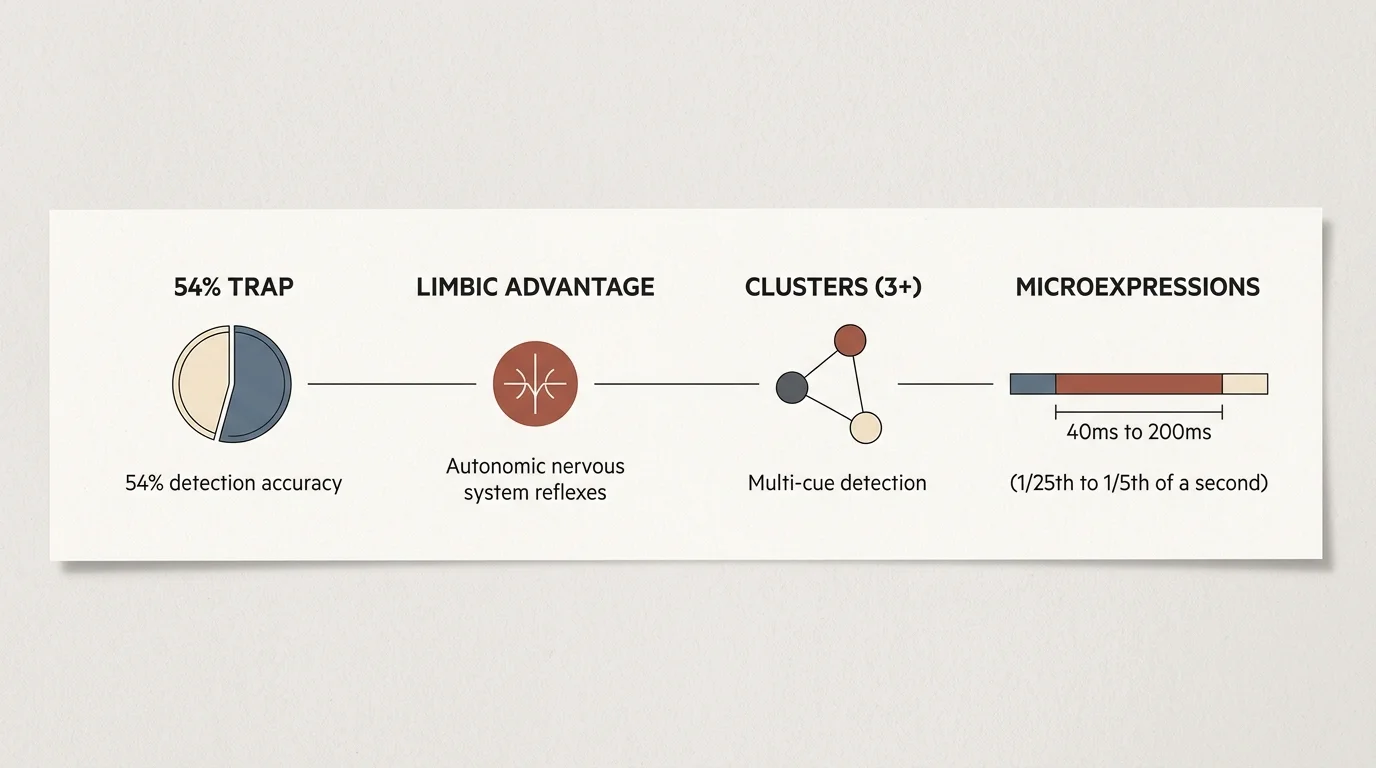
At a Glance: The Science of Nonverbal Deception
- The 54 Percent Trap: According to landmark research by Charles Bond Jr. and Bella DePaulo (2006), human intuition fails at lie detection because people focus on misleading cultural stereotypes rather than biological stress responses.
- The Limbic Advantage: While the neocortex constructs fabrications, the limbic system commands automatic survival reflexes—such as blood redirection, pupil dilation, and micro-muscle contractions—that leak the truth.
- Clusters Over Single Cues: Former FBI counterintelligence agents emphasize that no single cue proves deception; reliable detection requires identifying clusters of three or more baseline deviations.
- The Microexpression Window: Involuntary facial leaks occur within 40 to 200 milliseconds (1/25th to 1/5th of a second), bypassing conscious suppression.
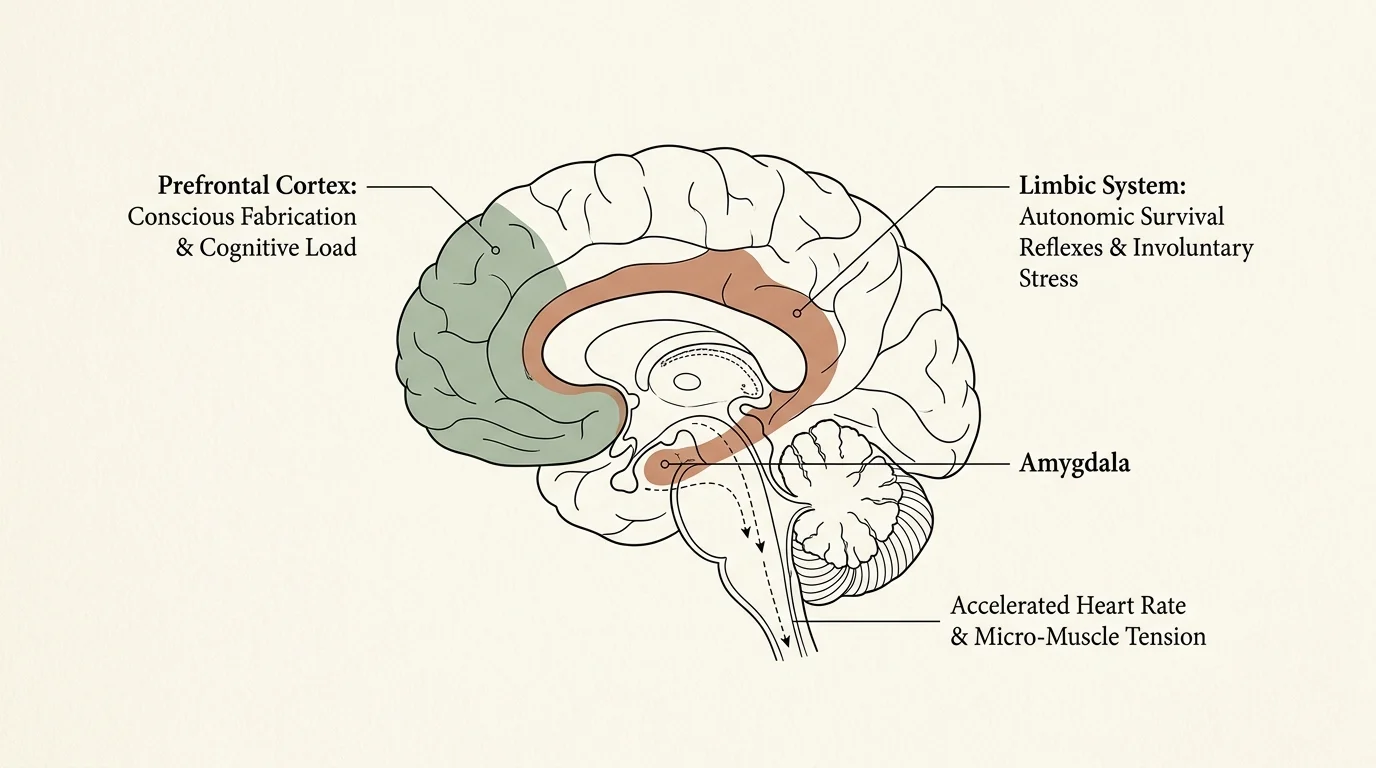
The Neuroscience of Deception: Why the Limbic System Cannot Lie
To understand why specific nonverbal cues betray dishonesty, you must understand the neurological tug-of-war occurring inside the brain during a lie. Deception is cognitively demanding. When someone fabricates a story, their prefrontal cortex must work overtime to invent narrative details, suppress the actual truth, monitor your reactions, and regulate their own outward demeanor.
While the prefrontal cortex attempts to orchestrate this calculated performance, the limbic system—the emotional, survival-driven core of the brain—detects internal conflict. The brain recognizes deception as a threat to social safety and personal integrity, which immediately activates the sympathetic branch of the autonomic nervous system. This releases stress hormones, accelerates heart rate, diverts blood flow, and tightens muscle groups.
As documented in clinical research hosted by the National Institutes of Health (NIH), the autonomic nervous system controls involuntary smooth muscles and glandular secretions. Because conscious willpower cannot directly dictate these autonomic pathways, biological strain inevitably spills into visible physical micro-behaviors. When you learn to spot these subtle signals, you bypass rehearsed words and observe pure neurobiology in action.

The FBI’s ‘Liar Code’: 10 Nonverbal Cues That Defy Conscious Control
Former FBI counterintelligence operatives and forensic psychologists rely on specific autonomic and micro-facial behaviors. Below are the ten most reliable nonverbal cues of lying and emotional distress that cannot be deliberately fabricated or suppressed.
1. Suprasternal Notch Touching (The Neck Dimple Pacifier)
When psychological stress spikes, the human brain seeks immediate physical self-soothing. One of the most potent pacifying behaviors identified by former FBI counterintelligence agent Joe Navarro in What Every BODY Is Saying (2008) involves the suprasternal notch—the small indentation located at the base of the neck between the collarbones.
When people feel threatened, insecure, or deceptive, their fingers instinctively gravitate toward this vulnerable area. Men frequently adjust their tie knots or collar buttons, while women often touch or cover the hollow of the neck with their fingers or a necklace. This action stimulates the vagus nerve, which runs through the neck, physically slowing the racing heart rate caused by autonomic arousal.
2. Microexpressions of Contempt (The Asymmetrical Smirk)
Pioneering psychologist Dr. Paul Ekman discovered that true emotional leaks appear as fleeting microexpressions lasting between 40 milliseconds (1/25th of a second) and 200 milliseconds (1/5th of a second). Among the seven universal human expressions—fear, anger, disgust, sadness, happiness, surprise, and contempt—contempt is the only asymmetrical signal.
Contempt manifests as a subtle, unilateral tightening and lifting of one corner of the mouth. In forensic and interpersonal contexts, a microexpression of contempt reveals moral superiority, secret defiance, or hidden dismissal. It signals that the speaker believes they are outsmarting you or that they disrespect the line of questioning.
“Contempt is the sulfuric acid of love; it erodes the immune system of a relationship and signals a profound disconnect between outward words and internal reality.” — Dr. John Gottman, Relationship Researcher & Founder of The Gottman Institute
Longitudinal studies conducted by The Gottman Institute show that nonverbal contempt predicts interpersonal breakdown and relationship dissolution with over 90 percent accuracy. When you catch this fleeting smirk during a serious conversation, treat it as a critical indicator of unexpressed hostility or hidden calculation.
3. Pupillary Dysregulation and Asynchronous Blink Cycles
The eyes offer direct insight into cognitive load and autonomic arousal. The iris muscles expand and contract via sympathetic and parasympathetic innervation, making pupillary dilation impossible to fake voluntarily. When a person invents complex details or experiences acute stress, their pupils dilate regardless of ambient lighting conditions.
Simultaneously, observe the subject’s blink cadence. During high-load deception, an individual’s blink rate frequently drops as their cognitive resources focus intensely on fabricating the narrative. However, the moment the fabrication is delivered, a dramatic “blink flutter” occurs—a rapid burst of eight to twelve blinks in quick succession as the brain releases stored cognitive tension.
4. The Limbic Freeze and Upper-Torso Rigidity
Popular culture often suggests that liars fidget constantly. However, the evolutionary “freeze, flight, or fight” response frequently causes the opposite effect: profound stillness. In interrogation settings, deceptive individuals often exhibit sudden upper-torso rigidity, locking their shoulders, neck, and arms in place.
When humans speak honestly about emotionally resonant events, their bodies move organically; their hands illustrate ideas, their posture shifts, and their head tilts naturally. When fabricating, the limbic system conserves energy and minimizes movement to avoid drawing attention. If an animated conversationalist suddenly turns statue-still while answering a direct inquiry, note this sharp departure from their natural rhythm.
5. Asymmetrical Facial Activation and Delayed Timing
Spontaneous, honest emotional expressions originate in the subcortical regions of the brain (the basal ganglia and amygdala) and activate both sides of the face symmetrically through involuntary motor tracts. In contrast, simulated emotions originate in the motor cortex of the prefrontal brain, traveling down voluntary pathways that struggle to execute simultaneous bilateral muscle movements.
Consequently, manufactured smiles, fake surprise, or performed sympathy often appear slightly crooked or lingering. A genuine smile engages the zygomaticus major (raising the lip corners) and the orbicularis oculi (crinkling the outer eye corners into crow’s feet). A forced social smile activates only the mouth, leaving the eyes vacant, and often lingers on the face a fraction of a second longer than a natural emotional impulse.
6. Ventral Denying and Barrier Shielding
The ventral (front) side of the human body houses vital organs—the throat, heart, stomach, and groin. When individuals feel comfortable and authentic, they expose their ventral surface toward the person they are interacting with. When deceptive or deeply uncomfortable, they subtly orient their torso away or place physical barriers between themselves and the listener.
Watch for sudden shifts where someone rotates their torso 45 degrees away from you while keeping their head turned. Pay attention if they suddenly cross their arms across their chest, clutch a coffee mug with both hands in front of their sternum, or stack folders between you. These behaviors represent unconscious barricades designed to guard against emotional vulnerability and direct confrontation.
7. Downward Palm Cleansing (The Leg-Clearing Pacifier)
Under autonomic stress, the eccrine sweat glands on the palms of the hands activate, creating subtle moisture. Simultaneously, the brain craves tactile calming. This dynamic produces the “leg-clearing” or “palm-cleansing” gesture, where a seated person places their palms flat against their thighs and slides them downward toward their knees.
FBI behavioral analysts view repetitive palm-clearing as a major pacifying tell. The individual is not simply drying nervous sweat; they are actively stimulating large nerve endings on the thighs to calm their autonomic system. When this behavior occurs immediately following a targeted question, it reflects acute internal friction.
8. The Incongruent Micro-Shrug
Authentic conviction requires full neurological alignment: words, vocal tone, and physical gestures must affirm the same message. An incongruent micro-shrug occurs when an individual makes a definitive verbal declaration (such as “I never saw that document” or “I am completely committed to this team”) while one shoulder subtly lifts a quarter of an inch.
A full, symmetrical two-shoulder shrug conveys honest uncertainty (“I don’t know”). A tiny, one-sided micro-shrug reveals somatic dissonance. It demonstrates that the speaker’s unconscious mind does not endorse the absolute truth of the statement their mouth just delivered.
9. Acoustic Glottal Shock and Laryngeal Constriction
Vocal production depends heavily on muscle elasticity and lubrication. When autonomic arousal surges during high-stakes deception, vocal cord muscles constrict, and salivary glands decrease production, causing acute vocal dryness.
This biological reaction creates audible acoustic indicators: a subtle spike in vocal pitch, sudden throat clearing, or “glottal shock”—a sharp, clicking sound produced when vocal folds break through excessive dryness. If a speaker’s pitch noticeably jumps and they repeatedly swallow before addressing a sensitive point, their body is signaling significant autonomic strain.
10. Involuntary Micro-Flushing and Blanching
Capillary blood flow is regulated entirely by the autonomic nervous system via vasomotor nerves. Conscious effort cannot stop skin tone shifts. Under sudden deception-induced stress, blood flow is either drawn outward to the facial capillaries (blushing/flushing) or yanked inward toward major muscle groups to prepare for physical escape (blanching/pallor).
Look for rapid color changes around the neck, ears, and cheekbones, as well as a sudden dilation of blood vessels along the throat. These vascular shifts serve as direct evidence of limbic arousal, showing that the conversation has triggered an internal fight-or-flight crisis.
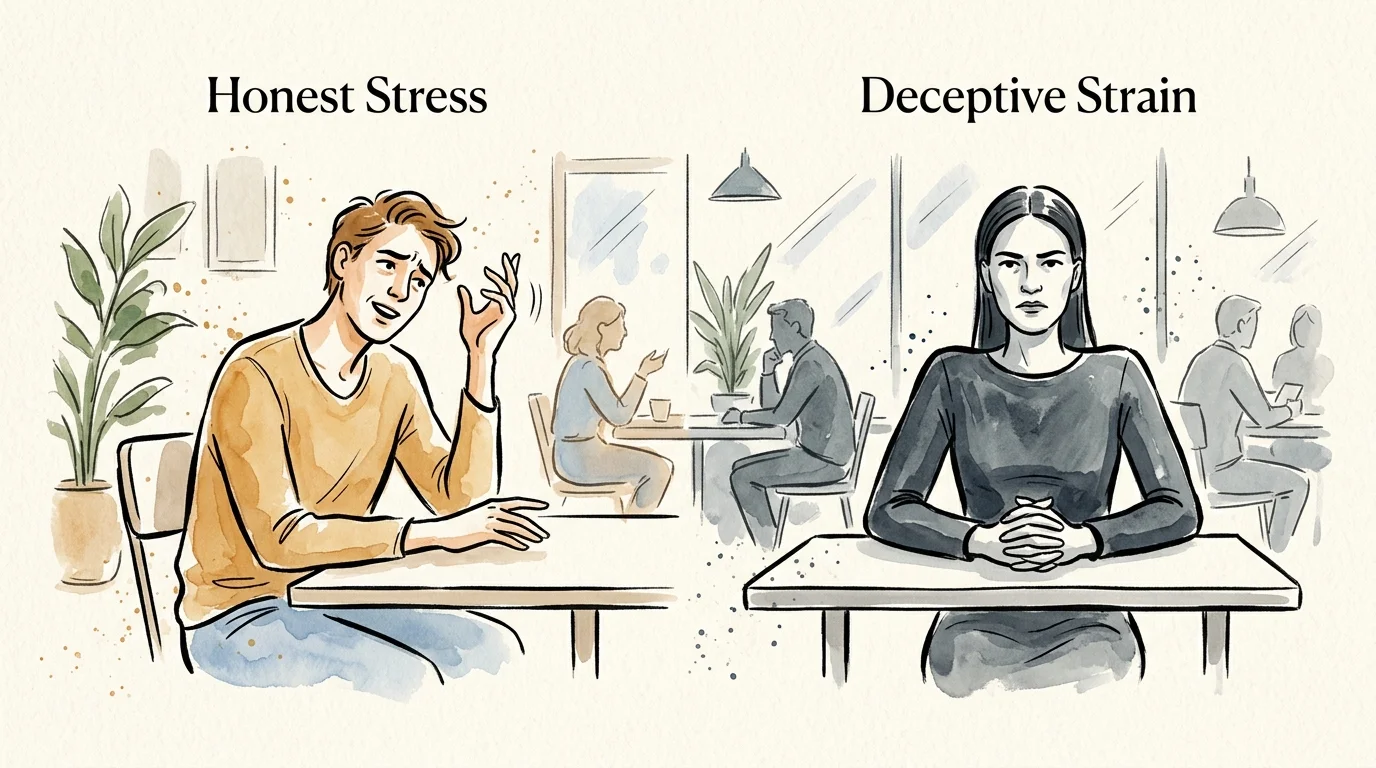
Comparing Honest Stress with Deceptive Strain
People often misinterpret benign social anxiety, introversion, or neurodivergence as deception. To prevent false accusations and maintain empathetic communication, use the following comparison table to distinguish genuine stress from deceptive cognitive load.
| Observation Metric | Honest Anxiety & Social Stress | Deceptive Cognitive Load |
|---|---|---|
| Eye Contact & Blinking | Frequent gaze shifting; rapid, continuous blinking due to nervousness. | Fixed, overcompensating eye contact; reduced blinking during story, followed by rapid blink flutters. |
| Facial Harmony | Symmetrical expressions of worry, embarrassment, or self-consciousness. | Asymmetrical microexpressions (such as unilateral contempt smirks) and delayed smile timing. |
| Vocal Cadence | Speech may speed up; thoughts flow spontaneously, including natural self-corrections. | Calculated latency; delayed answers or unnaturally rehearsed sentence structures; sudden pitch spikes. |
| Somatic Alignment | Head nods, hand gestures, and body orientation naturally match emotional statements. | Incongruent micro-shrugs, rigid torso freeze, and ventral shielding (turning away). |
| Post-Topic Reaction | Anxiety lingers steadily throughout the entire interaction. | Immediate, visible physical slump and deep exhalation the moment the stressful topic changes. |
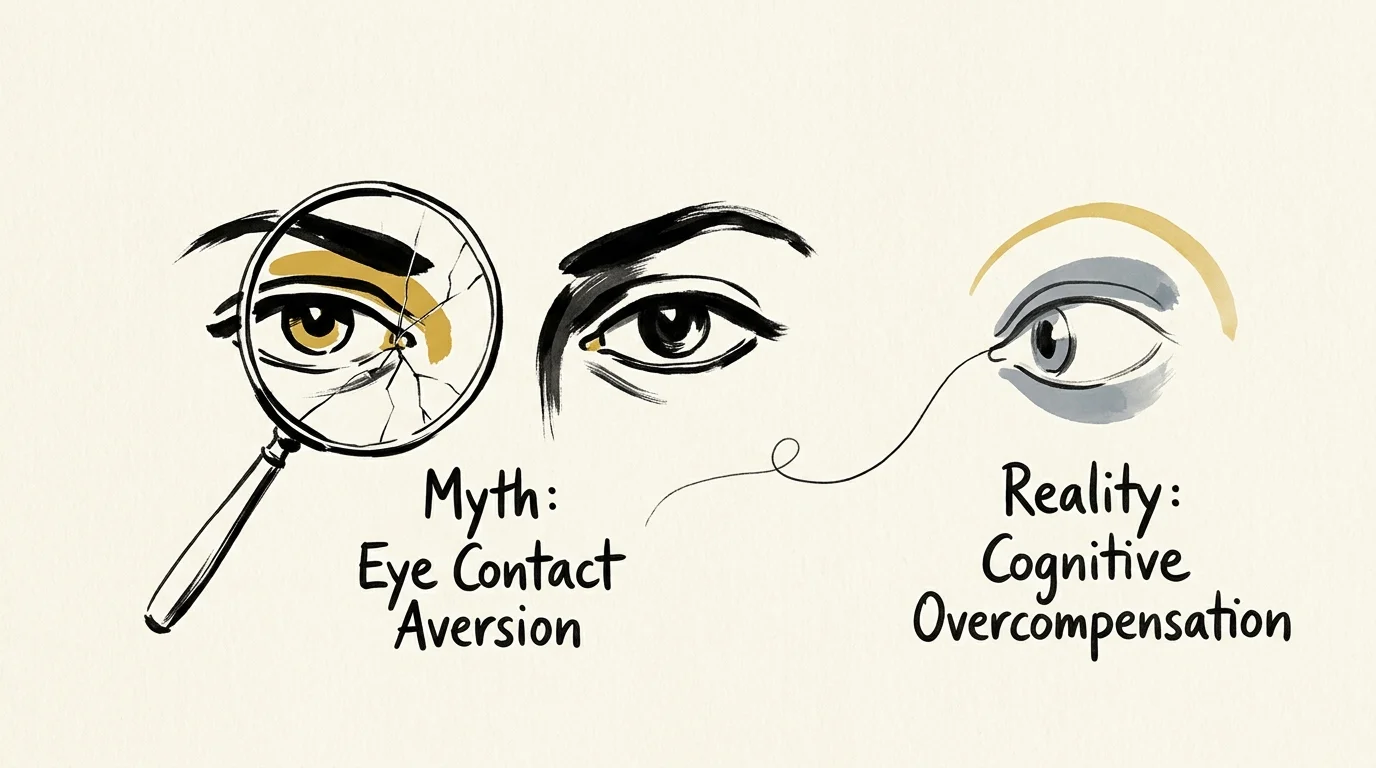
Patterns to Watch For: Common Misconceptions About Lie Detection
Popular media has popularized dangerous myths regarding body language. Understanding what not to look for is just as vital as identifying authentic nonverbal cues.
According to analytical reviews by the American Psychological Association (APA), relying on folk wisdom causes people to misjudge honest individuals while missing deceptive ones entirely. Review these critical misconceptions:
- Myth 1: “Liars Never Look You in the Eye.” In modern society, deceptive individuals know this myth. Consequently, they often maintain intense, unblinking eye contact to overcompensate and project false sincerity.
- Myth 2: “Looking Up and to the Left Indicates Memory Fabrication.” Neuro-Linguistic Programming (NLP) theories claiming directional eye movements prove lying have been repeatedly tested and debunked in rigorous psychological trials. Gaze direction reflects individual cognitive processing styles, not factual veracity.
- Myth 3: “Fidgeting Equals Dishonesty.” Fidgeting usually indicates excess physical energy, ADHD, sensory processing differences, or normal conversational anxiety. True deception cues are rooted in limbic inhibition (freezing) and pacifying reflexes rather than random baseline restlessness.

The FBI Method: Establish Baselines and Hunt for Clusters
Reading body language for lies requires a structured, disciplined approach. If you accuse a colleague, partner, or friend based on a single isolated gesture, you will likely cause unnecessary harm. Federal interrogators employ a strict three-step evaluation framework:
- Establish the Behavioral Baseline: Before assessing sensitive matters, observe how the person behaves during neutral, low-stress interactions. What is their natural blink rate? How do they sit when relaxed? How animated are their hands? You cannot spot an anomaly until you understand the norm.
- Track Clusters of Three: Never evaluate a single cue in isolation. A person might clear their throat because the room is dry, or cross their arms because they feel cold. Look for a synchronous cluster of at least three distinct nonverbal tells (e.g., suprasternal notch touching, a pitch spike, and an asymmetrical micro-shrug) occurring within a two-to-three-second window immediately following a specific trigger question.
- Measure Contextual Timing: The nonverbal reaction must occur in immediate chronological proximity to the stimulus question. If a behavioral shift appears ten seconds later, it may reflect an entirely different internal thought process.
For more insights on emotional regulation and behavioral psychology, explore resources on Psychology Today to understand how interpersonal dynamics shape nonverbal patterns.

Applying Deception Detection with Empathy and Emotional Intelligence
Discovering that someone is concealing information or wrestling with internal conflict does not mean you should immediately launch an aggressive interrogation. In everyday life and close relationships, deception often stems from fear, shame, people-pleasing tendencies, or a perceived lack of psychological safety.
When you notice a cluster of deceptive cues, use that insight as a diagnostic tool rather than a weapon. Ask open-ended, non-judgmental questions. Soften your vocal tone and create an environment where the other person feels safe enough to share the vulnerable truth without fearing immediate retaliation. By pairing keen observational acuity with deep emotional intelligence, you transform FBI deception detection tips into tools for genuine relationship healing and authentic connection.
Frequently Asked Questions
Can someone with sociopathic or narcissistic traits fake these nonverbal tics?
While individuals with antisocial personality structures can suppress conscious guilt and social shame, they cannot override baseline autonomic neurobiology. Complex fabrications still generate cognitive load, pupil dilation, and vasomotor blood flow changes. However, because their baseline emotional baseline differs, establishing a thorough neutral baseline is essential.
How do neurodivergence and trauma affect nonverbal cues?
Individuals with Autism Spectrum Conditions, ADHD, or PTSD frequently exhibit atypical eye contact, pacifying behaviors, and motor restlessness as everyday baseline traits. Never apply deception frameworks to neurodivergent individuals without deeply understanding their unique, idiosyncratic baseline behaviors.
Can microexpressions be seen with the naked eye?
Yes. Although microexpressions flash for only 40 to 200 milliseconds, the human visual cortex can perceive them with deliberate practice. Training involves learning where to look on the face—primarily the brow, eyelid margins, and mouth corners—and recognizing brief flashes of asymmetrical muscle contraction.
What is the very first step I should take if I suspect someone is lying to me?
Pause, ground your own emotions, and avoid reacting immediately. Ask an open-ended, neutral clarifying question and watch their baseline responses closely. Seek verifiable facts and direct collaboration rather than jumping to immediate confrontation.
Moving Forward with Clearer Vision
Learning the nonverbal language of the human nervous system empowers you to navigate complex conversations with clarity and confidence. As you refine your observational skills, remember that body language reveals emotional states and cognitive strain—not absolute courtroom proof. Use these insights to cultivate deeper awareness, protect your personal boundaries, and build authentic connections rooted in transparency and trust.
This is educational content based on psychological research and general principles. Individual experiences vary significantly. For personalized guidance, consult a licensed therapist, psychologist, or counselor.
Last updated: February 2026. Psychology research evolves continuously—verify current findings with professional sources.









Leave a Reply