

True confidence is quiet, but our culture frequently rewards the loudest person in the room, mistakenly labeling their bravado as self-assurance. You likely encounter these individuals daily—the coworker who monopolizes meetings, the partner who never apologizes, or the friend who spins every setback into a boast. While these actions look like unshakeable self-belief on the surface, psychological research reveals they often mask deep-seated insecurity and emotional fragility. Recognizing the difference between genuine confidence and its deceptive counterfeits empowers you to navigate relationships with greater clarity and emotional intelligence. By understanding what true self-worth looks like, you can protect your own energy and cultivate authentic resilience rather than relying on an exhausting, performative armor.
Table of Contents

1. Dominating Conversations and Refusing to Listen
Society often equates a commanding presence with high self-esteem. When someone speaks loudly, interrupts frequently, and controls the flow of a conversation, bystanders often assume that person possesses immense self-assurance. However, monopolizing a discussion rarely stems from a place of secure self-worth. Instead, it frequently acts as a defensive maneuver driven by social anxiety or an intense need for external validation.
Psychologists refer to this behavior as conversational narcissism. When individuals feel deeply insecure, they treat conversations like competitions they must win rather than cooperative exchanges. They dominate the airspace because they fear that if they stop talking, they will lose relevance, control, or the admiration of their audience. Silence feels threatening to an insecure ego.
Genuine confidence looks entirely different. A truly self-assured person feels entirely comfortable holding space for others. They listen actively, ask engaging questions, and do not feel an urgent need to prove their intellect in every interaction. Because they already know their own value, they view conversations as opportunities to learn about others rather than stages to perform on. The next time you encounter someone steamrolling a meeting, recognize that their volume likely correlates directly with their internal anxiety.

2. Never Admitting Mistakes or Apologizing
We often romanticize the image of the resolute leader who stands their ground against all opposition. While maintaining boundaries is healthy, flatly refusing to admit fault or apologize is a massive red flag masquerading as strength. People often mistake a stubborn refusal to back down for rock-solid conviction.
In reality, the inability to say “I was wrong” highlights a severe lack of psychological flexibility and a deeply fragile ego. When someone ties their entire sense of self-worth to being flawless, any mistake feels like a devastating blow to their identity. To protect themselves from the shame of failure, they will deploy defense mechanisms like gaslighting, shifting blame, or rewriting history to ensure they remain the victim or the victor.
True confidence involves separating your fundamental worth from your daily performance. A confident individual understands that making a mistake does not make them a failure; it simply makes them human. They offer sincere apologies without caveats because accountability does not threaten their self-image. Owning a misstep and actively working to repair the damage requires a level of emotional fortitude that defensive, insecure people simply cannot access.

3. Chronic Perfectionism and Over-Preparation
On paper, the chronic perfectionist looks like the ultimate high-achiever. They work late, meticulously check every detail, and consistently deliver flawless results. Bosses praise them, and friends admire their seemingly limitless drive. But beneath the polished surface, perfectionism is rarely fueled by confidence; it is almost entirely driven by fear.
Perfectionists harbor a deep-seated belief that they are only as valuable as their last achievement. They over-prepare because they are terrified of being exposed as incompetent. This behavioral loop is intimately tied to the impostor phenomenon. According to research from the American Psychological Association, up to 82% of people face feelings of the impostor phenomenon, struggling with the persistent sense that they are frauds despite objective evidence of their success.
Furthermore, cultural pressures are exacerbating this insecurity. A comprehensive study published by the American Psychological Association found that socially prescribed perfectionism—the crushing belief that others expect you to be flawless—has increased by 33% since the late 1980s. This generational spike highlights an anxious population desperately trying to earn their worth through impossible standards. Genuine confidence embraces the concept of “good enough.” It allows for a margin of error and understands that perfection is a defensive shield, not an attainable goal.

4. Putting Others Down Under the Guise of “Radical Honesty”
You have likely met someone who prides themselves on being “brutally honest” or “telling it like it is.” They freely dispense unsolicited criticism, mock others’ aspirations, and disguise sharp insults as mere jokes. In modern pop psychology, this abrasive behavior is sometimes wrongly categorized as “alpha” energy or the hallmark of a strong personality.
Psychologically speaking, hyper-critical behavior is a classic projection mechanism. When an individual harbors intense self-doubt, they experience internal psychological discomfort. To alleviate this pain, they externalize their harsh inner critic onto the people around them. By pointing out the flaws in their coworkers, friends, or partners, they artificially elevate their own status. They try to make themselves look taller by cutting off the legs of everyone else in the room.
A genuinely confident person operates from a mindset of abundance, not scarcity. They do not view another person’s success, beauty, or intelligence as a threat to their own. Because they are secure in their own lane, they are quick to compliment others and offer constructive, private feedback only when asked. They know that true strength elevates the room rather than tearing it down.

5. Toxic Positivity and Emotional Avoidance
Resilience is a key component of emotional intelligence, but an unwavering, permanent smile is not. People who exhibit toxic positivity refuse to acknowledge pain, grief, or frustration. They respond to serious hardships with dismissive platitudes like “good vibes only” or “everything happens for a reason.” Observers often mistake this emotional Teflon for an unshakeable, confident mindset.
In reality, toxic positivity is a profound form of emotional avoidance. According to Verywell Mind and other established mental health resources, repressing negative emotions does not eliminate them; it merely stores that stress in the body and damages authentic interpersonal connections. People who cannot tolerate negative emotions are terrified of the vulnerability required to process them. They wear positivity as a mask to keep the messy, uncontrollable reality of human suffering at arm’s length.
Authentic confidence requires the bravery to face the full spectrum of human emotion. As shame and vulnerability researcher Dr. Brené Brown eloquently explains:
“Vulnerability is not winning or losing; it’s having the courage to show up and be seen when we have no control over the outcome. Vulnerability is not weakness; it’s our greatest measure of courage.”
A confident person allows themselves to feel sadness, anger, and grief without letting those emotions permanently define them. They know they are strong enough to navigate the dark, rather than pretending the dark does not exist.

6. Refusing to Ask for Help
We live in a culture that champions the self-made individual. The person who works three jobs, sleeps four hours a night, and stubbornly refuses any assistance is frequently lauded as a paragon of independence and self-reliance. But there is a massive difference between healthy independence and trauma-informed hyper-independence.
When someone absolutely refuses to ask for help—even when they are visibly drowning in responsibilities—they are not operating from confidence. Often, this behavior is a learned trauma response. If a person was chronically let down, neglected, or punished for having needs in their formative years, they internalize the belief that relying on others is fundamentally unsafe. They mask this fear of abandonment or rejection behind a wall of fierce self-sufficiency.
Genuine confidence thrives on interdependence. A self-assured individual knows their strengths but is intimately aware of their limitations. They view asking for help not as a declaration of personal failure, but as a strategic delegation of resources. They are secure enough in their own competence to say, “I don’t know how to do this, can you teach me?” without feeling diminished.

7. Constant Self-Promotion and Bragging
Whether it is name-dropping at a networking event, constantly steering the conversation back to their own achievements, or obsessively curating a flawless image on social media, the chronic bragger demands that you acknowledge their greatness. While this behavior screams “I love myself,” the psychological machinery operating beneath the surface tells a much different story.
Psychological research frequently utilizes the “mask model” to understand narcissistic behaviors and extreme self-promotion. This model suggests that overt grandiosity and explicit self-esteem—the loud, boastful self-image presented to the world—actually serve to cover up a profound deficit in implicit, subconscious self-esteem. The chronic bragger is not trying to convince you of their worth; they are desperately trying to convince themselves.
If you possess a quiet, deeply rooted sense of self-worth, you do not need to turn every social interaction into a public relations campaign. Confident people let their actions, character, and results speak for themselves. They are entirely content to be quietly competent, knowing that external applause is nice, but internal validation is the only metric that truly sustains them.
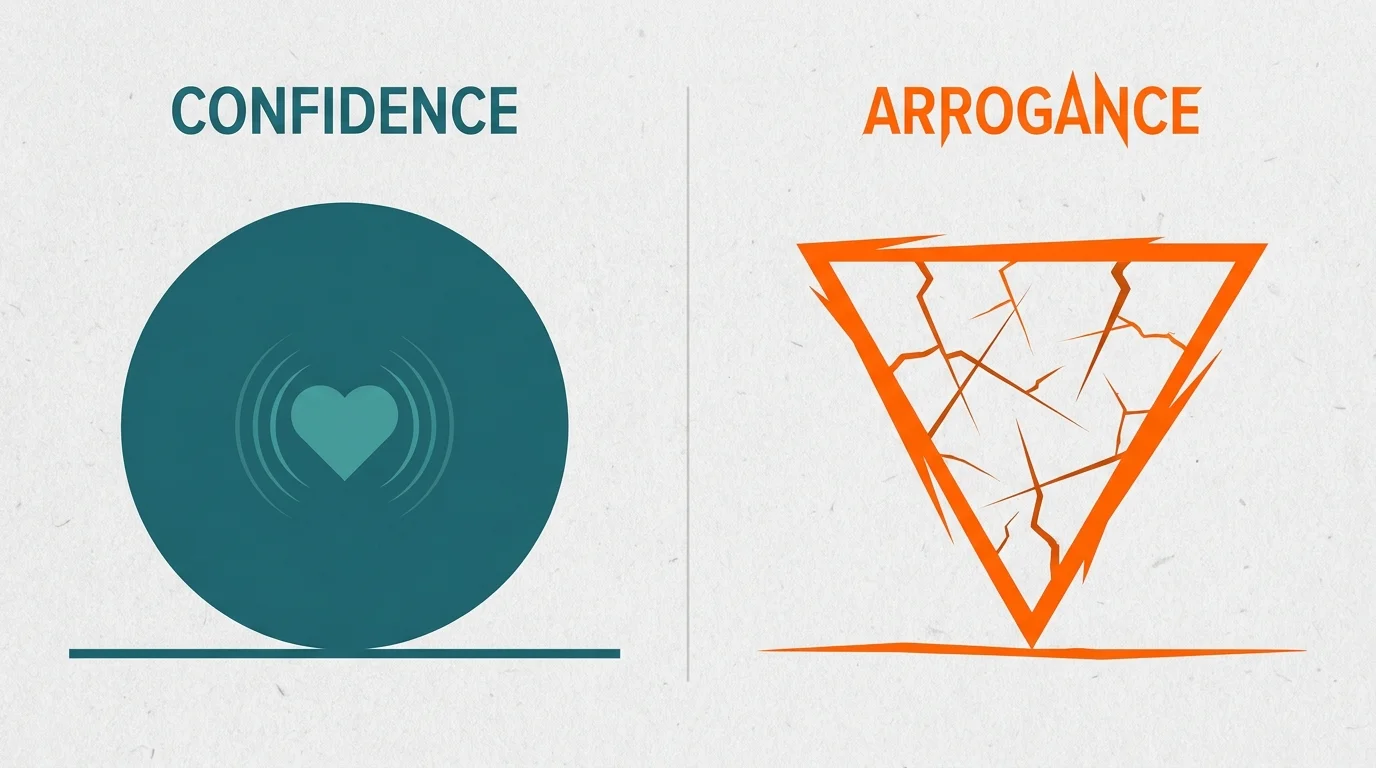
The Core Difference Between Confidence and Arrogance
To help you navigate your relationships and identify the authentic energy in the room, use this comparative guide to separate genuine self-worth from masked insecurity:
| Behavioral Metric | Performative Confidence (Masked Insecurity) | Genuine Confidence (Authentic Self-Worth) |
|---|---|---|
| Handling Failure | Deflects blame, makes external excuses, or denies the failure entirely. | Takes accountability, extracts the lesson, and adjusts behavior moving forward. |
| Communication Style | Talks over others, dictates terms, and listens only to formulate a rebuttal. | Listens actively, embraces silence, and values collaborative dialogue. |
| Success of Others | Views others’ achievements as a personal threat; minimizes their hard work. | Celebrates the success of peers; operates from a mindset of abundance. |
| Setting Boundaries | Uses aggressive walls and ultimatums to control other people’s behavior. | Communicates clear, calm boundaries to protect their own peace and energy. |
| Receiving Feedback | Reacts with immediate defensiveness, anger, or personal attacks. | Considers the feedback thoughtfully without internalizing it as a character flaw. |

Patterns to Watch For
As you work to differentiate authentic self-worth from masked insecurity, keep an eye out for these common misconceptions that frequently muddy the waters:
- The Extrovert Bias: Society frequently conflates high social energy with self-assurance. Remember that an introverted person who speaks less but stands firmly in their boundaries is infinitely more confident than a loud extrovert who requires constant external validation.
- The “Alpha” Myth: Online spaces frequently push the idea of “alpha” behavior, suggesting that dominance and emotional rigidity equal strength. In psychological reality, the need to aggressively dominate others is a primary indicator of a fragile, easily threatened ego.
- Stoicism vs. Avoidance: True emotional regulation means allowing yourself to feel your emotions and consciously managing your response to them. Blank-faced avoidance—pretending nothing bothers you—is not confidence; it is emotional dissociation.
- The Busy Badge of Honor: Equating self-worth with productivity is a dangerous game. People who brag about never sleeping and always working are often using chronic busyness to outrun their own internal thoughts and anxieties.

When Self-Help Isn’t Enough
While understanding these behavioral patterns can drastically improve your interpersonal dynamics, some ingrained habits require professional support. Unlearning years of defensive behaviors is challenging. You might benefit from working with a licensed therapist or counselor if you experience any of the following:
- Chronic Impostor Phenomenon: Your persistent fear of being “found out” causes you to actively sabotage career opportunities, avoid promotions, or experience daily, debilitating anxiety in the workplace.
- Relational Breakdown: Your inability to apologize, accept constructive feedback, or show vulnerability has repeatedly cost you meaningful friendships, family connections, or romantic partnerships.
- Exhausting Perfectionism: The immense pressure to maintain a flawless facade disrupts your sleep, leads to severe occupational burnout, or causes panic attacks when you fall short of your own impossible standards.
- Hyper-Independence as a Trauma Response: You actively refuse help even when you are facing a crisis, leading to severe emotional isolation, physical exhaustion, and chronic loneliness.
Working with a professional via Psychology Today’s therapist directory or similar resources can help you gently dismantle the armor you have built and replace it with authentic, sustainable self-esteem.
Frequently Asked Questions
How can I tell if someone is genuinely confident or just arrogant?
Genuine confidence is quiet and inclusive. Confident individuals lift others up, admit when they are wrong, and listen actively. Arrogance relies on putting others down, dominating conversations, and refusing to accept accountability. Arrogance requires an audience; confidence does not.
Why do I feel like a fraud even when I succeed?
This is known as the impostor phenomenon, and it is incredibly common among high-achievers. It occurs when you attribute your success to luck or timing rather than your own competence. Acknowledging these feelings and discussing them with trusted peers can significantly reduce their power.
Can over-talking really be a sign of social anxiety?
Yes. While many assume anxiety makes people quiet, it can also trigger a “fight or flight” verbal response. Some socially anxious individuals over-talk to control the narrative, avoid awkward silences, or preemptively defend themselves against perceived judgment.
Moving Forward With Authentic Confidence
Stripping away performative confidence is uncomfortable work. When you have spent years relying on perfectionism, defensive communication, or hyper-independence to keep yourself safe, letting go of those tools feels incredibly vulnerable. But that vulnerability is exactly where true self-worth is born. By paying attention to the behaviors you use to mask your insecurities, you can begin the brave work of meeting your own needs directly, rather than demanding the world validate you.
Start small. Practice saying “I don’t know” in a low-stakes conversation. Let a minor mistake slide without launching into a lengthy defense. Allow someone else to have the last word. As you practice these subtle shifts, you will discover that genuine confidence feels profoundly peaceful. The information in this article is meant for educational purposes and general guidance. It does not replace individual therapy, counseling, or medical treatment. If you or someone you know is in crisis, contact the 988 Suicide & Crisis Lifeline by calling or texting 988.
Last updated: May 2026. Psychology research evolves continuously—verify current findings with professional sources.









Leave a Reply