

Silence often feels uncomfortably loud when your mind harbors unresolved stress or self-criticism. Reaching for your phone the second you sit down reveals a protective habit known as emotional avoidance.
Modern culture rewards non-stop stimulation, making quiet self-reflection feel unnatural or even intimidating. When you perpetually outrun your own mind, everyday stress quietly accumulates beneath your conscious awareness.
Recognizing the signs of avoiding your thoughts allows you to rebuild an honest, calm relationship with yourself. Here are seven clear indicators that you fear internal silence, alongside practical steps to reclaim stillness.
The Psychology of Silence and Emotional Avoidance
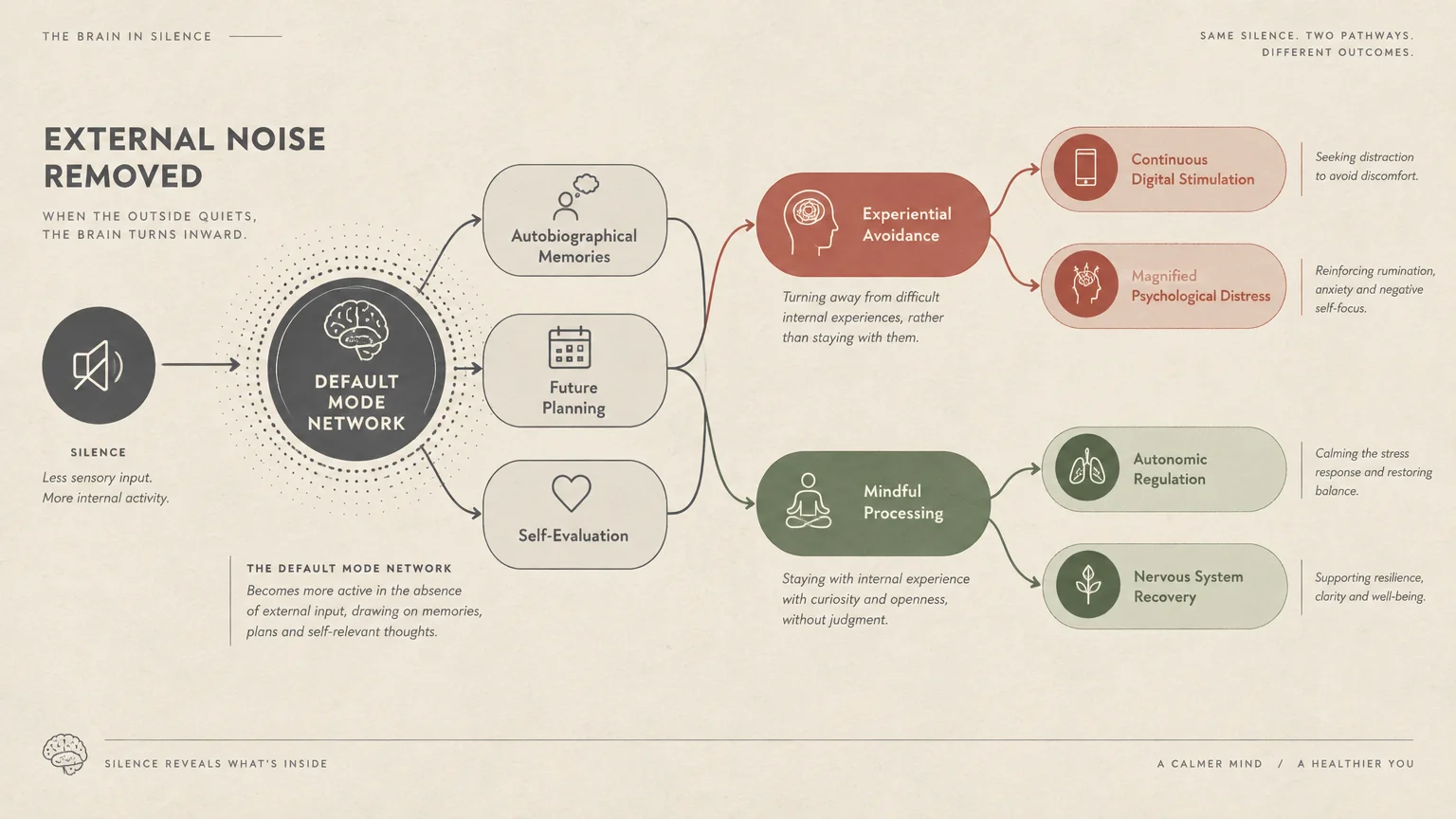
When external noise disappears, your brain automatically activates its default mode network. This interconnected neural system processes autobiographical memories, future planning, and self-evaluation.
If you carry unprocessed grief, relationship tension, or unexpressed anger, this network immediately brings those concerns forward. Your subconscious mind views quiet self-reflection as an emotional threat rather than a restful pause.
Psychologists categorize this continuous flight from internal discomfort as experiential avoidance. According to the American Psychological Association, evading painful thoughts and sensations often magnifies long-term psychological distress.
Distraction serves as a psychological analgesic, offering rapid but fleeting relief from difficult thoughts. When you drown out your mind with digital stimulation, you never give your nervous system the chance to process latent stress.
Over time, this defensive habit turns quiet reflection into an unfamiliar and threatening territory. Understanding how avoidance shows up in daily life is your first step toward restoring peace.

7 Signs You’re Afraid of Being Alone With Your Thoughts
Fear of internal silence rarely appears as conscious panic. Instead, it weaves into your daily schedule as socially accepted habits that conceal an underlying dread of solitude.
1. You Require Constant Background Noise
You rarely move across your living space without audio playing in your ears or through a speaker. You stream television shows while cooking, listen to podcasts while showering, and fall asleep to commentary.
This ambient noise creates an impenetrable acoustic barrier between you and your consciousness. Even a sixty-second gap in sound triggers an automatic impulse to hit play on another track.
You might believe you simply enjoy staying informed or entertained. In reality, you use other voices to suppress the thoughts you dread hearing from yourself.
2. You Weaponize Productivity Against Downtime
You pack your calendar with back-to-back commitments, side projects, and household chores. Sitting on the couch without a productive objective makes you feel anxious and deeply unsettled.
Workaholism and excessive organizing often function as socially rewarded avoidance strategies. Staying perpetually active allows you to outrun the difficult realizations lingering in the margins of your mind.
When a task ends, you instantly search for another chore to tackle. Rest feels like an enemy because stillness leaves you alone with unresolved emotional demands.
3. Physical Discomfort Surges During Moments of Stillness
When you sit quietly without your devices, your body rebels against the lack of stimulation. Your heart rate quickens, your chest tightens, or your legs bounce with restless kinetic energy.
Somatic agitation often signals that suppressed feelings are trying to register in your awareness. As Harvard Health highlights, chronic psychological tension disrupts autonomic regulation, turning sudden physical stillness into perceived danger.
You interpret this physical discomfort as proof that relaxing does not suit your personality. In reality, your nervous system is simply sounding an alarm against the emotions you refuse to feel.
4. Bedtime Triggers Compulsive Screen Scrolling
You delay turning off the bedroom lights for hours, losing yourself in infinite algorithmic feeds. Although your eyes burn with exhaustion, putting down your smartphone feels intolerable.
Nighttime strips away the external distractions that insulate you during your waking hours. The silent, dark room exposes you to unprocessed regrets, future worries, and existential questions.
Scrolling acts as a digital shield against that impending nighttime vulnerability. You stay awake until total physical exhaustion knocks you out, preventing spontaneous contemplation.
5. Micro-Moments of Solitude Demand Digital Input
You cannot wait in a grocery line, ride an elevator, or sit at a red light without checking your screen. These brief, empty moments generate an immediate itch for rapid digital input.
These transitory pauses are natural mental decompression periods that your brain requires to organize memories. Filling every micro-pause with information prevents your mind from sorting and clearing daily cognitive clutter.
This compulsive habit trains your brain to equate brief silence with intolerable boredom. Over time, your tolerance for your own uninterrupted stream of consciousness erodes completely.
6. You Deflect Meaningful and Introspective Conversations
When close friends ask how you are coping, you dismiss the question with humor or quick generic answers. You swiftly steer conversations toward safe topics, workplace gossip, or external events.
Emotional intimacy requires personal reflection, which feels perilous when you avoid your inner state. If you cannot look honestly at your own struggles, you cannot speak about them authentically.
Deflection keeps people at a distance where your emotional facade remains intact. Unfortunately, this protective barrier also isolates you from genuine connection and emotional validation.
7. A Harsh Inner Critic Awakens When the Noise Stops
The moment external stimulation fades, an intense barrage of self-reproach rushes in. Your mind inventories past awkward interactions, unreached goals, and lingering personal flaws.
You do not necessarily hate quiet environments; you hate the punishing voice that fills them. Avoiding solitude is often a self-protective instinct against relentless, internal judgment.
Rather than tolerating that internal cruelty, you choose the anesthesia of noise. This choice protects your self-esteem in the short term, but it leaves the core self-criticism unchallenged.
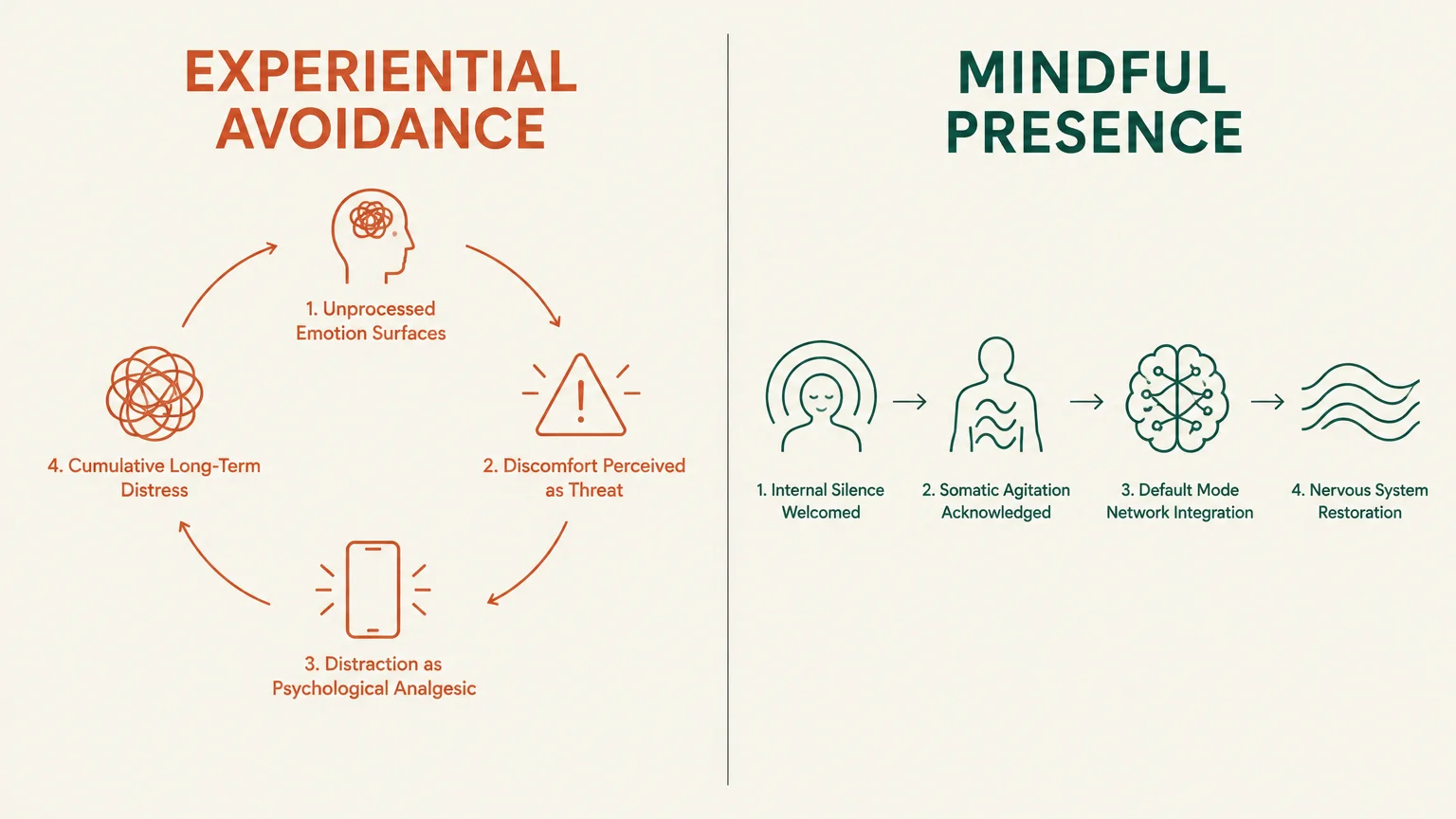
Experiential Avoidance vs. Mindful Presence
Distraction provides an immediate escape valve, but it deepens internal anxiety over the long term. Choosing mindful presence teaches your brain that difficult internal states are neither lethal nor permanent.
The table below highlights how avoidant coping mechanisms compare to mindful approaches when internal distress arises.
| Situation | Avoidant Coping (Distraction) | Mindful Presence (Acceptance) |
|---|---|---|
| Uncomfortable emotion emerges | Instantly reaches for a phone, video, or snack to numb the feeling. | Pauses, notices physical sensations, and allows the emotion to crest and fade. |
| Sudden silence occurs | Experiences acute agitation and turns on background sound immediately. | Takes a steady breath and observes ambient environmental sounds without panic. |
| Intrusive thought arises | Fights or suppresses the thought, increasing internal cognitive distress. | Acknowledges the thought as mental data without assuming it reflects objective truth. |
| Bedtime arrives | Scrolls social media until sheer exhaustion forces sleep. | Engages in brief somatic grounding or gentle breathing to wind down naturally. |
| Long-term psychological outcome | Heightened baseline anxiety, emotional numbness, and chronic physical fatigue. | Improved emotional resilience, greater mental clarity, and deeper self-trust. |
Shifting from avoidant coping toward mindful presence requires small, consistent behavioral adjustments. You do not have to conquer silence all at once; you merely learn to stay for a moment longer.
Myths Worth Debunking About Stillness and the Mind
Misconceptions regarding meditation and mental serenity lead many individuals to believe they are fundamentally flawed. Dismantling these myths makes self-reflection approachable and far less intimidating.
Myth 1: A Healthy Mind Is Completely Quiet and Calm
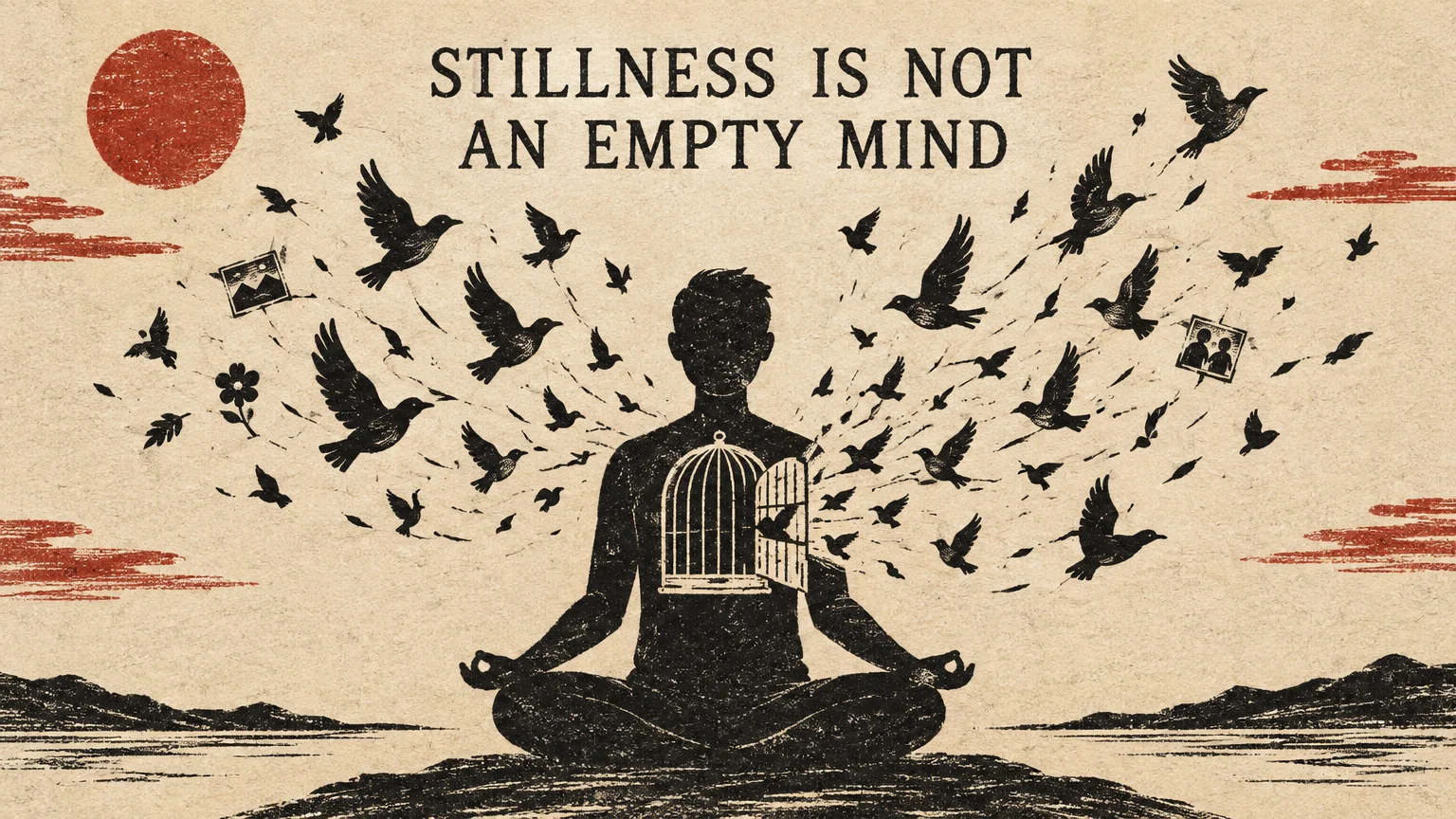
Popular media often depicts mental wellness as an empty, serene void devoid of disturbing thoughts. In truth, the human brain functions as an active thought-generating organ that constantly produces random hypotheses and memories.
Inner peace does not mean eradicating mental noise; it means changing your reaction to that noise. You can observe chaotic thoughts pass through your awareness without attaching your identity to them.
Myth 2: Chronic Distraction Is a Safe, Harmless Habit
Many people treat continuous podcast listening or binge-watching as benign self-care routines. While occasional distraction provides healthy relaxation, perpetual distraction acts as chronic emotional suppression.
Suppressed emotions do not dissipate on their own; they manifest as physical ailments, chronic fatigue, and sudden irritability. According to Psychology Today, emotional suppression directly fuels heightened baseline anxiety and depression.
Myth 3: Sitting With Your Thoughts Requires Exhaustive Analysis
You do not need to psychoanalyze every memory or fear that arises while you sit in silence. Trying to interpret every cognitive impulse leads directly into obsessive rumination.
True mindfulness involves witnessing your thoughts with neutral curiosity. You acknowledge the presence of an emotion, breathe through the sensation, and let it depart naturally.

Practical Steps to Build Comfort with Stillness
Conquering the fear of silence does not require hours of solitary retreat. You can retrain your autonomic nervous system using gradual, compassionate micro-exposures.
Carl Rogers, the pioneering psychologist who established person-centered therapy, highlighted the transformative value of self-acceptance:
“The curious paradox is that when I accept myself just as I am, then I can change.” — Carl Rogers, Psychologist
Apply these actionable, evidence-based practices to develop comfort with your internal landscape:
- Practice ninety-second micro-pauses: Wait for your morning coffee or tea without reaching for your phone. Use those brief moments to notice your breathing and physical surroundings.
- Apply affect labeling: When uncomfortable feelings surface, assign them simple descriptive words like “anxiety,” “frustration,” or “sadness.” Naming your emotions reduces activity in the emotional centers of your brain.
- Engage in sensory grounding: Anchor your awareness in your five physical senses whenever quietness feels overwhelming. Identify three sounds in your room, two physical sensations, and one calming visual detail.
- Establish a daily worry journal: Dedicate ten minutes each afternoon to write down your nagging fears and intrusive thoughts. Offloading them onto paper signals to your brain that they are safely recorded.
- Take silent walks outdoors: Walk around your neighborhood once a week without earbuds or audio accompaniment. Observe the cadence of your footsteps and allow your thoughts to meander freely.
Treat these exercises as gentle experiments rather than rigid performance tests. Building tolerance for quiet reflection takes steady, non-judgmental practice.

Signs It’s Time to Talk to a Therapist
While everyday restlessness in silence is normal, intense internal distress often warrants professional clinical care. Professional support provides the guidance needed to process deep-seated emotional wounds safely.
Consider scheduling an evaluation with a licensed therapist if you encounter any of the following scenarios:
- Unwanted flashbacks, traumatic memories, or overwhelming dissociation that erupt the moment external stimuli stop.
- Severe physical panic symptoms, including hyperventilation, chest tightness, or dizziness, whenever you are left alone in silence.
- Compulsive rituals or obsessive behaviors that you feel forced to execute to keep frightening thoughts at bay.
- Pervasive feelings of despair, self-loathing, or persistent thoughts of self-harm whenever you pause your busy routine.
Modalities such as Acceptance and Commitment Therapy (ACT) and Cognitive Behavioral Therapy (CBT) effectively treat chronic emotional avoidance. The National Alliance on Mental Illness offers resources to help you connect with qualified mental health providers.
Frequently Asked Questions
Why does silence feel so physically uncomfortable?
Silence strips away auditory stimulation, which directs your conscious focus toward autonomic tension and muscle tightness you normally ignore. Your nervous system mistakes that sudden sensory shift for an environmental threat until you acclimate.
Can practicing mindfulness make anxiety worse at first?
Yes, focusing on your thoughts often triggers an initial spike in anxiety because you are confronting suppressed material. This discomfort is temporary and diminishes as your nervous system learns that thoughts are not physical dangers.
How can I calm racing thoughts before going to sleep?
Write down tomorrow’s to-do list and major worries in a notebook an hour before bed. Discharging these cognitive tasks on paper reassures your executive brain that nothing urgent will be forgotten overnight.
Is listening to audiobooks and podcasts all day bad for your brain?
Educational media is beneficial in moderation, but continuous listening robs your brain of default mode processing time. Your brain requires quiet intervals to consolidate memories, integrate emotions, and foster creative insights.
Learning to Befriend Your Solitude
Silence is not an empty vacuum designed to torment you; it is a restorative refuge where genuine healing happens. Facing your thoughts dissolves their frightening illusions and restores your sense of personal autonomy.
Start small today by setting your phone down for two quiet minutes of mindful breathing. Embracing stillness allows you to discover that your mind can become your most comforting companion.
This article provides general educational information about psychology and relationships, and it is not a substitute for professional therapy or medical advice. Everyone’s situation is unique—if you’re struggling, please reach out to a licensed mental health professional.
Last updated: October 2026. Psychology research evolves continuously—verify current findings with professional sources.









Leave a Reply