
If you want to protect your long-term cognitive and heart health, your dream cycles may matter far more than you realize. A landmark study tracking 95,559 adults linked higher levels of rapid eye movement (REM) sleep to a lower risk of 83 different diseases.
Published in PLOS Medicine, the research followed middle-aged and older participants for nearly nine years using wearable movement sensors. The findings reveal that REM sleep provides sweeping defense across your nervous and cardiovascular systems.
Understanding how your nightly sleep stages function can help you make targeted adjustments to your evening routine and daily recovery habits.
Inside the 95,000-Adult Sleep Study
Researchers at Peking University and Capital Medical University evaluated 95,559 adults from the UK Biobank cohort. Participants had an average age of 56.2 years at baseline and wore wrist accelerometers for seven consecutive days.
Using the SleepNet deep-learning algorithm, the team estimated specific sleep stages for each individual. They then tracked 1,049 health outcomes across a median follow-up period of 8.9 years.
This sleep study of 95,000 adults identified 156 significant associations between sleep architecture and newly diagnosed conditions. Even after rigorous statistical adjustments, 95 associations remained durable over time.
Which Disease Risks Dropped the Most?
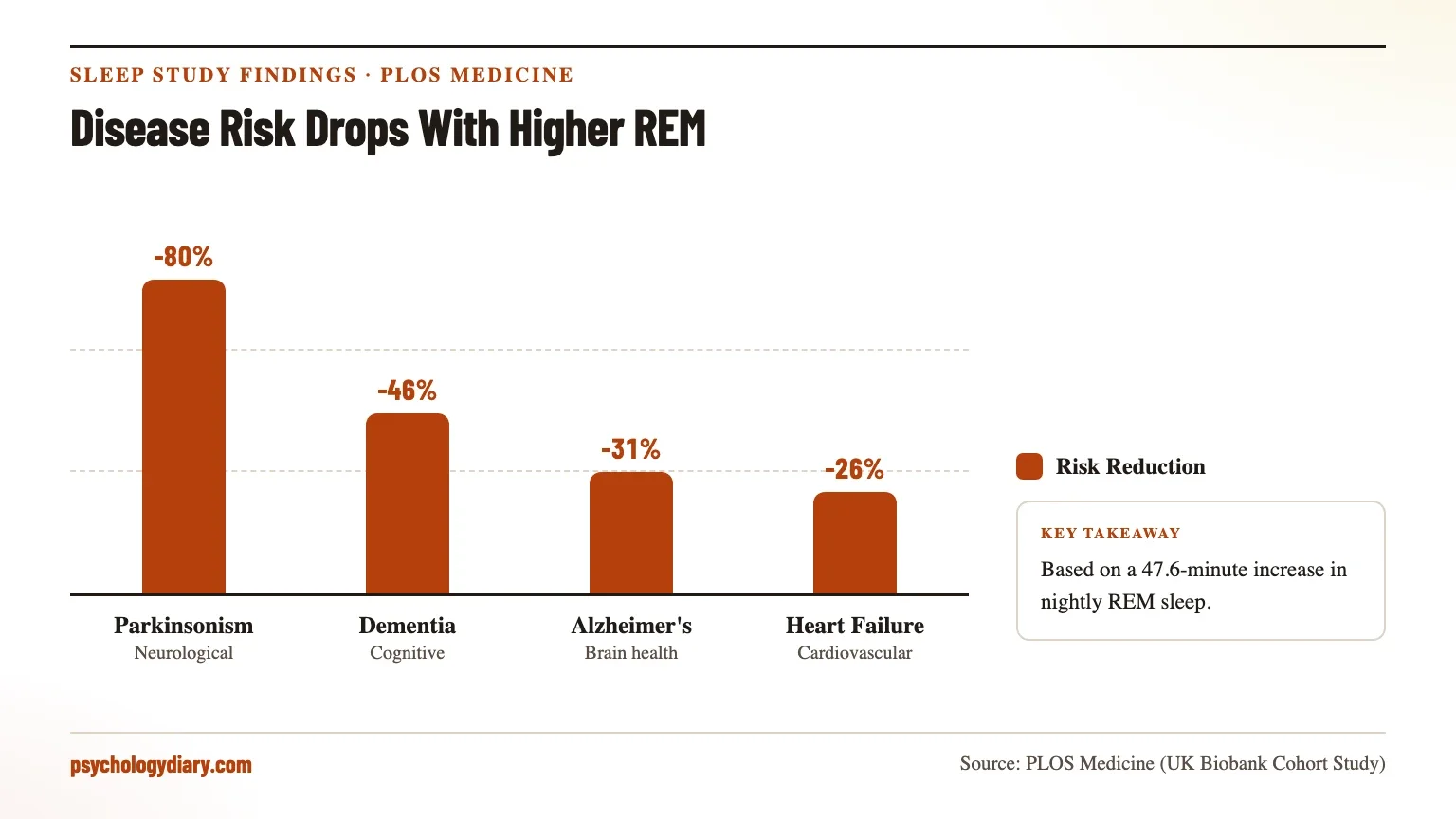
The most striking REM sleep benefits emerged in brain and cardiovascular health. For every 47.6-minute increase in REM sleep, participants experienced dramatic reductions in serious chronic disease risk.
Neurological conditions saw some of the steepest declines. Participants with higher REM sleep had an 80% lower risk of parkinsonism and a 46% lower risk of general dementia.
The study also recorded a 31% lower risk of Alzheimer’s disease and a 52% lower risk of multiple sclerosis. Researchers observed substantial protection for the heart as well.
Higher REM duration was tied to a 26% lower risk of heart failure. It also correlated with lower risks for atrial fibrillation and ischemic heart disease.
REM Sleep vs. Deep Sleep: Understanding the Differences
People often conflate dream sleep with deep slow-wave sleep, but your brain performs vastly different duties during each stage. While REM sleep was linked to 83 reduced disease risks, deep sleep showed distinct advantages for 7 conditions.
Deep sleep—designated as stage N3—focuses on physical tissue repair and metabolic balance. The National Institutes of Health (NIH) notes that cellular repair accelerates during this slow-wave period.
In the study, each 47.5-minute increase in deep sleep was linked to an 11% lower risk of type 2 diabetes. It also reduced the risk of major depressive disorder by 14%.
| Sleep Stage | Brain Activity | Primary Biological Focus | Diseases Reduced in Study |
|---|---|---|---|
| REM Sleep | Rapid brain waves; vivid dreaming; motor paralysis | Memory consolidation; emotional processing; autonomic regulation | 83 conditions, including dementia, Parkinson’s, and heart failure |
| Deep Sleep (N3) | Slow delta waves; low blood pressure; relaxed muscles | Physical tissue repair; growth hormone release; glucose regulation | 7 conditions, including type 2 diabetes and major depression |
Balancing both stages requires listening carefully to your body’s physical and psychological signals rather than forcing rigid routines.
“The curious paradox is that when I accept myself just as I am, then I can change.” — Carl Rogers, Ph.D.
When you approach your rest with self-compassion instead of anxiety, restorative sleep cycles naturally become easier to sustain.
Hidden Saboteurs of Your Dream Cycles
REM sleep predominantly occurs during the second half of the night, lengthening in duration toward morning. Anything that disrupts early-morning rest disproportionately cuts your dream sleep short.
According to the Mayo Clinic, alcohol serves as one of the most potent REM suppressors. While a late evening drink might help you fall asleep faster, it fractures your sleep architecture later in the night.
Recent public health data reveals that 12.9% of adults regularly rely on sleep aids or supplements. Many sedative medications induce unconsciousness while actively suppressing the natural brain rhythms required for REM.
Frequent nighttime awakenings also disrupt your progression through continuous sleep cycles. In the study, wakefulness after sleep onset was linked to higher rates of anxiety and substance use disorders.

Practical Habits to Protect and Increase REM Sleep
You cannot consciously force your brain into REM sleep, but you can build conditions that allow it to flourish. Focus on structural habits that protect the final third of your night.
- Maintain a consistent wake time: Waking at the same hour stabilizes your circadian rhythm and preserves morning REM cycles.
- Target a 6-to-8-hour window: The study found that sleeping within 6 to 8 hours carried the lowest disease risks for 69 conditions.
- Eliminate evening alcohol: Stop alcohol consumption at least three to four hours before bed to keep sleep cycles intact.
- Keep your bedroom cool: A cooler sleeping environment prevents micro-arousals that eject your brain from dream stages.
Guidance from Harvard Health emphasizes that morning light exposure reinforces nighttime melatonin release. Stepping outside shortly after waking helps anchor your internal clock.
Myths Worth Debunking
Misconceptions about sleep stages often lead people to mismanage their nighttime routines. Clearing up these myths helps you focus on what truly supports your health.
Myth 1: Deep sleep is the only restorative stage. While deep sleep restores muscle tissue, REM sleep shields your vascular and neurological systems across 83 distinct conditions.
Myth 2: More sleep is always better. In this dataset, sleeping over eight hours was tied to a 60% higher risk of major depressive disorder compared to six to eight hours.
Myth 3: Sedatives create natural sleep stages. Many chemical sedatives suppress slow-wave and REM cycles, leaving you unconscious without delivering true cellular restoration.

Signs It’s Time to Talk to a Professional
Occasional poor sleep is normal, but persistent disruptions require personalized medical investigation. Current sleep health research highlights that chronic sleep debt deeply impairs emotional regulation.
The American Psychological Association (APA) notes that persistent sleep struggles often overlap with mood disorders. Consider speaking with a physician or licensed sleep specialist if you notice any of these signs:
- You regularly wake up exhausted despite spending seven to eight hours in bed.
- You act out vivid or violent dreams physically during the night.
- You struggle with chronic nighttime awakenings that leave you tossing and turning for hours.
- Severe daytime brain fog or fatigue interferes with your work, relationships, or safety.
Evidence-based therapies like Cognitive Behavioral Therapy for Insomnia (CBT-I) provide structured, lasting relief without medication side effects.
Next Steps for Your Sleep Health
Protecting your sleep is a foundational investment in your lifelong cognitive and cardiovascular resilience. Start with one manageable adjustment to your evening routine tonight.
This article provides general educational information about psychology and relationships. It is not a substitute for professional therapy or medical advice. Everyone’s situation is unique—if you’re struggling, please reach out to a licensed mental health professional.
Last updated: November 2026. Psychology research evolves continuously—verify current findings with professional sources.