

Someone mentions a tiny detail you shared three weeks ago, or sends a late-night link to an obscure song you once loved. Moments like these reveal that you are living rent-free in someone’s head—occupying their thoughts long after a conversation ends.
Human brains rarely replay interactions by accident; relationship psychology shows that unresolved curiosity, emotional resonance, and dopamine-driven reward pathways keep certain people at the forefront of our minds. Recognizing the subtle signs someone thinks about you helps you respond with clarity instead of guesswork.
Below, you will learn the behavioral cues that prove someone can’t stop thinking about you and what to do with that knowledge.
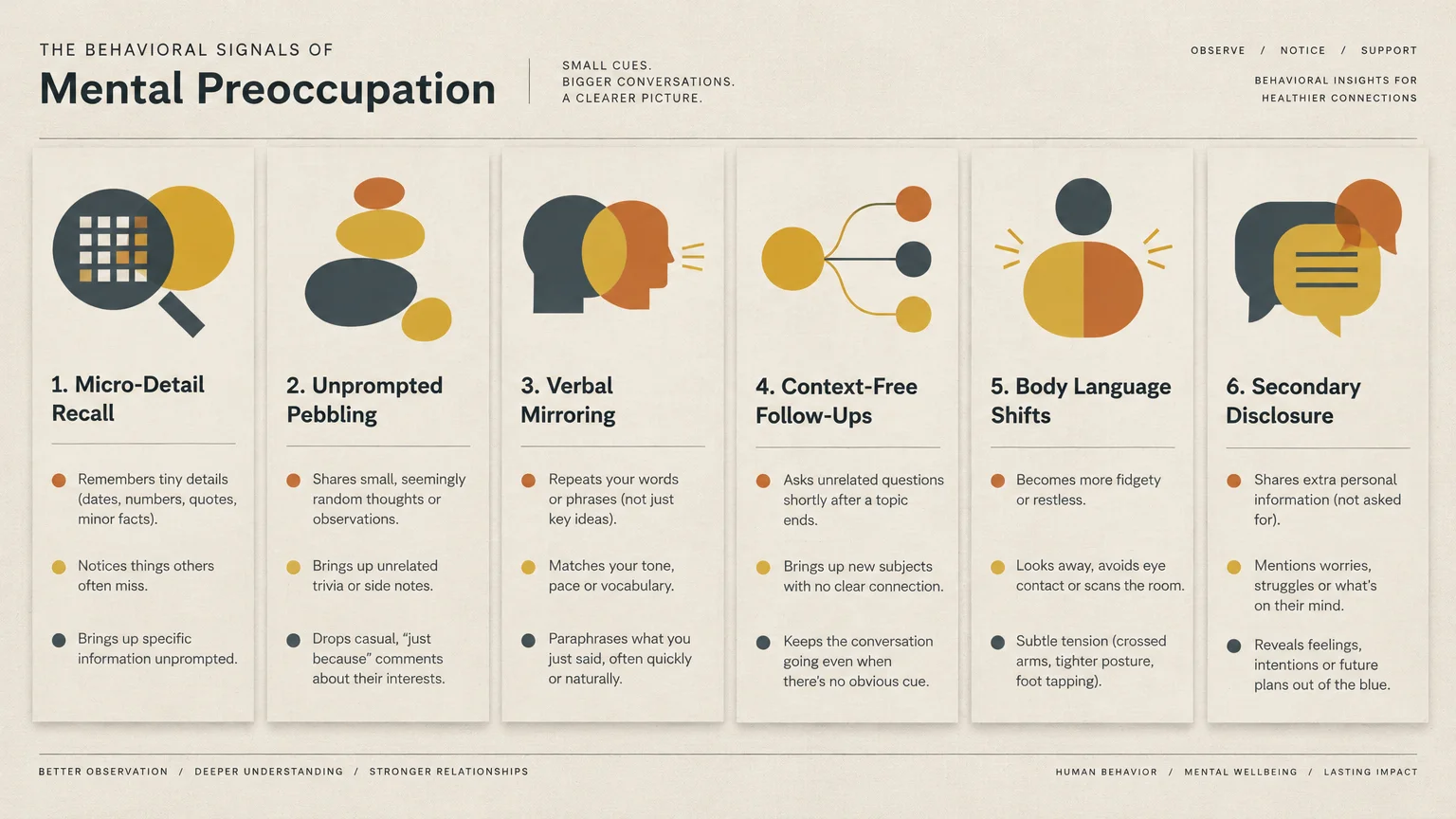
At a Glance: How Mental Preoccupation Shows Up
When you occupy space in someone’s internal world, their everyday behavior leaks small clues. Even people who pride themselves on emotional composure struggle to hide ongoing mental preoccupation.
- Hyper-specific memory recall: They remember offhand remarks, food preferences, or dates you barely recall mentioning yourself.
- Unprompted “pebbling”: They send articles, memes, or songs because everyday objects continually trigger associations with you.
- Verbal and behavioral mirroring: They unconsciously adopt your phrasing, humor, or body language through repeated mental rehearsal.
- Context-free follow-ups: They restart conversations days later as if no time has passed because the dialogue never stopped in their mind.
- Nervous or over-calibrated body language: Their physical demeanor shifts the second you enter a room, showing heightened nervous system arousal.
- Secondary disclosure: Their friends or coworkers already know your stories before you ever formally meet them.
The Psychology Behind Living Rent-Free in Someone’s Head
The slang phrase “living rent-free in someone’s head” describes an involuntary psychological phenomenon. When someone thinks about you repeatedly without your prompting, specific cognitive and neurochemical mechanisms are driving that focus.
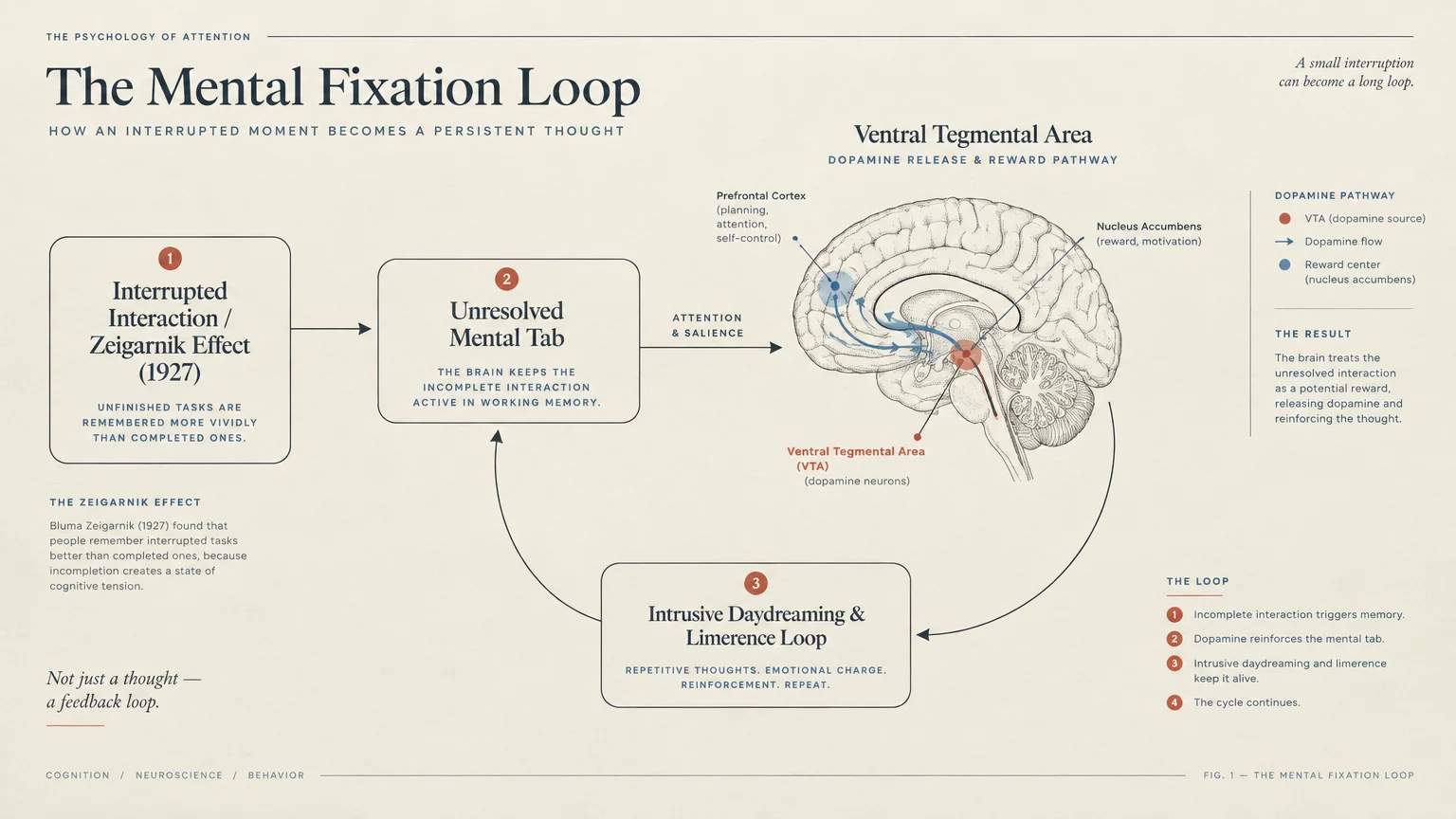
One of the strongest drivers is the Zeigarnik effect, first identified by psychologist Bluma Zeigarnik in 1927. Her research demonstrated that the human brain remembers interrupted or incomplete tasks far better than completed ones.
In relationship psychology, an unresolved emotional exchange acts just like an unfinished task. When a conversation leaves lingering tension, mystery, or unspoken attraction, the brain keeps the mental tab open to seek closure.
Neurochemistry amplifies this loop whenever attraction or admiration enters the picture. Neuroimaging studies on romantic focus show that thinking about an intriguing person activates the brain’s ventral tegmental area, flooding reward pathways with dopamine.
According to the American Psychological Association, dopamine fuels motivation, craving, and goal-directed attention. Each time the person replays a memory of your laugh or imagines a future conversation, their brain delivers a small neurochemical reward that reinforces the habit.
Psychologist Dorothy Tennov coined the term “limerence” in 1979 to describe an intense, involuntary state of romantic preoccupation. While not everyone who thinks about you experiences full limerence, even mild emotional intrigue triggers similar patterns of intrusive daydreaming and heightened sensitivity to your cues.

1. They Recall Micro-Details You Forgot Sharing
Human memory functions like a selective filter, discarding roughly 90 percent of mundane daily chatter while preserving whatever carries emotional weight. When someone remembers a fleeting detail you mentioned weeks ago, your words bypassed their mental clutter entirely.
Perhaps you casually mentioned during a noisy group dinner that you hate cilantro or that your sister lives in Chicago. Three weeks later, they order appetizer plates without cilantro or ask how your sister handled a Midwest snowstorm.
This level of recall requires two distinct cognitive steps: intense attention during the initial moment and subsequent mental rehearsal. Memory consolidation research highlighted by Harvard Health confirms that emotional arousal signals the amygdala and hippocampus to stamp experiences into long-term storage.
Furthermore, people solidify memories by replaying them after the interaction ends. They remembered your sister’s city because they re-ran the conversation in their head on the drive home.
How to Spot It in Real Time
Pay attention to how they reference past conversations during casual catch-ups. People who think about you frequently will anchor new conversations to tiny details from your personal history.
- The anniversary check-in: They text you on the exact morning of a stressful presentation or medical appointment you mentioned once in passing.
- Sensory memory: They hand you your exact coffee order or remember the specific brand of pen you prefer using at work.
- Story continuity: They ask for updates on minor characters in your life, such as a roommate’s dog or a childhood friend.
When someone shows this level of recall, acknowledge it warmly instead of brushing past it. Saying, “I can’t believe you remembered that—thank you,” validates their attentiveness and invites deeper candor.

2. They Initiate “Pebbling” and Spontaneous Digital Bids
In the wild, Gentoo penguins present smooth pebbles to potential mates as a tangible sign of investment. Relationship psychologists now use the term “pebbling” to describe how people share memes, articles, photos, or songs to build connection.
When someone sends you a photo of a strange street sign or a link to a podcast episode at 2:00 p.m. on a Wednesday, consider what happened thirty seconds prior. They were going about their day, encountered a stimulus, and immediately filtered that experience through their mental file of you.
Dr. John Gottman, co-founder of The Gottman Institute, calls these outreach moments “bids for connection.” In his decades-long longitudinal studies on couples, Gottman found that emotional bonds thrive or fail based on how people offer and receive these small daily bids.
A spontaneous digital bid proves that you serve as an active reference point in their daily environment. You are not out of sight, out of mind; instead, their brain actively scans the world for excuses to bridge the distance between you.
Distinguishing Genuine Bids from Low-Effort Habits
Not every forwarded reel means someone can’t stop thinking about you. Some people blast the same generic video to twelve friends out of boredom while waiting in line.
Look for specificity to tell the difference between boredom and genuine preoccupation. A generic viral clip requires zero mental effort, whereas a niche article accompanied by “This reminded me of your point the other day” proves active contemplation.
Notice the timing of their outreach as well. Messages sent during quiet transitional hours—early morning commutes, late evenings, or Sunday afternoons—indicate that their mind drifts toward you whenever external distractions fade.

3. They Unconsciously Adopt Your Words and Mannerisms
Have you ever noticed someone suddenly using your signature slang, ordering your favorite drink, or adopting your cadence of speech? This phenomenon stems from the “chameleon effect,” documented by psychologists Tanya Chartrand and John Bargh in 1999.
Chartrand and Bargh demonstrated that human beings unconsciously mimic the postures, facial expressions, and verbal habits of people they want to bond with. While physical mirroring happens face-to-face, verbal and lifestyle mirroring often intensifies when you are apart.
When you live rent-free in someone’s head, they mentally rehearse conversations with you throughout the week. That internal dialogue embeds your vocabulary, humor, and perspective directly into their own speech patterns.
You might also see them exploring your hobbies or media tastes without explicitly giving you credit at first. If you rave about a specific author or indie band and they casually mention listening to that same artist two weeks later, they investigated your world on their own time.
“Staying vulnerable is a risk we have to take if we want to experience connection.” — Brené Brown, Ph.D., Research Professor
Adopting someone else’s interests is a quiet, low-risk way to practice vulnerability. By stepping into your preferences privately, they build common ground so future conversations with you feel effortless.

4. They Continue Conversations Days Later Without Context
Most people treat conversations like discrete chapters that open with a greeting and close with a goodbye. When someone thinks about you constantly, however, their conversation with you never actually closes.
You might receive a text on Thursday afternoon that says, “Wait, going back to what you said on Monday—there is no way that movie ending made sense.” There is no “Hey, how are you?” because, in their mind, the two of you have been talking all week.
This behavior reveals an ongoing internal monologue where you play the role of their primary interlocutor. When they encounter new information or mull over a problem during the week, they test their counterarguments against their mental version of you.
Psychologists refer to this as maintaining an “internalized other.” We only build rich internal models of people who hold high emotional significance—whether through romantic intrigue, deep intellectual respect, or unresolved rivalry.
Why Delayed Realizations Matter
Sometimes this sign appears in person rather than over text. You might bump into a colleague or acquaintance in the hallway, and they immediately say, “I thought a lot about what you said last week.”
Take that statement literally. Out of the hundreds of interactions they navigated over the past seven days, your perspective lingered, challenged their assumptions, and reshaped their thinking.

5. Their Body Language Shifts Before You Even Speak
Words can be edited, delayed, or carefully scripted, but the autonomic nervous system reacts in milliseconds. When someone spends hours thinking about you in private, seeing you in the flesh triggers an immediate physiological spike.
Because their brain has built you up as a high-stakes figure, your physical presence activates mild sympathetic nervous system arousal. This creates a fascinating paradox: the people who think about you the most often act the strangest when you walk into the room.
Depending on their personality and attachment style, this nervous energy leaks out in two opposite directions: hyper-attentiveness or sudden over-correction.
- The magnetic pivot: Their torso and feet angle toward you even when they are locked in conversation with someone else across the room.
- Visual tracking: You catch them looking at you from across a crowded space, and they quickly dart their eyes away the split second you make eye contact.
- Preening and self-soothing: They unconsciously smooth their hair, adjust their collar, or touch their neck when you approach their desk or table.
- The “cool” over-correction: An avoidant or shy person who thinks about you nonstop may suddenly act stiff, overly formal, or distracted to hide how much your presence affects them.
Look for the baseline shift rather than any single gesture. If someone acts relaxed and witty with everyone else in the room but becomes noticeably fidgety, intensely focused, or uncharacteristically quiet around you, you hold significant weight in their mind.

6. Their Friends Already Know Surprisingly Specific Things About You
When someone’s mind is full of you, that mental energy eventually spills over into their conversations with trusted friends. Internal preoccupation naturally seeks an external outlet.
You will discover this sign the first time you meet their inner circle, roommates, or siblings. You introduce yourself, and their best friend smiles knowingly and says, “Oh, I’ve heard all about your marathon training,” or “So you’re the one with the strong opinions on sourdough.”
Watch the person’s face when their friend accidentally gives them away. A flash of embarrassment or a quick attempt to change the subject confirms that they bring your name up regularly when you aren’t around.
Even if you never meet their friends, you may hear echoes of these third-party conversations directly from the person. They might say, “I was telling my brother about that hilarious story you told me,” which proves you have become a recurring character in their daily narrative.
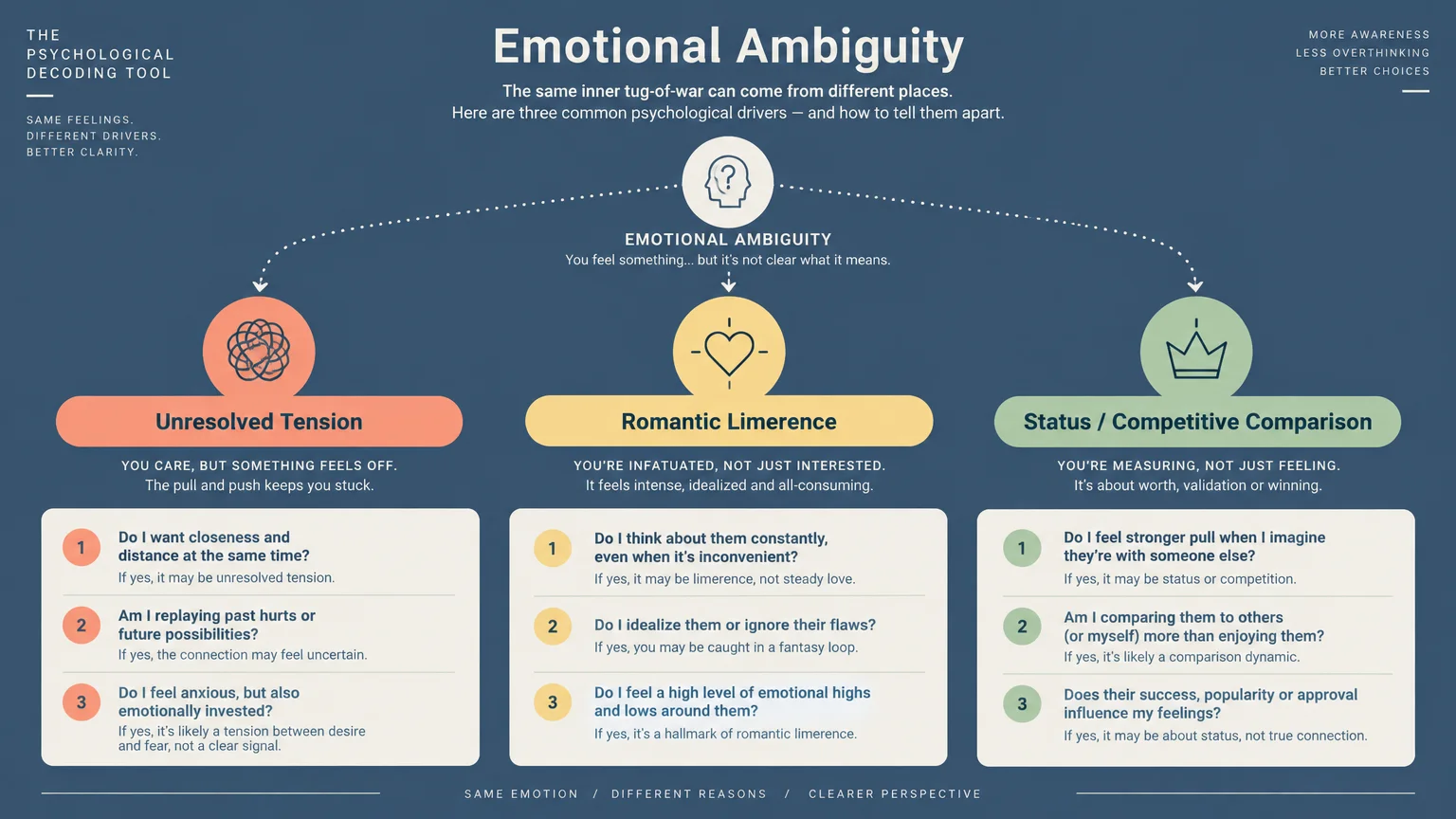
Decoding the Motive: Why Someone Can’t Stop Thinking About You
Realizing you live rent-free in someone’s head is flattering, but mental preoccupation is not always romantic. People fixate on others for several distinct psychological reasons, ranging from genuine affection to competitive friction.
Before you decide how to respond, evaluate the broader context of their behavior. Use the comparison table below to distinguish healthy emotional connection signs from limerence, unresolved friction, or ego-driven attention.
| Type of Preoccupation | Core Psychological Driver | How They Behave Around You | Healthy Way to Respond |
|---|---|---|---|
| Genuine Emotional or Romantic Connection | Curiosity, shared values, and mutual appreciation for who you actually are. | Consistent warmth, active listening, follow-through on plans, and respect for your boundaries. | Reciprocate their bids for connection and suggest intentional one-on-one time. |
| Limerence and Idealization | Dopamine craving and fantasy projection; using your image to regulate their own mood. | Intense hot-and-cold swings, nervous pedestal-placing, and anxiety if you don’t reply instantly. | Stay grounded, communicate clear expectations, and avoid feeding unrealistic fantasies. |
| Unresolved Friction or Envy | The Zeigarnik effect triggered by bruised ego, workplace rivalry, or an unfinished argument. | Backhanded compliments, obsessive social media watching, or bringing up old disagreements. | Address lingering workplace or social tension directly, or maintain polite emotional distance. |
| Ego-Driven Breadcrumbing | Validation-seeking; keeping you on an emotional hook without wanting real commitment. | Sporadic late-night messages and nostalgic callbacks paired with excuses whenever you suggest meeting up. | Match their investment to their actions rather than their words, and protect your time. |
As psychotherapist Esther Perel notes in her work on modern relationships, human desire thrives on mystery and the space between two people.
“Love rests on two pillars: surrender and autonomy. Our need for togetherness exists alongside our need for separateness.” — Esther Perel, Psychotherapist and Author
When someone respects your autonomy while leaning toward togetherness, their preoccupation feels warm and steady. When their preoccupation stems from insecurity or control, it feels pressuring, erratic, or draining.

Patterns to Watch For
When trying to read signs someone thinks about you, your own psychology can easily cloud your judgment. Human brains are wired to find patterns—even when those patterns exist primarily in our own wishes or fears.
Watch out for these three common cognitive traps before drawing firm conclusions about someone else’s inner world.
1. The Projection Trap and Confirmation Bias
Sometimes you suspect you are living rent-free in someone’s head simply because they are living rent-free in yours. When you spend hours analyzing someone’s texts, confirmation bias forces you to over-interpret neutral behaviors.
For example, seeing their name at the top of your social media story viewers does not automatically mean they are refreshing your profile all day. Algorithms sort viewer lists based on your own engagement habits—meaning they appear at the top because you frequently click on their profile.
2. Confusing Anxious Protest Behavior with Deep Love
In attachment psychology, people with an anxious attachment style often experience intense preoccupation whenever they sense emotional distance. If someone texts you repeatedly only when you pull away, they are reacting to separation anxiety rather than steady affection.
Once you reassure an anxiously attached person or give them your full attention, their intense focus may suddenly evaporate—especially if they lean toward fearful-avoidant dynamics. Look for steadiness when things are calm, not just intensity when things feel uncertain.
3. Mistaking Digital Orbiting for Real Investment
Sociologists and dating researchers use the term “orbiting” to describe someone who cuts off direct communication yet continues watching every story, liking old posts, or viewing your LinkedIn profile. According to relationship experts at the Cleveland Clinic, ambiguous digital habits often create emotional exhaustion when they lack real-world follow-through.
Yes, an orbiter is thinking about you, at least for a few seconds at a time. However, passive surveillance costs zero vulnerability; never equate a tap on a screen with the courage required to show up in your life.

How to Respond Based on What You Actually Want
Once you spot multiple behavioral signs that someone can’t stop thinking about you, the next move belongs to you. Uncertainty keeps both people stuck in an exhausting guessing game, whereas clear communication shifts the dynamic forward.
If You Want to Deepen the Connection
If the feeling is mutual, stop waiting for them to make a grand confession and reward their subtle bids instead. People often hide behind micro-signals because they fear rejection; lowering the barrier to entry helps them step forward with confidence.
- Enthusiastically receive their bids: When they send a “pebble” or bring up an old detail you shared, respond with warmth and ask an open-ended follow-up question.
- Name the connection lightly: Use playful, low-pressure candor such as, “I love that you remembered that—clearly we need to continue this conversation over coffee this week.”
- Offer your own micro-recall: Mention something specific they taught you or a recommendation of theirs you tried, showing that the mental space is mutual.
If You Value the Friendship or Work Relationship Only
Sometimes you realize a coworker, client, or platonic friend has developed a one-sided fixation on you. You can preserve their dignity and protect the relationship by setting warm, unambiguous boundaries early.
- Avoid feeding late-night or overly intimate bids: Reply to non-urgent evening messages during normal daytime hours to subtly reset expectations.
- Use inclusive, group-oriented language: Shift one-on-one invitations toward group settings, or casually mention your partner or dating life in natural conversation.
- Keep praise focused on shared tasks: In professional settings, redirect personal flattery back to collaborative goals and team appreciation.
If You Need to Close an Unfinished Loop with an Ex
If an ex-partner or former situationship keeps popping up with nostalgic callbacks, the Zeigarnik effect is keeping both of you tethered to the past. Unless both of you are ready to address the core issues that ended the relationship, nostalgic breadcrumbs only delay healing.
You can close the mental tab kindly by saying, “I always wish you well, but staying in touch like this keeps me from moving forward, so I need to take space.” Clear closure frees up mental real estate for both of you.

When Self-Help Isn’t Enough
Most of the time, wondering whether someone thinks about you is a normal, harmless part of navigating romance and friendship. In certain situations, however, mental preoccupation crosses the line into distress that benefits from professional support.
- Your own preoccupation disrupts daily life: If decoding someone else’s subtle signs consumes hours of your workday, ruins your sleep, or triggers panic whenever they don’t text back, working with a therapist trained in attachment theory or cognitive behavioral therapy (CBT) can help you reclaim your focus.
- You are stuck in a painful on-again, off-again cycle: When two people stay locked in mutual limerence for months or years without building a stable relationship, couples counseling or individual relationship therapy helps uncover the deeper fears blocking commitment.
- Someone’s fixation feels intrusive or unsafe: If another person’s preoccupation escalates into unwanted showing up at your home or workplace, relentless messaging after you asked for no contact, or monitoring your movements, trust your instincts immediately. Document their behavior, lean on local safety resources, and seek professional and legal guidance.
- Past relational trauma makes neutral cues feel threatening: If hypervigilance from past toxic relationships forces you to constantly scan others’ moods and thoughts to stay safe, trauma-informed therapies like EMDR or somatic experiencing can help calm your nervous system.
Frequently Asked Questions
Can you intuitively feel when someone is thinking about you?
While popular culture romanticizes telepathic connection, psychology explains that “sixth sense” through subconscious pattern recognition. Your brain quietly registers micro-expressions, shifts in texting cadence, and eye contact during shared moments, surfacing those clues later as an intuitive gut feeling or dream.
Why does someone keep checking my social media if they never reach out?
Consistent profile viewing without direct outreach usually stems from curiosity mixed with fear of rejection, unresolved nostalgia, or avoidant attachment. Watching from a distance allows them to feel connected to your life without risking the vulnerability or accountability of a real conversation.
How do shy or avoidant people show you’re in their head?
Shy or avoidant individuals rarely use direct verbal flattery when they think about you. Instead, they show preoccupation through thoughtful acts of service, remembering tiny details about your preferences, hovering near your physical space in groups, and following up on topics weeks later.
How long does someone stay rent-free in a person’s mind?
The duration depends on whether the emotional loop stays open or reaches resolution. According to research on the Zeigarnik effect and limerence, intermittent contact and ambiguity can keep someone in a person’s thoughts for months or years, whereas clear communication or consistent boundaries help the fixation fade naturally.
Moving From Guesswork to Genuine Connection
Spotting the signs that you live rent-free in someone’s head gives you valuable insight into how your presence impacts others. Whether they remember your coffee order from a month ago or send you mid-week reminders of an inside joke, those moments reflect a mind that values your company.
Instead of staying stuck in endless analysis, use these behavioral clues as a bridge toward honest communication. When you pair emotional awareness with the courage to ask for what you want, you transform silent preoccupation into real, lasting connection.
The information in this article is meant for educational purposes and general guidance. It does not replace individual therapy, counseling, or medical treatment.
If you or someone you know is in crisis, contact the 988 Suicide & Crisis Lifeline by calling or texting 988.
Last updated: February 2026. Psychology research evolves continuously—verify current findings with professional sources.









Leave a Reply