

Guilt acts as an internal alarm system, signaling when your actions clash with your deeper moral compass. While this complex emotion evolved to help humans maintain vital social connections, recognizing its subtle manifestations in others often requires looking past their words to notice sudden behavioral shifts. People rarely announce their remorse directly; instead, guilt leaks out through avoidance patterns, overcompensation, defensive outbursts, or specific body language cues. Understanding these hidden indicators empowers you to navigate delicate interpersonal dynamics with empathy rather than jumping to conclusions. By learning to decode the psychological and physical signs of a guilty conscience, you can foster deeper understanding, address underlying conflicts constructively, and ultimately strengthen your most important relationships.

The Psychological Anatomy of a Guilty Conscience
Before examining the behavioral signs of guilt, it helps to understand what is happening inside the mind of someone carrying it. According to the American Psychological Association, guilt is a self-conscious emotion characterized by a painful appraisal of having done—or thought—something wrong. Unlike fear, which is typically a response to an external threat, guilt is an entirely internal mechanism. It forces an individual to hold a psychological mirror up to their own actions, often resulting in profound discomfort.
Interestingly, this emotion does not just live in the mind; it manifests physically. In a fascinating study on embodied cognition published in the journal PLOS ONE, psychology researchers from Princeton University and the University of Waterloo discovered that guilt literally weighs people down. Participants who were asked to recall an unethical act reported feeling a subjective increase in their own body weight compared to those who recalled ethical memories. When someone is carrying the “weight of a guilty conscience,” they are experiencing a very real, scientifically documented phenomenon.
Because guilt is so uncomfortable, people naturally try to alleviate the pressure. When they cannot or will not offer a direct apology, that psychological pressure leaks out through their behavior. By observing these behavioral shifts, you can gain insight into the emotional turbulence happening beneath the surface.

7 Behavioral and Psychological Signs of Hidden Guilt
1. Uncharacteristic Overcompensation and “Fixing”
One of the most common behavioral responses to guilt is an intense, sudden drive to repair perceived damage through excessive attempts at reparation. When someone feels they have wronged you, their conscience demands balance. If they are not ready to confess or directly apologize, they will often try to balance the scales through uncharacteristic generosity or helpfulness.
You might notice a partner suddenly bringing home elaborate gifts for no reason, a coworker taking on extra tasks they usually avoid, or a friend offering an overwhelming stream of compliments. While spontaneous kindness is a beautiful aspect of human connection, the context matters. If this behavior represents a sudden, sharp departure from their usual baseline personality—especially if it follows a period of tension or unexplained absence—it may be driven by a desire to soothe their own internal remorse.
2. Defensive Deflection and Unprovoked Anger
Sometimes, the best defense is a good offense. When someone feels guilty, their self-esteem takes a significant hit. To protect their ego from the painful reality of their actions, they might unconsciously project that discomfort outward. If you ask a simple, clarifying question—like “Where were you this afternoon?” or “Did you finish that report?”—a guilty person might erupt with disproportionate anger or defensiveness.
This deflection serves a specific psychological purpose: it changes the subject. By picking a fight or turning the tables to accuse you of being controlling or paranoid, they successfully move the spotlight off their own actions. Psychology Today experts frequently note that individuals struggling with a guilty conscience will often hyper-focus on the flaws of others to minimize their own internal feelings of inadequacy. If you find yourself frequently apologizing after simply asking for basic information, you may be dealing with someone deflecting their own hidden guilt.
3. Specific Body Language Cues (Neck-Touching and Slumping)
While pop psychology often claims that a lack of eye contact is the ultimate sign of deception or guilt, clinical research paints a much more specific picture. A comprehensive study examining the non-verbal signals of guilt found that feelings of remorse are most closely associated with two specific physical actions: frowning and neck touching.
Additional research into self-conscious emotions reveals that people experiencing guilt often adopt a diminished posture. They may slump their shoulders, pull their arms inward toward the midline of their chest, and tilt their head downward—unconsciously trying to make themselves appear physically smaller to avoid scrutiny. While gaze aversion can certainly be a factor, it is the combination of this collapsed posture, frequent neck-touching, and agitated, restless movements that provides a much stronger indicator of internal emotional distress.
4. The Weight of Avoidance and Emotional Withdrawal
When someone feels guilty about how they have treated you, your very presence acts as a psychological trigger. Looking at you reminds them of the values they compromised. As a result, they may initiate a pattern of avoidance and emotional withdrawal.
This avoidance can manifest physically, such as leaving the room when you enter, suddenly changing their routine to avoid crossing paths with you, or canceling plans at the last minute. It can also manifest emotionally; they might remain in the same room but become completely closed off, offering only one-word answers and avoiding meaningful conversation. If an otherwise warm and communicative relationship suddenly feels like an empty shell without a clear catalyst, underlying guilt is a strong potential culprit.
5. Over-Explaining and Excessive Justification
Silence feels deafening to a guilty conscience. When people feel secure in their actions, they usually offer brief, straightforward answers to questions. Conversely, when someone is trying to mask a transgression or convince themselves that they did nothing wrong, they tend to over-explain.
If you ask a friend why they missed your dinner party, and they launch into a highly detailed, five-minute monologue involving multiple sub-plots, traffic patterns, and minor inconveniences, pay attention. This excessive justification is often a sign of a guilt complex; the person is trying to build a watertight case for their innocence, hoping that a mountain of details will obscure the reality of their choices.
6. Hypersensitivity to Innocent Remarks
A person carrying hidden remorse views the world through a lens of paranoia. Because their guilt is at the forefront of their mind, they assume it is at the forefront of yours, too. This leads to severe hypersensitivity, where entirely innocent comments are interpreted as pointed accusations.
For example, if you make a general comment like, “I’ve been feeling so disconnected lately,” a guilty partner might immediately snap back with, “Are you saying I’m not paying enough attention to you?” They hear the accusation they have already been leveling against themselves in their own mind. Their guilty conscience acts like an emotional amplifier, turning your neutral observations into perceived personal attacks.
7. Self-Deprecation and Subconscious Self-Punishment
Guilt frequently strips away a person’s sense of self-worth. When people feel they have compromised their morals, they often believe they no longer deserve happiness, comfort, or success. This can lead to persistent self-deprecation, where they frequently put themselves down, call themselves “stupid” or “a terrible person,” or refuse to accept compliments.
In more extreme cases, this manifests as self-sabotage. You might watch someone ruin a perfectly good weekend, pick apart a successful project, or sabotage a healthy dynamic simply because their internal guilt narrative tells them they do not deserve to be happy. They are essentially acting as their own judge and executioner, seeking punishment to alleviate their emotional debt.
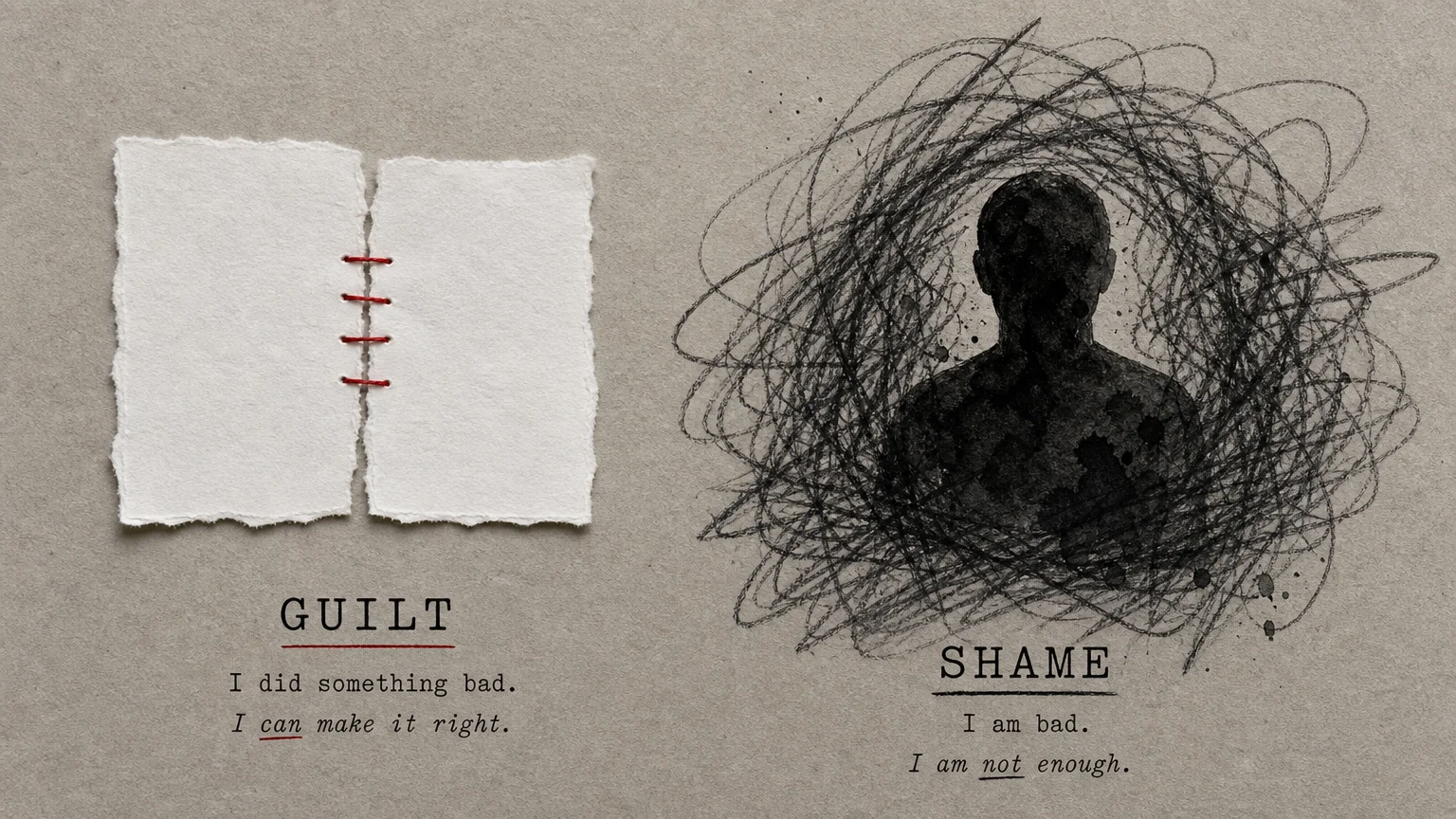
Common Misconceptions: Guilt vs. Shame
To truly understand human behavior, you must separate guilt from its much darker cousin: shame. People often use these terms interchangeably, but psychologists draw a hard line between the two, as they produce vastly different behavioral outcomes.
“The majority of shame researchers and clinicians agree that the difference between shame and guilt is best understood as the differences between ‘I am bad’ and ‘I did something bad.’… Shame is about who we are, and guilt is about our behaviors.” — Brené Brown, PhD, MSW
When someone feels guilt, they are evaluating a specific action. Because actions can be corrected, guilt—while painful—can actually be highly motivating. It encourages apologies, personal growth, and relationship repair. Shame, however, is an attack on identity. When a person feels shame, they believe they are fundamentally flawed and unlovable. This feeling is highly destructive and often drives people toward isolation, addiction, or profound depression as they try to escape the agonizing feeling of being inherently “broken”.
| Emotional Feature | Guilt | Shame |
|---|---|---|
| Core Internal Belief | “I did something bad.” Focuses on a specific behavior. | “I am bad.” Focuses on global identity and self-worth. |
| Primary Response | Proactive. Often leads to a desire to fix the mistake or make amends. | Reactive. Often leads to hiding, anger, or lashing out at others. |
| Impact on Empathy | Increases empathy. The person focuses on how their actions hurt you. | Decreases empathy. The person is consumed by their own internal pain. |
| Long-Term Outcome | Can strengthen relationships if processed and communicated effectively. | Correlates highly with anxiety, depression, and relationship breakdown. |

How to Respond When You Notice These Signs
Spotting the signs of guilt is only half the equation; how you choose to respond can either de-escalate the tension or drive the person further into defensive hiding. If you suspect someone in your life is wrestling with a guilty conscience, consider taking a measured, empathetic approach:
- Do not immediately accuse: Confronting someone with aggressive accusations will likely trigger their defensive reflexes. Instead of demanding a confession, focus on the shifts in their behavior.
- Create psychological safety: People confess when they feel safe, not when they feel cornered. Foster an environment where honesty is valued over perfection. You might say, “I’ve noticed you seem really tense lately, and I want you to know you can talk to me about whatever is going on without judgment.”
- Rely on “I” statements: Frame your observations around your own feelings. Saying, “I feel disconnected from you when you leave the room every time I enter,” is much more effective than, “You are always avoiding me.”
- Ask open-ended questions: Give them the space to fill in the blanks. Questions like, “How have you been feeling about our dynamic recently?” invite a dialogue rather than a defensive yes-or-no response.
- Manage your own boundaries: While empathy is crucial, you are not required to absorb someone else’s emotional outbursts or abusive deflection. If their guilt manifests as anger directed at you, it is entirely appropriate to step away from the conversation until they can communicate respectfully.

Finding the Right Professional Help
While guilt is a normal, healthy part of the human experience designed to keep our moral compass aligned, it can sometimes morph into a chronic, debilitating condition. Excessive, irrational guilt is a recognized symptom of several mental health conditions, including clinical depression, generalized anxiety disorder, and obsessive-compulsive disorder (OCD). For individuals with OCD, guilt can become an obsessive loop, forcing them to constantly ruminate on past mistakes or falsely believe they have caused harm.
Professional therapy becomes highly recommended, and often necessary, in the following scenarios:
- The guilt is entirely disproportionate: The person is emotionally paralyzed by a minor mistake (like a slight miscommunication at work) that was resolved months ago.
- It leads to self-punishment: The individual is denying themselves basic self-care, food, sleep, or joy because they feel they must “pay” for their perceived sins.
- It severely impacts relationships: Their constant need for reassurance or their defensive outbursts are eroding the foundations of their marriage, friendships, or career.
- It transitions into shame: The narrative has shifted from “I made a mistake” to “I am a fundamentally worthless human being,” accompanied by signs of depression or thoughts of self-harm.
Therapeutic approaches like Cognitive Behavioral Therapy (CBT) and Acceptance and Commitment Therapy (ACT) are incredibly effective at helping individuals untangle healthy, productive guilt from toxic, rumination-based guilt. A licensed mental health professional can provide the tools needed to process these heavy emotions and move forward with self-compassion.
For more insights into navigating difficult relationship dynamics, institutions like The Gottman Institute and resources from SAMHSA offer excellent, research-backed guidance on communication and mental well-being.
Emotional intelligence requires a willingness to look beneath the surface. By understanding the heavy, often exhausting reality of a guilty conscience, you can approach difficult relationship moments with a steadier hand. You do not have to excuse bad behavior, but recognizing the signs of guilt allows you to address the root of the problem rather than simply reacting to the symptoms. Ultimately, bringing hidden guilt into the light is the first step toward genuine accountability, forgiveness, and deeper connection.
The information in this article is meant for educational purposes and general guidance. It does not replace individual therapy, counseling, or medical treatment. If you or someone you know is in crisis, contact the 988 Suicide & Crisis Lifeline by calling or texting 988.
Last updated: June 2026. Psychology research evolves continuously—verify current findings with professional sources.








Leave a Reply