

It takes profound vulnerability to say, “I was wrong,” yet many people find these three words nearly impossible to speak. When you struggle to admit mistakes, it rarely stems from malice; instead, it is a psychological shield designed to protect a fragile ego from the crushing weight of shame. Avoiding accountability actively harms your connections. Dr. John Gottman’s research demonstrates that defensiveness—a refusal to take responsibility—is a primary predictor of relationship failure. Uncovering why you dodge responsibility helps you break the cycle of self-justification and cultivate intellectual humility. By recognizing your defensive patterns, you can transform conflict into an opportunity for profound personal growth and deeper emotional intimacy.
The Psychology Behind the Resistance
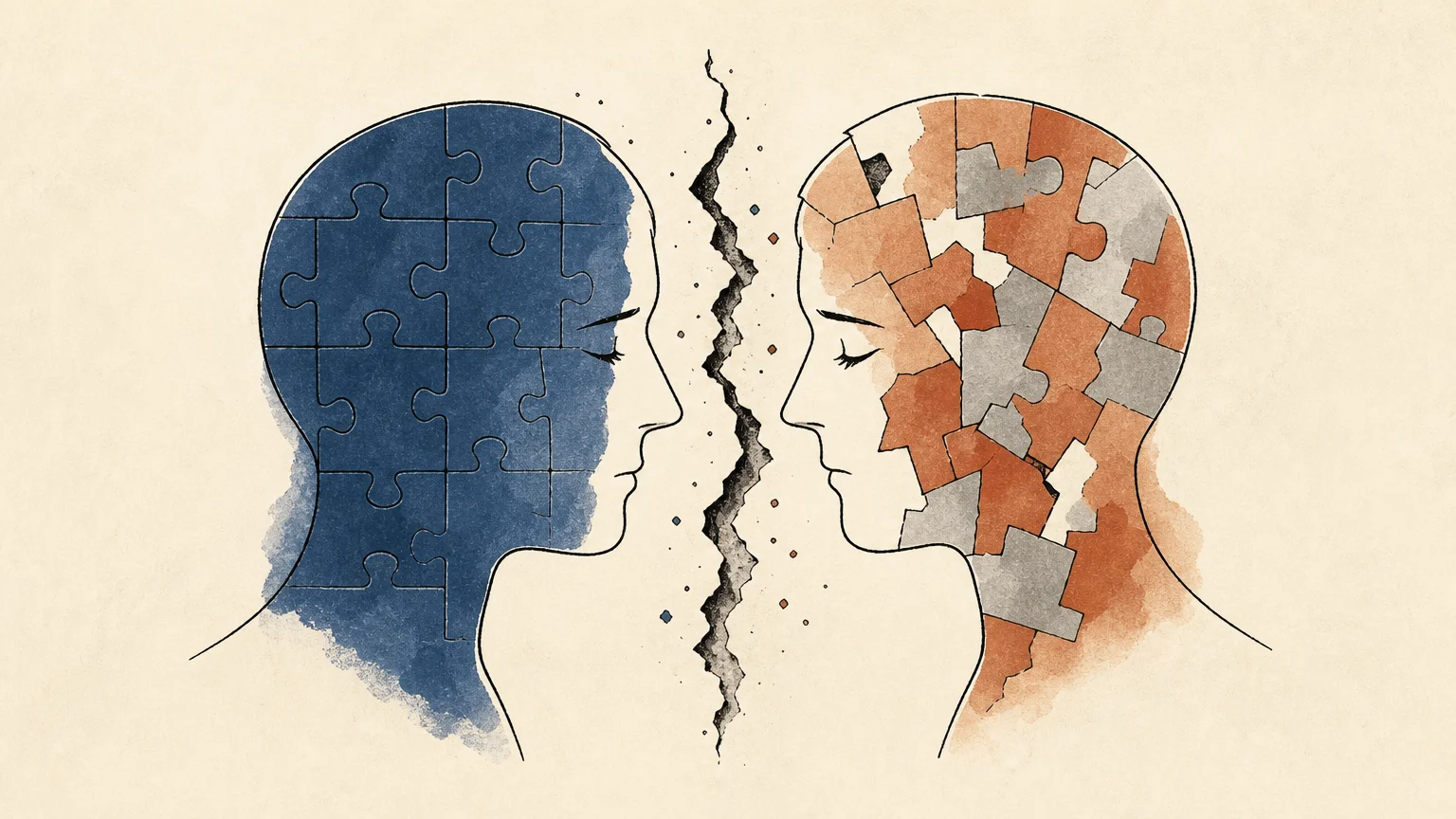
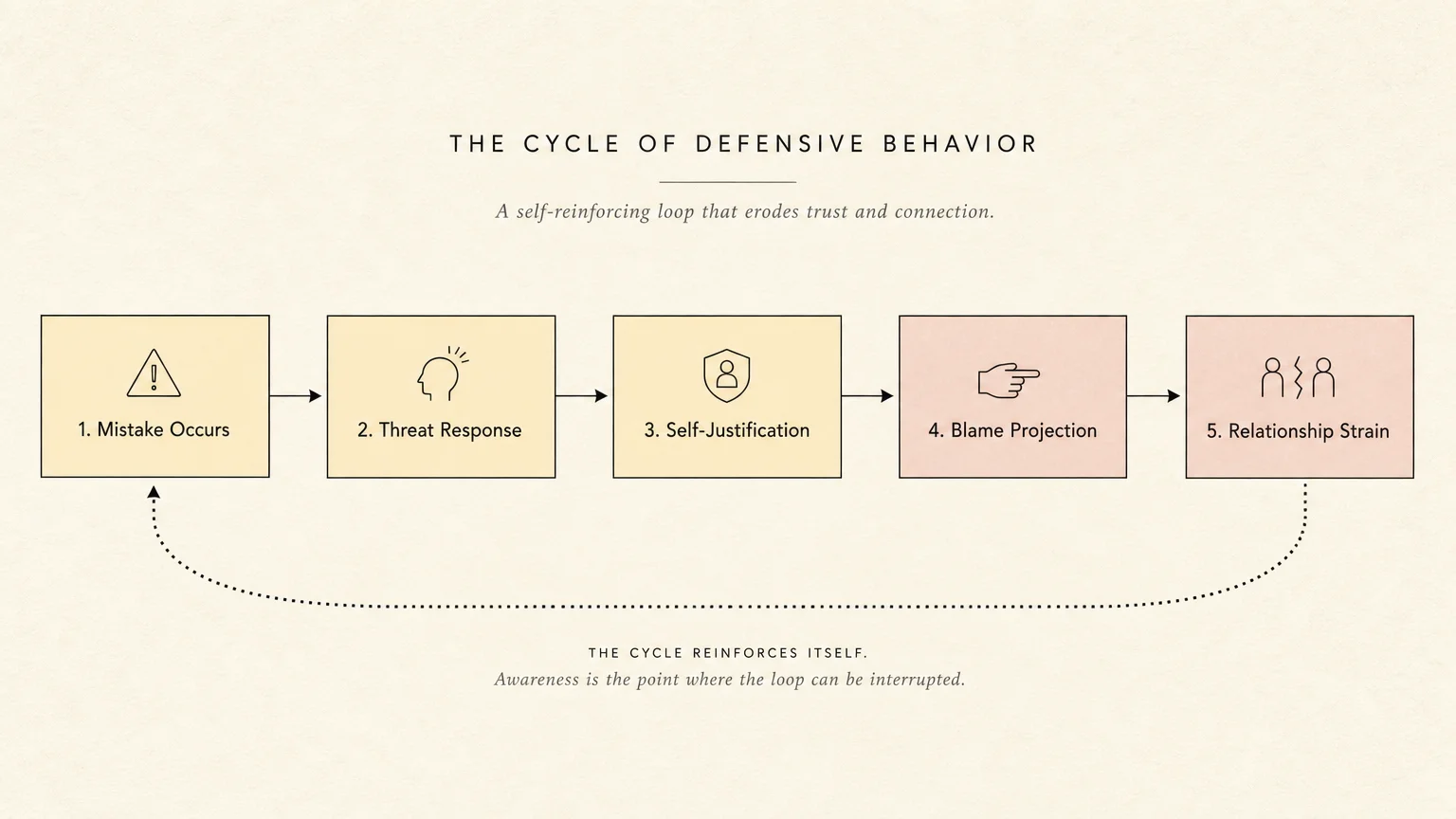
Understanding why you struggle to admit mistakes requires looking beneath the surface of everyday stubbornness. At its core, the inability to take accountability is rarely about the specific mistake you made; rather, it is about what that mistake represents to your self-concept. When you view yourself as a competent, intelligent, and moral person, making a poor decision creates a state of intense psychological discomfort. Psychologists refer to this internal tension as cognitive dissonance.
To resolve this dissonance, your brain must make a subconscious choice: either update your self-concept to include the reality that you are fallible, or twist the facts of the situation to maintain your original self-image. Because accepting fallibility triggers vulnerability, the brain often defaults to self-justification. You unconsciously rewrite the narrative, shifting blame and minimizing impact, all to preserve your psychological safety. Over time, this defense mechanism becomes a rigid behavioral pattern that alienates the people closest to you and prevents genuine emotional connection.

Sign 1: You Rationalize Your Behavior with External Factors
One of the most common signs that you struggle to admit mistakes is a relentless reliance on external factors to explain your behavior. Instead of owning a misstep, you immediately search your environment for a scapegoat. If you are late, it is entirely the fault of the traffic. If you snap at your partner, it is because you had a stressful day at work. While external factors absolutely influence our behavior, using them as a blanket excuse prevents you from taking personal responsibility.
This habit is a form of ego preservation. By blaming outside circumstances, you protect yourself from the discomfort of inadequacy. However, this creates a frustrating dynamic for those around you, as they feel you are dodging the reality of your choices. How to pivot: The next time you find yourself listing reasons why a mistake wasn’t your fault, pause. Acknowledge the external factors internally, but out loud, take ownership of your specific action. You can say, “Traffic was terrible, but I should have left earlier. I apologize for keeping you waiting.”

Sign 2: Your Apologies Include a “But”
The conditional apology is a hallmark of someone who struggles with accountability. When you say, “I am sorry I yelled, but you wouldn’t listen to me,” you are not actually apologizing. The word “but” acts as an emotional eraser, entirely negating the remorse that preceded it and shifting the blame right back onto the other person.
This tactic allows you to perform the social expectation of an apology while secretly retaining your sense of righteousness. You get to feel like the bigger person for saying “I’m sorry,” without actually experiencing the vulnerability of being at fault. How to pivot: Practice the art of the period. Deliver your apology and stop talking. “I apologize for raising my voice. It was disrespectful.” Allow the discomfort of the silence to exist without rushing to justify your actions.

Sign 3: You Rely on “Whataboutism” to Deflect
When confronted with a mistake, do you immediately bring up something the other person did wrong in the past? This tactic is known as whataboutism. It is a highly effective, albeit destructive, defense mechanism that immediately derails the conversation. If your partner says, “It hurt my feelings when you dismissed my idea,” and you respond with, “Well, what about last week when you ignored me in front of your friends?”, you have successfully shifted the spotlight off your own behavior.
Whataboutism operates on the flawed premise that someone else’s past mistake cancels out your current one. It turns relationships into scorekeeping exercises rather than partnerships built on mutual growth. How to pivot: Compartmentalize the conflicts. If someone brings up a grievance, focus entirely on that specific issue. If you harbor resentment over a past event, agree to discuss it at a separate time. Say, “I want to address your concern right now and hear why you are upset. We can talk about my feelings regarding last week later.”

Sign 4: Your Body Goes Into Fight-or-Flight Mode
The inability to admit mistakes is not purely cognitive; it is deeply physiological. When someone gently points out an error, you might experience a sudden spike in heart rate, a tightening in your chest, or a flush of heat across your skin. Your nervous system is perceiving the criticism not as a bid for connection or a simple correction, but as a literal threat to your survival.
This fight-or-flight response effectively shuts down the prefrontal cortex—the logical, empathetic part of your brain. When you are flooded with stress hormones, you cannot access the rational thought required to evaluate your behavior objectively. You react defensively because your body believes it is under attack. How to pivot: Learn to recognize your bodily cues. When you feel that surge of heat or tension, ask for a brief pause. Dr. John Gottman’s research suggests that taking a 20-minute break allows your heart rate to return to baseline, enabling you to re-engage in the conversation with a calmer, more open mindset.

Sign 5: You Rewrite History to Justify Your Actions
Memory is notoriously malleable, and when you struggle to admit fault, your brain will unconsciously alter the facts of a situation to cast you in a more favorable light. You might genuinely remember a conversation differently, recalling yourself as calm and reasonable while viewing the other person as aggressive and unstable. This is the danger of self-justification: it literally distorts your perception of reality.
When you rewrite history, you leave the other person feeling incredibly invalidated, a dynamic that can border on unintentional gaslighting. They are left questioning their own reality because you are so steadfast in your altered version of events. How to pivot: Cultivate an openness to the idea that your memory is not a perfect recording. When a dispute arises over how something happened, stop arguing over the details. Focus instead on the emotional impact. You can say, “We seem to remember the conversation differently, but what matters is that you feel hurt, and I want to understand that.”
Sign 6: You Minimize the Impact of Your Behavior
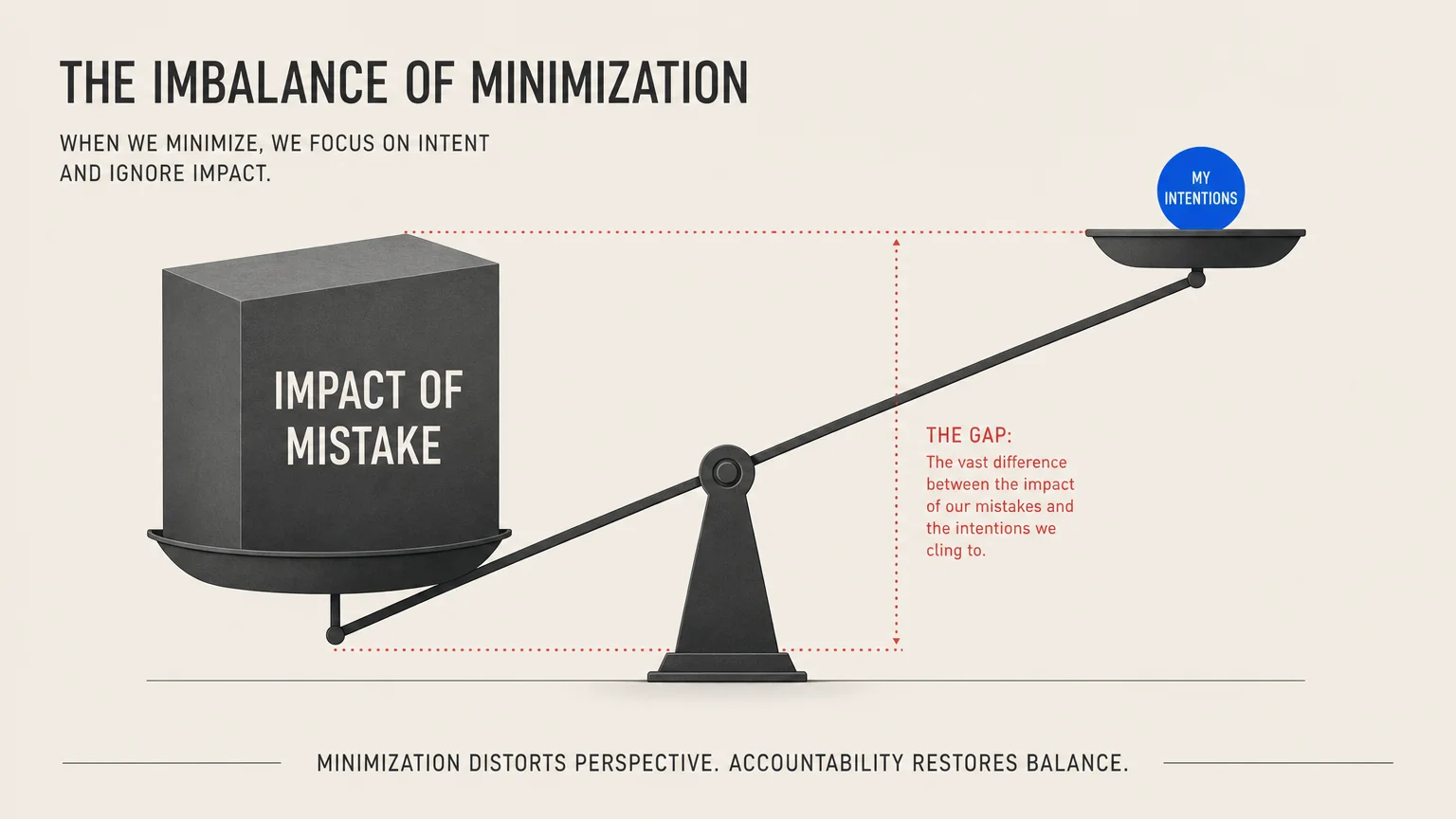
If you cannot deny the mistake entirely, you might resort to minimizing its significance. Phrases like, “It wasn’t a big deal,” “You are overreacting,” or “You need to let it go,” are classic minimization tactics. By shrinking the importance of the event, you shrink your own responsibility to make amends.
Minimization strips the other person of their right to feel hurt. It dictates how they should process the event based entirely on what is most comfortable for you. How to pivot: Accept that you do not get to decide how your actions affect someone else. Impact matters more than intent. Validate their emotional reality by saying, “I didn’t realize how much that affected you, but I hear you, and I understand why you are upset.”
Sign 7: You Equate Being Wrong with Being Unworthy
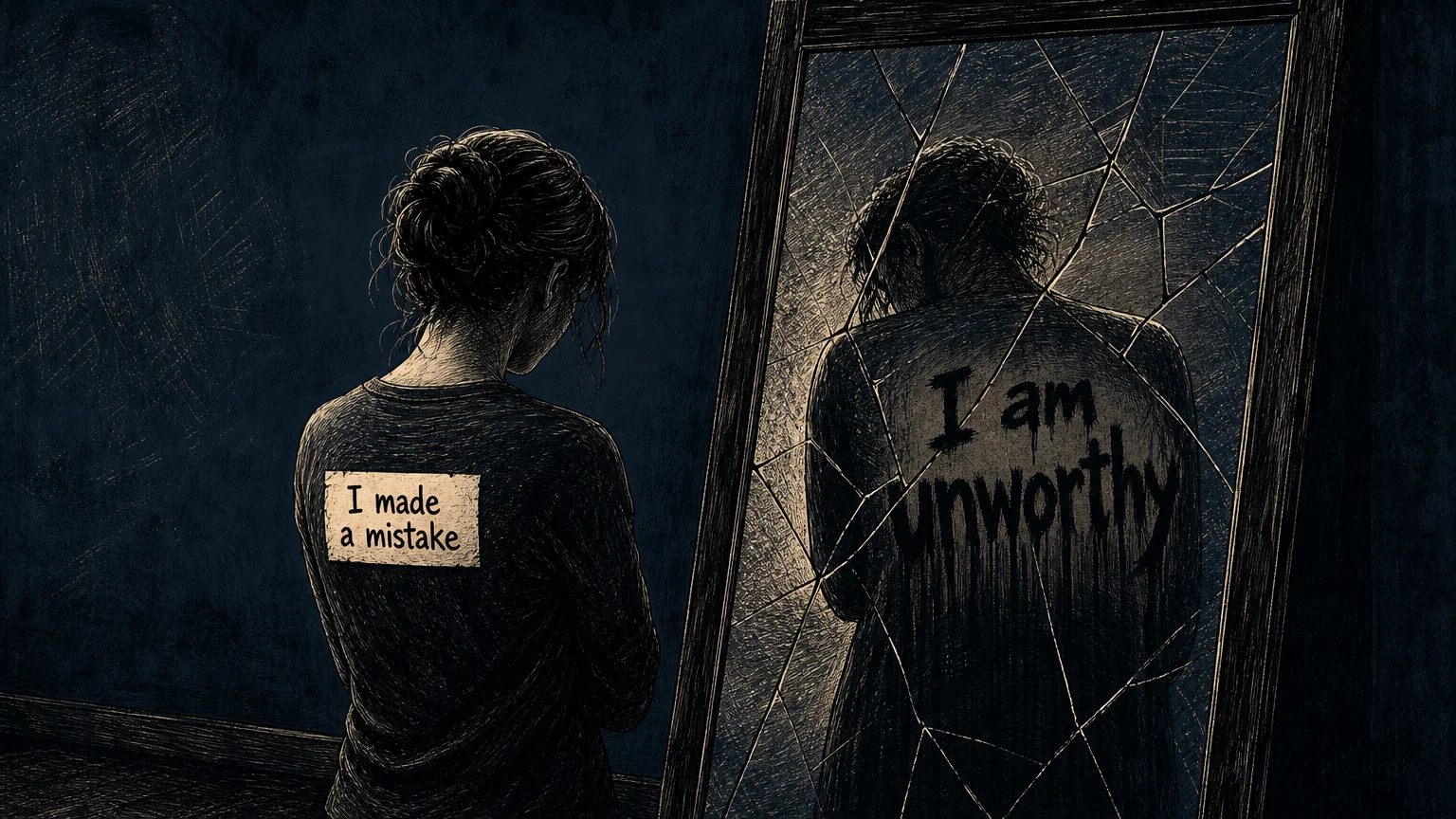
For many people, making a mistake triggers a profound sense of toxic shame. There is a critical psychological difference between guilt and shame. Guilt says, “I did something bad.” Shame says, “I am bad.” If you carry deep-seated shame, perhaps from childhood experiences where affection was conditional or punishment was severe, admitting a mistake feels like an admission of inherent worthlessness.
When accountability feels like a threat to your basic human value, you will fight tooth and nail to avoid it. Healing this pattern requires separating your self-worth from your actions. Making a poor choice does not make you a fundamentally broken person; it simply makes you human.
“The curious paradox is that when I accept myself just as I am, then I can change.” — Carl Rogers, Psychologist

Sign 8: You Lack Intellectual Humility
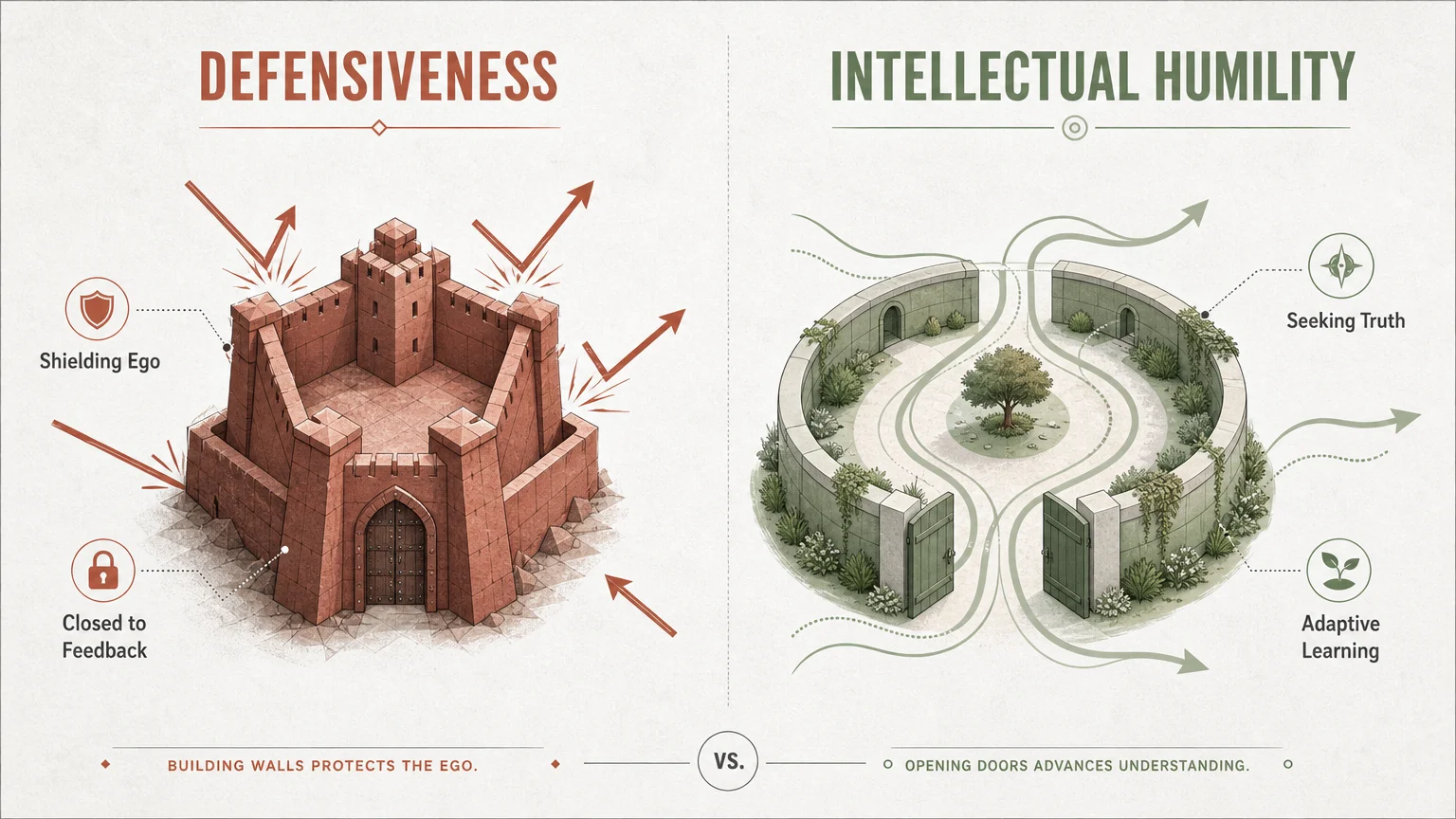
Recent psychological research highlights the crucial role of “intellectual humility”—the recognition and acceptance of the limitations of your own knowledge. If you struggle to admit mistakes, you likely view conversations as debates to be won rather than opportunities for mutual learning. You feel an overwhelming need to be the smartest person in the room, terrified that acknowledging ignorance will lower your social standing.
Individuals with high intellectual humility demonstrate enhanced emotional regulation and a greater ability to accurately assess their own judgments without excessive defensiveness. They do not tie their ego to being right all the time. How to pivot: Actively practice saying, “I don’t know enough about this topic,” or “I might be mistaken.” Normalizing these phrases reduces the pressure to maintain a facade of perfection and invites genuine curiosity into your interactions.

Sign 9: You Stonewall When Confronted
Sometimes, the refusal to admit a mistake does not look like an explosive argument; it looks like total withdrawal. Stonewalling occurs when you completely shut down, give the silent treatment, or physically walk away from the conversation without an explanation. Dr. John Gottman identifies stonewalling as one of the Four Horsemen of communication that predict relationship failure with staggering accuracy.
While stonewalling often feels like a protective measure to keep yourself from saying something worse, to the other person, it feels like abandonment. It communicates a total lack of investment in resolving the issue. How to pivot: If you are too overwhelmed to engage, you must communicate that clearly rather than just disappearing. Say, “I am feeling too overwhelmed to think clearly right now. I need an hour to process this, and then I will come back so we can talk.”
Defensiveness vs. Intellectual Humility
Shifting from a defensive posture to a stance of intellectual humility takes conscious effort. The following table contrasts common defensive reactions with healthier, humble alternatives that foster connection and growth.
| Defensive Pattern | Intellectually Humble Alternative |
|---|---|
| “I’m sorry you feel that way.” | “I apologize for my actions and the pain they caused.” |
| “I only did that because you…” | “I am responsible for how I reacted, regardless of the trigger.” |
| “You’re making a big deal out of nothing.” | “Help me understand why this is so important to you.” |
| “I am not the only one who makes mistakes around here.” | “I want to focus on my behavior right now and hear your feedback.” |
| Shutting down and giving the silent treatment. | Asking for a specific amount of time to cool down before resuming the talk. |
Patterns to Watch For
Our struggles with accountability are often fueled by deeply ingrained cultural and personal misconceptions. Watch out for these false beliefs that might be keeping you trapped in a cycle of denial:
- Misconception: Accountability is a zero-sum game. You might fear that admitting any fault means taking 100 percent of the blame for a complex issue. In reality, multiple people can contribute to a conflict. Owning your 10 percent allows the other person to feel safe enough to own their 90 percent.
- Misconception: Good intentions erase negative impacts. Many people believe that because they meant well, they should not be held responsible for a bad outcome. Empathy requires recognizing that your intentions do not dictate another person’s experience.
- Misconception: Apologizing diminishes your authority. Leaders, parents, and partners often fear that admitting a mistake makes them look weak. Psychological research consistently shows the opposite: vulnerability and intellectual humility significantly increase respect, trust, and psychological safety within groups.

When Self-Help Isn’t Enough
While developing self-awareness is a powerful first step, chronic defensiveness can sometimes require professional intervention. Consider seeking support from a licensed therapist or counselor if you recognize the following scenarios:
- Your inability to admit mistakes has led to a complete breakdown of trust, emotional safety, or intimacy in your primary relationships.
- You catch yourself engaging in chronic gaslighting, making your partner feel as though they are losing their grip on reality.
- Your fear of being wrong is rooted in severe childhood trauma or Complex PTSD, causing debilitating anxiety or emotional flashbacks when criticized.
- You experience intense, overwhelming shame that spirals into depressive episodes or self-harming thoughts when a mistake is brought to your attention.
Frequently Asked Questions
Why do some people physically struggle to apologize?
It is rarely a physical inability; it is a severe psychological block. For individuals who are highly prone to toxic shame, admitting fault feels like a profound threat to their identity and survival. The ego creates a mental wall to prevent the profound distress that an apology would trigger.
How do you communicate with someone who refuses to take accountability?
Focus on using “I” statements that describe your emotional experience rather than “you” statements that sound like accusations. For example, instead of saying, “You never admit when you are wrong,” try, “I feel disconnected and frustrated when we can’t find a shared understanding of what happened.” Set clear boundaries regarding how you are willing to be spoken to during conflicts.
Is the inability to admit mistakes a sign of narcissism?
While an extreme, pervasive inability to admit fault is a trait associated with Narcissistic Personality Disorder, it is also a very common human defense mechanism. Many people who do not have a personality disorder struggle with defensiveness due to insecurity, anxiety, or fragile self-esteem. Context and the presence of other behavioral patterns matter.
Can someone genuinely change if they struggle to admit fault?
Yes. Change is entirely possible when an individual becomes aware of their defensive patterns and actively commits to building emotional intelligence and intellectual humility. Therapy, particularly approaches that focus on emotion regulation and attachment wounds, is highly effective in treating chronic defensiveness.
Admitting your mistakes is not an act of surrender; it is an act of incredible courage. It requires putting down your psychological armor and trusting that you are worthy of love and respect, even when you are imperfect. Start small. Acknowledge a minor misstep without adding a caveat or excuse. Notice the discomfort that arises, breathe through it, and watch how taking responsibility quietly transforms the dynamic between you and the people you care about most. Growth lives on the other side of your ego.
The information in this article is meant for educational purposes and general guidance. It does not replace individual therapy, counseling, or medical treatment. If you or someone you know is in crisis, contact the 988 Suicide & Crisis Lifeline by calling or texting 988. You can also find resources through the American Psychological Association, Psychology Today, or The Gottman Institute.
Last updated: June 2026. Psychology research evolves continuously—verify current findings with professional sources.









Leave a Reply