
You walk away from a routine conversation feeling strangely guilty, confused, and eager to apologize—even though you did nothing wrong. Over time, that quiet disorientation erodes your confidence and keeps you walking on eggshells.
Spotting the signs of a manipulator early protects your mental health and preserves your sense of reality. Psychological research shows that emotional manipulation rarely begins with obvious cruelty; instead, it relies on subtle, repeatable patterns designed to shift power.
Below, you will learn ten evidence-backed psychology red flags, how manipulative behavior differs from healthy conflict, and practical ways to reclaim your boundaries.

What Psychological Research Reveals About Emotional Manipulation
The American Psychological Association (APA) defines manipulation as behavior designed to exploit, control, or influence others to serve one’s own advantage. Rather than using open persuasion, a manipulator hides their true intent behind guilt, confusion, or artificial warmth.
This pattern is far more common in everyday life than many adults realize. According to the Centers for Disease Control and Prevention (CDC) in its early 2026 2023/2024 National Intimate Partner and Sexual Violence Survey (NISVS) Data Brief, psychological aggression affects millions of adults.
In that national survey of 15,609 U.S. adults, 30.2% of women and 22.3% of men reported experiencing psychological aggression by an intimate partner in their lifetime. Within the prior 12 months alone, 3.4% of women and 2.5% of men experienced these behaviors.
Global data confirms the scale of the problem as well. In November 2025, the World Health Organization (WHO) and United Nations partners reported that nearly 1 in 3 women globally—31.6%—have experienced intimate partner or sexual violence, explicitly classifying psychological abuse and controlling behaviors within that framework.
The mental health toll of manipulative behavior is measurable and serious. A systematic review and meta-analysis of 45 studies published in Trauma, Violence, & Abuse found that coercive control correlates significantly with both post-traumatic stress disorder (PTSD) and depression.
Another meta-analysis of 201 studies covering 250,599 women identified lifetime psychological violence as the most prevalent form of partner abuse. Exposure substantially raised the odds of depression, PTSD, and suicidality.
To understand why certain people lean on these tactics, psychologists Delroy L. Paulhus and Kevin M. Williams (2002) studied 245 adults in the Journal of Research in Personality. They identified three overlapping traits called the Dark Triad: Machiavellianism, subclinical narcissism, and subclinical psychopathy.
While these traits differ in style, Paulhus and Williams found they share one core personality link: low agreeableness. People high in these traits prioritize personal gain over empathy, fairness, or mutual trust.
10 Telltale Signs of a Manipulator
Manipulative behavior can appear in romantic partnerships, friendships, families, and workplaces. Paying attention to recurring patterns—not just isolated bad days—helps you separate ordinary human flaws from deliberate control.
1. Gaslighting Your Memory and Reality
The APA Dictionary of Psychology defines gaslighting as manipulating another person into doubting their own perceptions, experiences, or understanding of events. Named after the 1944 film Gaslight, this tactic turns your own memory into the enemy.
A manipulator might insist they never made a promise you clearly heard, or claim you are imagining slights that happened yesterday. They may also label normal emotional reactions as irrational or unstable.
What to watch for: You start keeping screenshots, voice notes, or written logs just to prove to yourself that events really happened. Trust that urge as a clear warning sign.
2. Love Bombing Followed by Sudden Withdrawal
According to the National Domestic Violence Hotline (NDVH), love bombing involves over-the-top displays of affection and attention early in a connection to gain rapid influence. Texts arrive around the clock, compliments feel intoxicating, and future plans move at dizzying speed.
Once you feel emotionally hooked, that intense warmth abruptly cools. The sudden contrast leaves you chasing the version of them you met in week one.
Actionable check: Healthy intimacy builds at a pace that respects your existing routines, friendships, and caution. Anyone rushing closeness while brushing past your boundaries is seeking leverage, not partnership.
3. Using DARVO to Flip Blame
Psychologist Jennifer J. Freyd (1997) coined the term DARVO in Feminism & Psychology to describe a classic deflection sequence: Deny, Attack, and Reverse Victim and Offender. When you raise a legitimate concern, the conversation flips within minutes.
First, the manipulator flatly denies harming you, then attacks your character or motives for bringing it up. Finally, they cast themselves as the injured party so you end up comforting them instead.
Studies by Harsey, Zurbriggen, and Freyd (2017) and Harsey and Freyd (2020, 2023) involving 230 participants showed that DARVO increases victim self-blame. Worse, it often tricks outside observers into doubting the person speaking up.
How to respond: Refuse to defend your right to raise an issue. Calmly restate the original topic once, and step away if they keep turning your boundary into an attack.
4. Punishing You With the Silent Treatment
Everyone occasionally needs an hour to cool down during a heated argument, provided they say when they will return. Deliberate silence without explanation, however, serves a very different purpose.
Social psychologist Kipling Williams and his colleagues demonstrated through extensive experiments that ostracism triggers measurable psychological pain. Prolonged silent treatment threatens four fundamental human needs: belonging, self-esteem, control, and meaningful existence.
The NDVH also lists withholding affection or attention as a core emotional abuse tactic. By freezing you out, the manipulator trains you to drop your complaints just to restore basic warmth.
Practical boundary: Distinguish healthy space from silent punishment by asking directly when you can resume the conversation. If silence continues for days as leverage, recognize it as control rather than cooling off.
5. Creating Cycles of Intermittent Reinforcement
If someone were cruel all the time, leaving would feel straightforward. Manipulators keep people invested through unpredictable swings between sharp mistreatment and rare, dazzling generosity.
In a 1993 study published in Violence and Victims, psychologists Donald Dutton and Susan Painter examined 75 women leaving abusive relationships. Building on their 1981 work, they found that a power imbalance paired with intermittent maltreatment strongly predicted persistent emotional attachment after separation.
Psychologists call this dynamic traumatic bonding. Because kindness arrives unpredictably, your brain stays hyper-focused on earning the next good moment.
Reality check: Evaluate the relationship based on its average Tuesday, not its rare high-point apologies. Consistent respect matters far more than dramatic rescues after harm.
6. Isolating You From Support Networks
Manipulative behavior thrives in an echo chamber where no outside voice can challenge distorted narratives. Over time, a controlling person gently or sharply undermines the people who ground you.
They might pick fights right before you see close friends, complain that your family disrespects them, or demand constant updates on your whereabouts. In the CDC’s 2026 NISVS Data Brief, 27.2% of women and 19.5% of men reported experiencing coercive control and entrapment—including isolation and monitoring—in their lifetime.
Warning sign: Notice if you hide normal conversations or shrink your social circle just to keep the peace at home. Reconnecting with one trusted friend immediately restores perspective.
7. Constant Criticism and Expressive Aggression
Sometimes manipulation hides inside barbed jokes, public embarrassment, or relentless nitpicking disguised as helpful feedback. You slowly begin to believe you are too sensitive, disorganized, or flawed to manage without their guidance.
The CDC’s 2026 Data Brief defines this pattern as expressive aggression, which includes insults, humiliation, and mocking in front of others. Roughly 20.4% of U.S. women and 13.1% of U.S. men reported experiencing expressive aggression from a partner in their lifetime.
What helps: Pay attention to how you feel around them compared with how you feel around supportive peers. Chronic shame in one specific relationship usually points to the dynamic, not your character.
8. Moving the Goalposts and Exploiting Guilt
With a manipulator, yesterday’s compromise is never enough to earn lasting peace today. Every time you meet an unspoken demand, the standard quietly shifts further out of reach.
This aligns with what Paulhus and Williams (2002) described as Machiavellianism—strategic deceit and calculated exploitation of others. A manipulator studies your deepest values, such as loyalty or fairness, and weaponizes guilt whenever you hesitate to comply.
Practical step: When a request triggers intense guilt alongside a tight chest, pause before answering. Give yourself twenty-four hours to decide whether you truly want to say yes.
9. Controlling Finances, Time, or Daily Choices
Coercive control often expands into the practical details of everyday life, limiting your independence one small decision at a time. A partner or relative may monitor bank accounts, discourage paid work, dictate clothing, or monopolize shared transportation.
Governments increasingly recognize how devastating these non-physical restrictions are. England and Wales criminalized controlling or coercive behavior under Section 76 of the Serious Crime Act 2015, carrying penalties of up to five years in prison, and Scotland followed in 2019.
In Australia, standalone criminal laws took effect in New South Wales in July 2024 and Queensland in May 2025, with South Australia passing legislation in September 2025 and Victoria assenting in September 2026. In the United States, Hawaii holds a standalone criminal statute, while states including California (via SB 1141 in 2021), Colorado, Connecticut, Massachusetts, New Jersey, and Washington recognize coercive control in civil and family courts.
Actionable safeguard: Protect independent access to your own identification, bank account, and private communication devices whenever possible. Financial and logistical autonomy remain vital anchors of safety.
10. Refusing Accountability While Playing the Victim
Healthy adults make mistakes, feel remorse, and adjust their behavior without turning repair into a performance. A manipulator treats accountability like a threat to their superiority.
Reflective of subclinical narcissism in the Dark Triad framework, they may offer hollow non-apologies—blaming your reaction, their childhood stress, or impossible circumstances. Soon you find yourself comforting them for the hurt they caused you.
Decision aid: Watch actions over the thirty days following an apology rather than focusing on emotional speeches in the moment. Real remorse shows up as changed behavior.
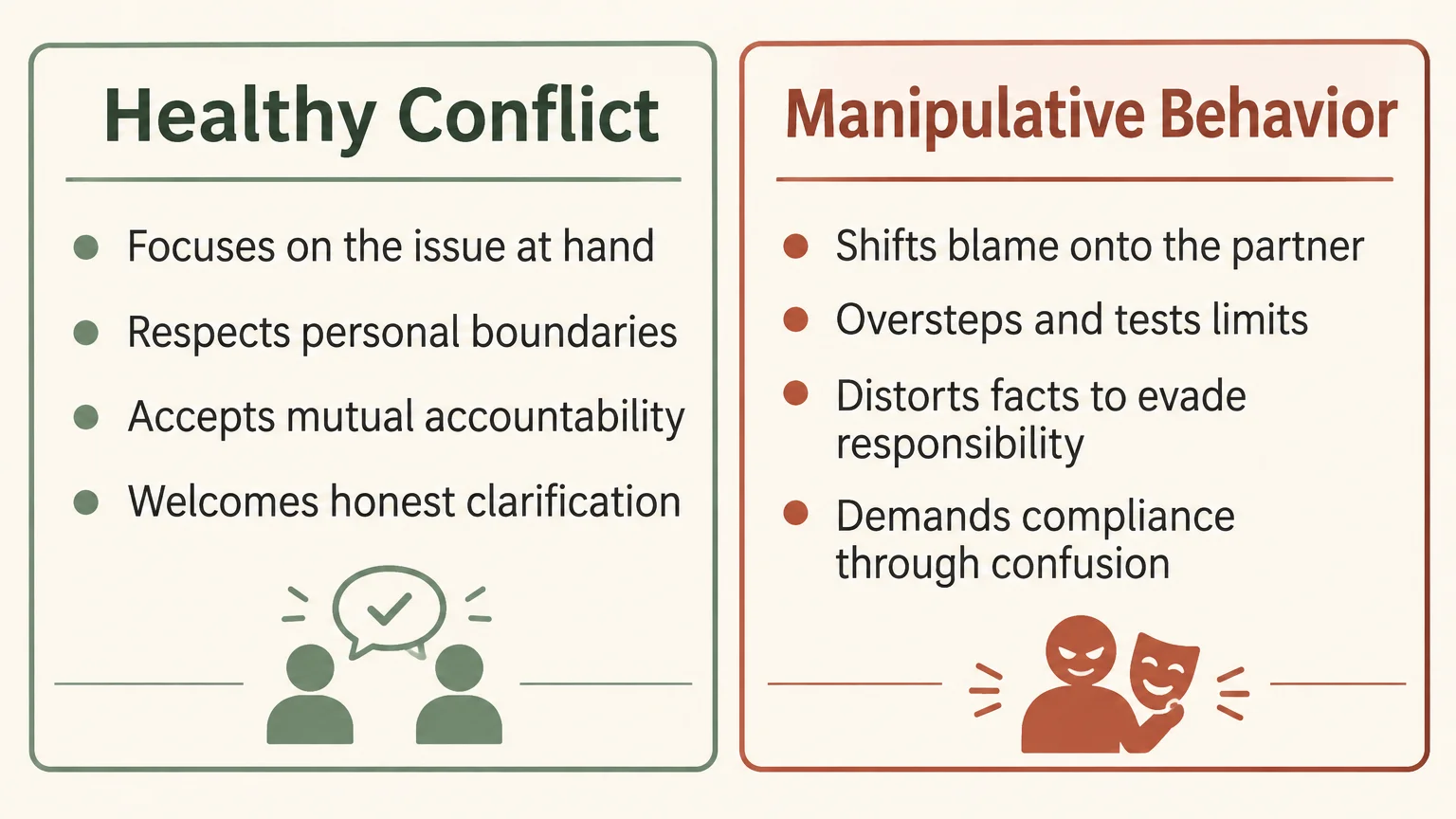
Healthy Conflict vs. Manipulative Behavior: A Quick Comparison
Every close relationship hits rough patches, misunderstandings, and moments of defensiveness. Comparing everyday friction against chronic manipulative behavior helps you judge what you are truly facing.
| Relationship Dimension | Healthy Influence & Conflict | Manipulative Behavior |
|---|---|---|
| Accountability | Owns mistakes clearly and works to repair trust. | Uses DARVO, blame-shifting, or vague non-apologies. |
| Boundaries | Respects your no without sulking or retaliation. | Tests limits repeatedly or punishes you with silence. |
| Affection & Warmth | Steady, predictable, and grounded in mutual care. | Intense love bombing followed by abrupt withdrawal. |
| Disagreements | Focuses on solving the specific problem together. | Attacks your character, memory, or sanity instead. |
| Outside Relationships | Encourages your friendships, family ties, and hobbies. | Criticizes your support system and monitors your time. |
| Emotional Aftermath | Leaves you feeling heard, safe, and respected. | Leaves you anxious, guilty, confused, and drained. |
Pay closer attention to how your nervous system feels after a conversation than to how persuasive the other person sounded during it.
Confusion, chronic self-doubt, and exhaustion are valuable pieces of psychological data. When someone repeatedly benefits from your disorientation, the pattern is rarely accidental.

Common Misconceptions About Manipulative Behavior
Myths about toxic relationships keep many thoughtful people stuck far longer than they realize. Clearing up these misunderstandings makes it easier to trust your instincts early.
- Misconception 1: Manipulation only happens in romantic couples. Emotional manipulation appears in parent-adult child dynamics, friendships, peer groups, and workplaces wherever power imbalances and low agreeableness intersect.
- Misconception 2: You would spot a manipulator right away. Skilled manipulators begin with charm, attentive listening, and generosity, revealing controlling habits gradually once emotional investment is already high.
- Misconception 3: Abuse always involves shouting or physical violence. Research documents that non-physical coercive control, isolation, and psychological aggression cause severe mental health harm without leaving bruises.
- Misconception 4: Staying means someone is weak or gullible. Research on traumatic bonding by Dutton and Painter (1993) shows that intermittent warmth and power disparities create powerful psychological conditioning that makes leaving deeply complex.
Recognizing these dynamics removes misplaced shame from the person being targeted. Manipulation works precisely because it exploits normal human empathy and loyalty.
Practical Steps to Protect Your Boundaries
Once you spot psychology red flags, moving from confusion into calm action puts control back in your hands. Start small, stay observant, and prioritize your physical and emotional safety first.
- Keep a private, factual record. Write down dates, exact statements, and how agreements change over time in a password-protected note so gaslighting cannot rewrite your memory.
- Stop debating distorted narratives. Manipulators often pull you into exhausting arguments about intent; state your boundary plainly without over-explaining or justifying your feelings.
- Reality-check with someone outside the dynamic. Describe one specific incident neutrally to a trusted friend, relative, or counselor to break isolation and regain perspective.
- Set clear behavioral consequences. Decide in advance what you will do—such as ending a phone call or leaving a room—if insults, shouting, or guilt trips begin.
- Build an exit or safety plan if control escalates. Secure copies of vital documents, separate emergency funds if feasible, and avoid announcing a breakup in person if you fear retaliation.
If manipulative behavior crosses into threats, monitoring, financial restriction, or intimidation, free confidential help is available around the clock. In the United States, contact the National Domestic Violence Hotline at 1-800-799-SAFE (7233), text START to 88788, or reach Loveisrespect at 1-866-331-9474 for young adults.
Beyond emotional damage, coercive relationships carry steep real-world burdens. A CDC Data Brief citing Peterson et al. estimates lifetime intimate partner violence costs at $103,767 per female victim and $23,414 per male victim, totaling nearly $3.6 trillion nationwide—making early support a crucial investment in your future.

Finding the Right Professional Help
Untangling emotional manipulation on your own can feel overwhelming, especially when self-doubt has lingered for months or years. A licensed mental health professional offers a steady, objective space to rebuild trust in your judgment.
Consider reaching out for professional support in these specific situations:
- Persistent anxiety, depression, or trauma symptoms: Given the strong links between coercive control, PTSD, and depression, evidence-based trauma therapy can help calm hypervigilance and intrusive self-blame.
- Feeling pulled back by traumatic bonding: If you know a relationship harms you yet feel an overpowering urge to return during lonely moments, a therapist can help you break intermittent reinforcement cycles.
- Navigating high-conflict co-parenting or family ties: When cutting contact completely is not possible, counseling provides concrete communication strategies—like minimal, businesslike responses—to limit ongoing manipulation.
- Rebuilding identity after leaving toxic relationships: Therapy helps you recognize old people-pleasing habits, strengthen personal boundaries, and choose healthier connections moving forward.
Look for clinicians trained in trauma-informed care, cognitive behavioral therapy, or relational boundaries through trusted directories such as Psychology Today. You can also explore general mental health treatment guidance through the National Institute of Mental Health (NIMH).
Frequently Asked Questions
Can a manipulator change their behavior?
Genuine change requires sustained accountability, empathy, and long-term professional work rather than brief apologies after conflict. Unless someone consistently respects your boundaries over time without external pressure, protecting yourself remains the safest choice.
How can I tell the difference between manipulation and poor communication?
Poor communication usually involves mutual misunderstandings that improve once both people clarify expectations and apologize. Manipulation follows a one-sided pattern where confusion, guilt, or fear consistently benefits one person at the other’s expense.
Why do I feel guilty when I set boundaries with a manipulative person?
Manipulators often condition partners or relatives to equate personal boundaries with selfishness or betrayal. That lingering guilt is usually a conditioned stress response rather than proof that your limit was unfair.
Is emotional manipulation considered abuse?
Yes, chronic emotional manipulation—such as gaslighting, isolation, financial restriction, and verbal humiliation—falls under psychological aggression and coercive control. Both public health agencies and an expanding number of legal systems recognize these patterns as serious forms of abuse.

Moving Forward With Clarity
Learning to recognize manipulative behavior gives you back something subtle control quietly takes away: trust in your own mind. You do not need dramatic proof or anyone else’s permission to step back from a dynamic that leaves you diminished.
Start by honoring one small boundary this week and reconnecting with someone who respects your voice without conditions. This is educational content based on psychological research and general principles. Individual experiences vary significantly. For personalized guidance, consult a licensed therapist, psychologist, or counselor.
Last updated: November 2026. Psychology research evolves continuously—verify current findings with professional sources.