When someone leaves your text unanswered, you probably assume they moved on without a second thought. Silence feels dismissive; you picture the other person scrolling peacefully while your message hangs in digital limbo.
Groundbreaking research published in late 2026 reveals that non-responders actually feel far worse about their silence than waiting recipients ever predict. People who go quiet rarely act out of cold indifference.
Instead, leaving a message unreturned sparks unexpected guilt and self-reproach, creating a silent friction that damages emotional well-being on both sides of the screen.
The Research: An Invisible Emotional Chasm
A landmark study led by researchers Sophia Li, Coral Zheng, and Juliana Schroeder (2026) examined this dynamic across 1,146 adults. Their findings, published in the Personality and Social Psychology Bulletin, challenge popular assumptions about conversational silence.
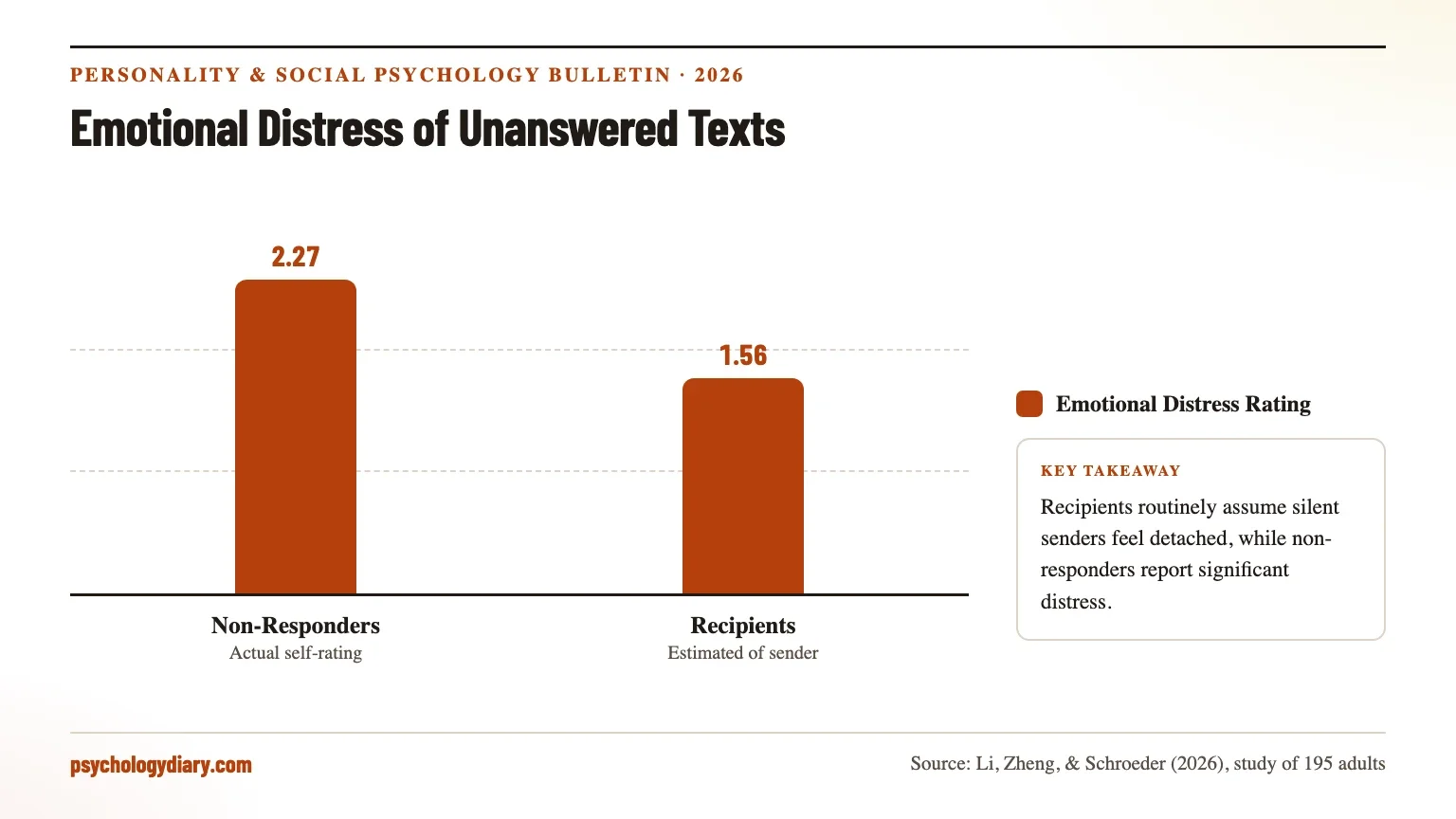
In one experiment involving 195 adults recalling real ghosting incidents, non-responders rated their emotional distress at an average of 2.27 on a 5-point scale. Waiting recipients estimated that number at merely 1.56.
This gap highlights a profound misunderstanding in the psychology of ghosting. While you might interpret silence as uncaring detachment, the person who stopped texting is frequently wrestling with discomfort and regret.
Non-responders accurately anticipated the waiting partner’s hurt, rating it at 2.11 out of 5—matching the exact rating recipients reported. Yet recipients consistently assumed the silent sender felt virtually nothing.
Why Recipients Fall Into the Self-Blame Trap
When a screen goes dark, your brain naturally seeks an explanation. Unfortunately, the mind often directs that uncertainty inward.
In the researchers’ second study of 601 participants, approximately one-third of waiting recipients immediately assumed they had done something annoying to cause the silence. Non-responders, however, rarely held those negative impressions.
Additional research in the Journal of Experimental Psychology: General by YeJin Park and Nadav Klein (2024) uncovered a similar pattern. Recipients regularly underestimate how much ghosters care about their feelings.
Ghosters often delay a reply to avoid delivering an awkward or painful direct rejection. That avoidance backfires, allowing texting anxiety to fester for both parties.
“Clear is kind. Unclear is unkind.” — Brené Brown, PhD, LMSW
The Transformative Power of a Five-Second Text
Repairing this communication rift does not require an essay. The 2026 study tested what happens when senders dispatch a single brief sentence: “Sorry, but I can’t talk right now.”
That minimal message slashed recipient self-blame dramatically. The proportion of recipients assuming they were annoying dropped from one-third down to roughly one in five.
A simple acknowledgment also closed the emotional gap between participants, shifting predicted feelings much closer to reality. It spares your conversational partner from spiraling into unwarranted self-doubt.

Digital Overwhelm and Communication Fatigue
Unanswered texts often have nothing to do with relationship quality. Instead, they reflect modern communication fatigue and digital overwhelm.
According to the American Psychological Association, chronic connectivity significantly amplifies daily stress. When messages pile up across multiple platforms, paralysis easily sets in.
An American Psychiatric Association Healthy Minds poll found that 62% of U.S. adults feel anxious without their phones. Concurrently, 40% are actively attempting to cut back on screen time to protect their peace.
When people feel inundated, replying to even a friendly check-in can feel like an impossible task. You put off replying for an hour, which stretches into days, compounding your guilt.
Perception Versus Reality in Unanswered Texts
Understanding the cognitive divide between senders and recipients can help you navigate digital silence with greater clarity and compassion.
| Waiting Recipient Assumption | Non-Responder Actual Experience | Evidence-Based Reality |
|---|---|---|
| “They do not care about me or my message.” | They feel guilt, sadness, and internal conflict. | Recipients routinely underestimate non-responders’ bad feelings (Li et al., 2026). |
| “I must have said something annoying or offensive.” | They forgot, got distracted, or felt overwhelmed. | Recipients project self-blame that senders rarely feel toward them. |
| “They are ignoring me to assert social dominance.” | They dread crafting the ‘perfect’ response. | Avoidance usually stems from discomfort rather than malice (Park & Klein, 2024). |

How to Break the Texting Avoidance Cycle
If an overflowing inbox triggers your communication fatigue, practical systems can liberate you from perpetual guilt. You can preserve relationships without sacrificing your mental bandwidth.
- Send a neutral placeholder: A quick line like “In the middle of work, will check back Friday” manages expectations instantly.
- Ditch the elaborate apology: Long excuses increase cognitive load; simply address the message warmly and move forward.
- Batch your correspondence: Designate specific 15-minute blocks daily for correspondence rather than staying perpetually on call.
- Embrace voice notes or calls: Transitioning off text eliminates the emotional ambiguity that fuels mutual misinterpretations.
What Can Go Wrong: The Costs of Prolonged Avoidance
Believing that prolonged silence is harmless represents a dangerous relationship mistake. Ignoring messages rarely dissolves tension; it magnifies it.
A 2023 study in the Journal of Social and Personal Relationships found that ghosting deprives people of core psychological needs. Being ghosted severely undermines belonging, control, and self-esteem compared to direct communication.
Furthermore, lingering unread messages heighten your own chronic stress. Senders who continually avoid replies trap themselves in enduring self-reproach.
When to Seek Professional Support
While digital fatigue touches nearly everyone, extreme avoidance sometimes points toward deeper mental health struggles.
Consulting a qualified mental health provider through directories like Psychology Today or resources at NAMI is recommended if you notice these warning signs:
- Severe social withdrawal where avoiding texts leads to weeks of total interpersonal isolation.
- Intense panic attacks or somatic dread triggered whenever your phone chimes or alerts.
- Professional impairment, such as ignoring crucial workplace communications due to paralyzing fear.
- Pervasive beliefs that any relationship conflict will result in catastrophic abandonment.
Frequently Asked Questions
Why do I feel so guilty when I do not text back?
Unanswered texts linger as unfinished cognitive tasks. Your brain tracks this unresolved social obligation, generating persistent guilt and emotional strain.
Does a short text really reduce someone’s hurt?
Yes. Research shows a five-second note confirms connection and cuts recipient self-blame by nearly half.
How should I respond if someone suddenly ghosts me?
Avoid assuming personal fault. Remind yourself that silence usually reflects the other person’s internal overwhelm rather than your personal worth.
Modern communication makes continuous access effortless, but human emotional bandwidth remains finite. Recognizing the shared vulnerability behind unanswered texts allows you to replace silent resentment with mutual empathy.
This is educational content based on psychological research and general principles; individual experiences vary significantly. For personalized guidance, consult a licensed therapist, psychologist, or counselor.
Last updated: November 2026. Psychology research evolves continuously—verify current findings with professional sources.