

You transition from directing a child’s daily life to relating to an autonomous adult the moment they achieve independence. Even well-intentioned parental remarks can inadvertently fracture emotional safety and breed quiet distance.
Navigating this delicate dynamic requires replacing outdated authority with mutual respect and healthy emotional boundaries. When regular interactions slip into subtle guilt or unsolicited critique, grown kids inevitably pull back to protect their peace.
Discover twelve damaging phrases parents often say to grown children, unpack why they backfire psychologically, and learn supportive alternatives that foster lifelong warmth.
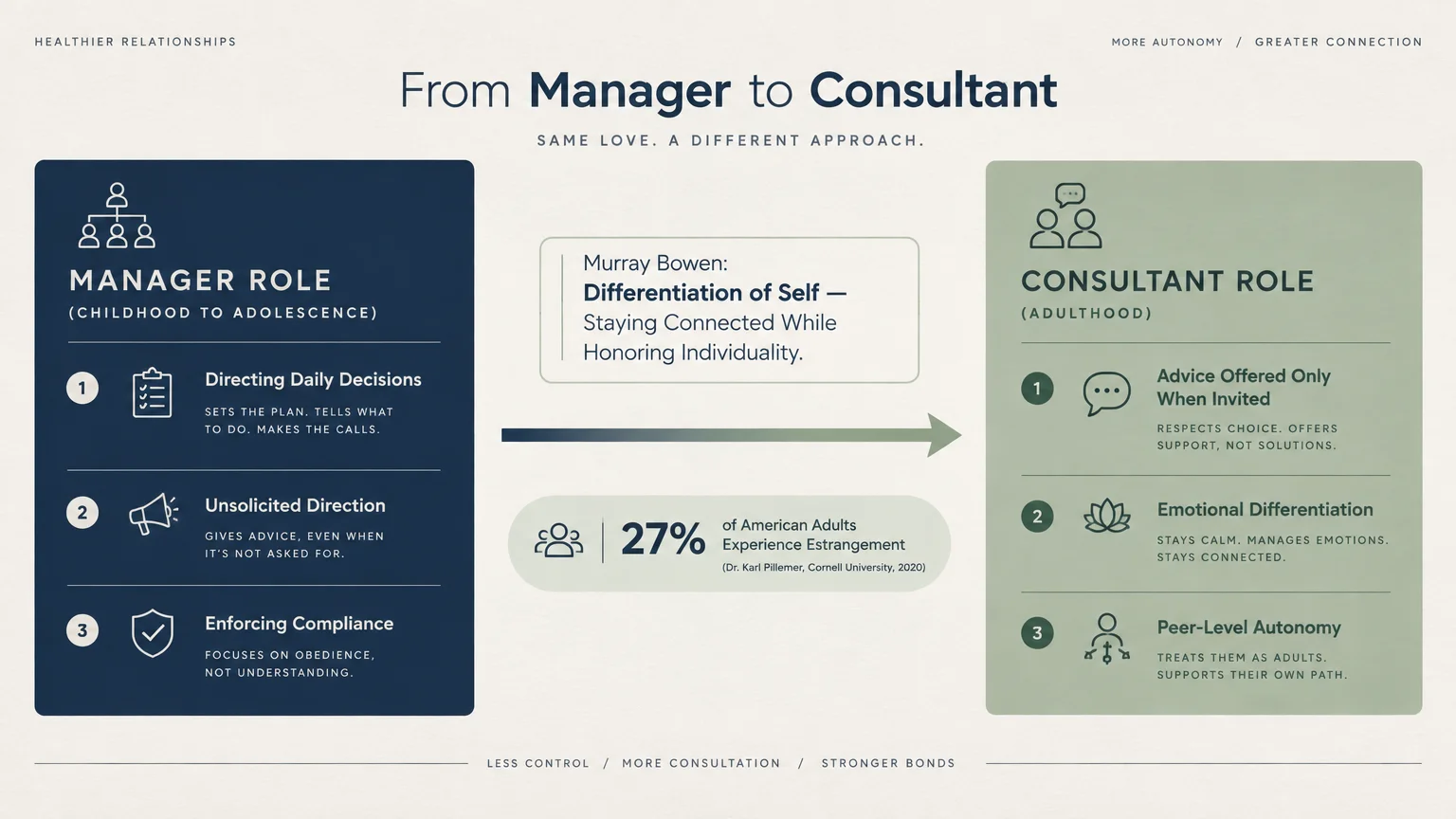
The Psychological Shift from Manager to Consultant
Parenting an adult child demands a fundamental identity shift. You no longer serve as an executive manager overseeing daily decisions; you become an invited consultant.
According to research from Cornell University led by sociologist Dr. Karl Pillemer (2020), approximately 27% of American adults experience family estrangement. Strained communication, unsolicited interference, and unresolved value clashes frequently accelerate these painful ruptures.
Family systems pioneer Murray Bowen emphasized differentiation of self, which describes your ability to stay emotionally connected with family while maintaining your own individuality. When parents refuse to acknowledge differentiation, conversations quickly devolve into control battles.
The American Psychological Association emphasizes that supportive parent-child relationships in adulthood correlate with lower depression rates and greater resilience across both generations. Transitioning to an adult-to-adult dynamic protects this vital lifeline.
“Contempt is the single greatest predictor of relationship breakdown; it conveys disgust and superiority rather than connection.” — John Gottman, Ph.D.
When you speak to adult children with respect rather than superiority, you create an environment where closeness thrives naturally.
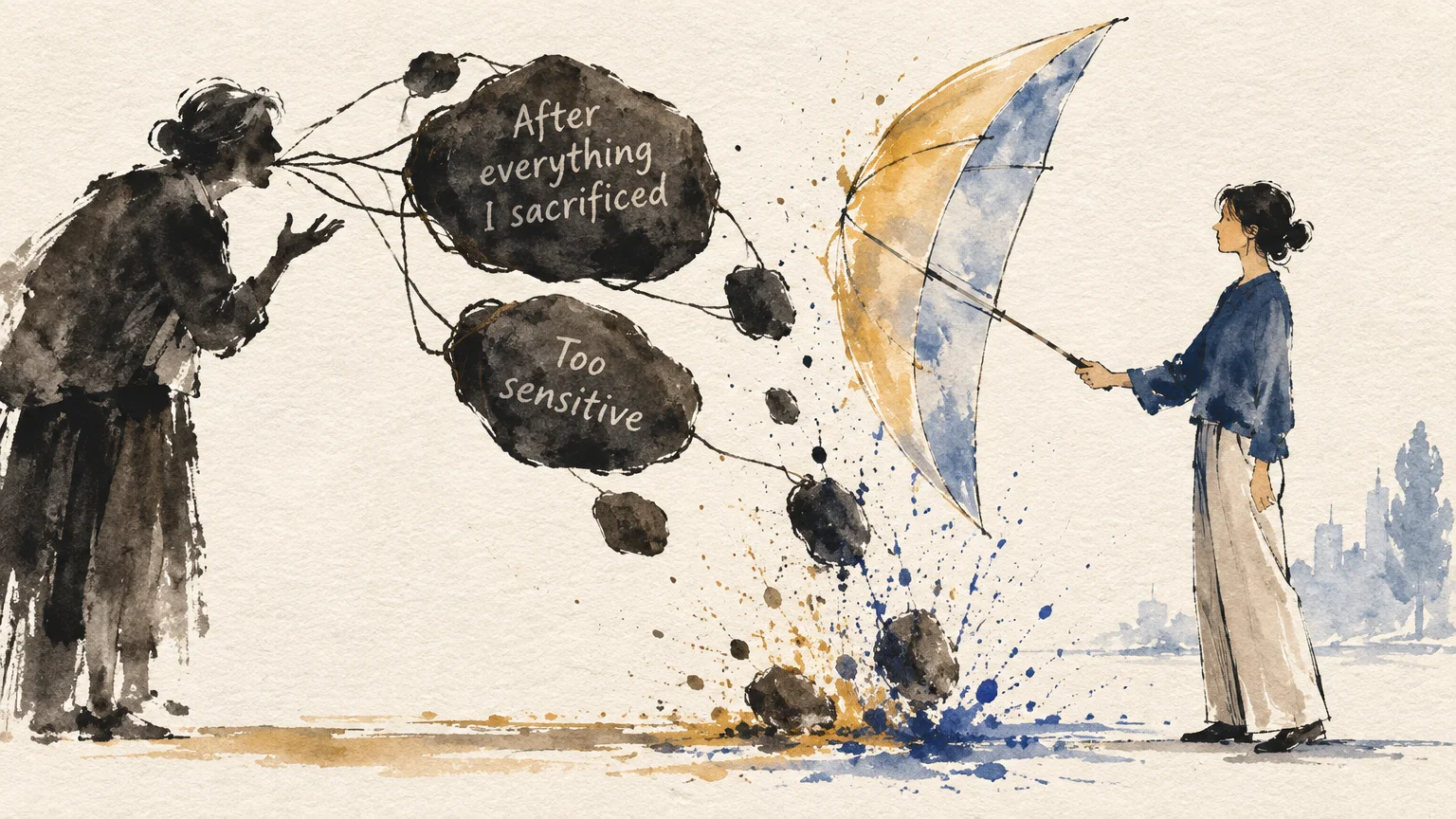
12 Phrases That Damage Parent-Adult Child Relationships
1. “After everything I sacrificed for you, this is how you repay me?”
This phrase weaponizes past parental care as leverage. It transforms your love into an emotional debt that your adult child never agreed to carry.
Sacrifice is an inherent part of raising children. Using past devotion to demand current compliance creates guilt, resentment, and avoidance.
What to say instead: “I want us to find a solution that works for both of us, because our connection matters to me.”
2. “You are being way too sensitive.”
Dismissing your child’s feelings invalidates their lived reality. It communicates that their internal experience is flawed, wrong, or inconvenient to you.
According to The Gottman Institute, emotional invalidation corrodes intimacy and fuels defensive withdrawal. When people feel unheard, they stop sharing altogether.
What to say instead: “I did not realize my words hurt you; please help me understand your perspective.”
3. “When are you finally going to give me grandchildren?”
Inquiring about grandchildren may feel like harmless excitement, but it pressures adult children on deeply personal territory. Reproductive choices involve medical, financial, and emotional complexities you may not see.
Treating family expansion as an obligation to grandparents strips away your child’s bodily autonomy and marital privacy.
What to say instead: “I love seeing you build your life, and I support whatever future you choose for yourself.”
4. “I guess I was just the worst parent in the world.”
This dramatic reaction is a classic conversational derailment tactic. It shifts the focus from your child’s legitimate hurt onto your wounded ego.
Psychologists identify this behavior as an attempt to force the child into comforting the parent. It shuts down constructive dialogue and prevents genuine accountability.
What to say instead: “I made mistakes, and I am willing to hear how my actions affected you.”
5. “Your sibling would never treat me like this.”
Parental comparisons foster toxic sibling rivalry and deep-seated inadequacy. Pitting siblings against one another damages family cohesion and breeds lifelong resentment.
Each child possesses unique temperaments, boundaries, and emotional capacities. Evaluating your relationship with one child through the lens of another erodes trust instantly.
What to say instead: “I want to focus solely on my relationship with you and how we can communicate better.”
6. “You look tired; have you gained weight?”
Unsolicited comments about physical appearance—even masked as concern—inflict shame. Adults already face intense societal pressure regarding physical health and appearance.
When parental interactions begin with visual appraisals, your child feels judged rather than accepted. They will hesitate to visit if every encounter comes with an evaluation.
What to say instead: “It is wonderful to see you. How are you holding up emotionally lately?”
7. “I told you that would happen; you should have listened to me.”
Delivering an “I told you so” during a vulnerable moment prioritizes being right over being supportive. It kicks your child while they are already down.
Adults learn through trial, failure, and self-correction. Undermining their decision-making competence reinforces self-doubt and prompts them to hide future mistakes from you.
What to say instead: “That sounds really tough. What do you think your best next step is?”
8. “I do not care how old you are; I am still your parent.”
Parents often invoke this line to justify crossing personal boundaries or ignoring privacy. While your status as a parent never changes, your authority over an adult does.
Demanding deference based on title alone triggers immediate resistance. Adult relationships thrive on mutual dignity, not parental rank.
What to say instead: “I recognize that you make your own choices, and I want to respect your boundaries.”
9. “Your partner is changing you and pulling you away.”
Attacking your child’s partner directly threatens their primary adult attachment bond. Clinical psychology shows that adults must prioritize their spouse or primary partner to establish a stable foundation.
Forcing your child into a loyalty competition between you and their partner guarantees you will lose. Accept that growth naturally alters priorities.
What to say instead: “I am getting used to our new dynamic, but I want to support your relationship with your partner.”
10. “Why do you never call or visit me anymore?”
Leading with guilt-inducing accusations ensures that future phone calls feel like dreaded chores. Obligation and emotional coercion never cultivate authentic intimacy.
Adult children stay in touch with parents whose presence feels energizing, affirming, and peaceful. Invitations work far better than complaints.
What to say instead: “I always love catching up with you. Let me know when you have a free evening to chat.”
11. “You have no idea what real stress feels like.”
Gatekeeping exhaustion or struggle minimizes your child’s challenges. Comparing economic environments, parenting pressures, or work hours invalidates their very real distress.
Every generation navigates unique economic and cultural pressures. Acknowledging their stress costs you nothing and offers immense emotional comfort.
What to say instead: “You are managing a tremendous amount right now; how can I help lighten your load?”
12. “That never happened; you are imagining things.”
Denying past events or emotional wounds constitutes gaslighting, even when unintentional. Memory is subjective, but your child’s emotional pain is real.
Writing off their childhood memories as fabrications destroys emotional safety. Healing requires hearing their memories without mounting an aggressive legal defense.
What to say instead: “I remember things differently, but I want to listen to how that experience felt for you.”
“Shame corrodes the very part of us that believes we are capable of change.” — Brené Brown, Ph.D.
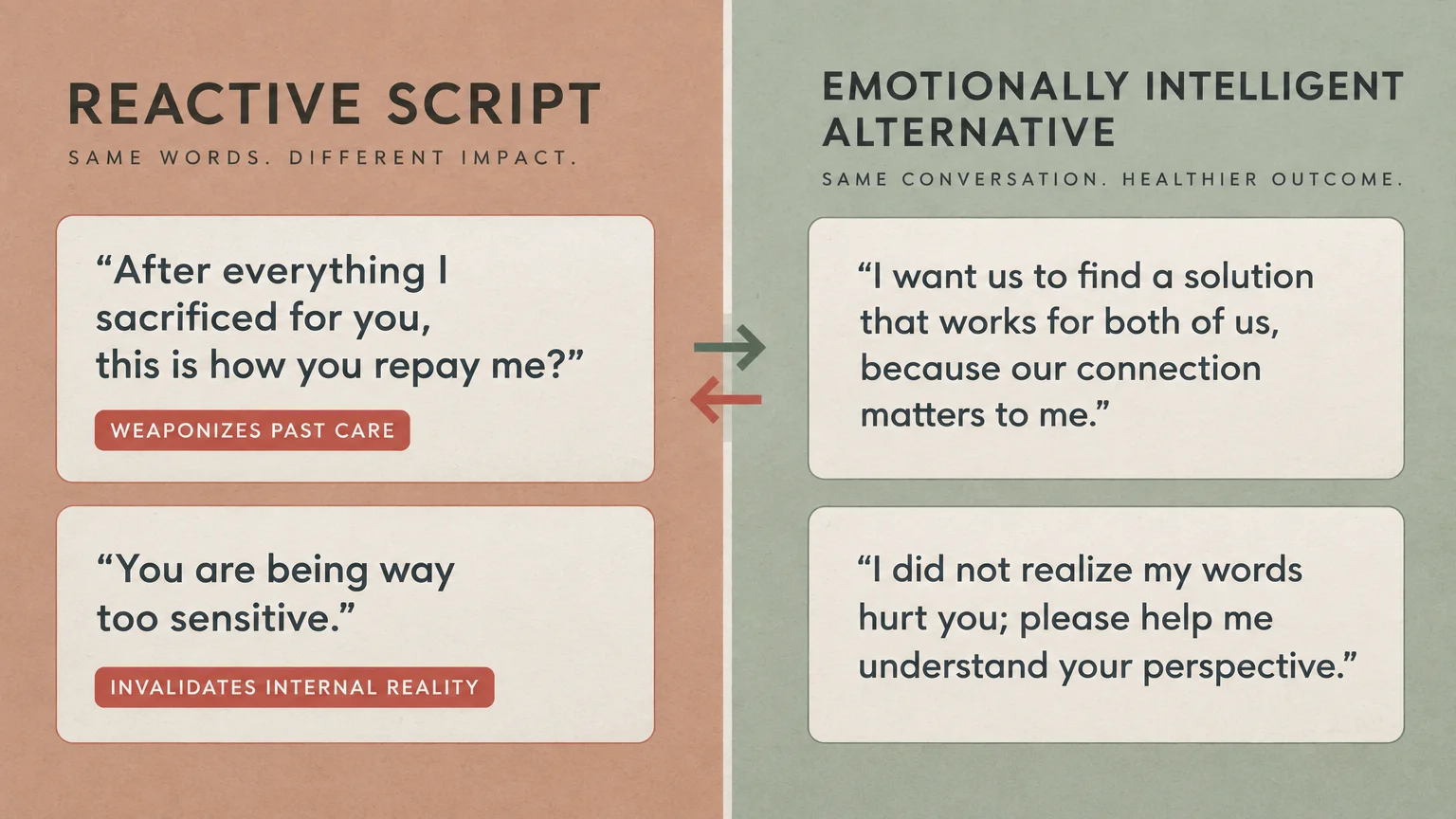
Comparison: Damaging Scripts vs. Emotionally Intelligent Responses
Changing entrenched communication habits requires conscious substitution. Use the following framework to replace destructive remarks with connecting responses.
| Damaging Phrase | Psychological Impact | Constructive Alternative |
|---|---|---|
| “After everything I sacrificed, this is how you repay me?” | Creates emotional debt, guilt, and resentment. | “Our relationship matters deeply to me; let’s find common ground.” |
| “You are being way too sensitive.” | Invalidates internal reality and promotes emotional withdrawal. | “I didn’t realize I hurt you; please help me understand your view.” |
| “I guess I was just a terrible parent then.” | Deflects accountability and manipulates the child into soothing you. | “I made mistakes, and I want to hear how they affected you.” |
| “I told you that would happen.” | Undermines adult autonomy and triggers defensiveness. | “That sounds difficult. What do you think is your best path forward?” |
| “Why don’t you ever call me?” | Turns contact into a chore driven by guilt. | “I miss you and would love to catch up whenever your schedule allows.” |

Common Misconceptions About Parenting Adult Children
Many communication mistakes stem from lingering cognitive biases about what parenting adult children entails. Clearing up these assumptions restores perspective.
- Misconception: Offering unsolicited advice demonstrates deep love. In reality, adult children perceive unasked-for advice as criticism of their competence. Save suggestions for when they explicitly request your input.
- Misconception: Healthy boundaries signal emotional rejection. Boundaries do not exist to push parents away; they exist to preserve the relationship safely. Honoring boundaries prevents eventual estrangement.
- Misconception: Parents have an inherent right to full access. Privacy is a fundamental component of psychological adulthood. Healthy adults maintain private spaces in their finances, marriages, and daily habits.
- Misconception: Acknowledging past mistakes undermines your authority. Offering a sincere apology actually builds respect. Mature vulnerability demonstrates emotional security and invites deeper trust.
Examining your personal motives behind every comment ensures you speak from connection rather than control.

Finding the Right Professional Help
Unraveling decades of family conditioning can prove challenging without objective guidance. According to Psychology Today, family systems therapy offers structured methods to dismantle toxic communication loops.
Consider seeking a licensed marriage and family therapist (LMFT) or professional counselor in the following scenarios:
- Repeated estrangement cycles: When conflicts consistently lead to prolonged silent treatment, cutoffs, or blocked communication.
- Severe boundary disputes: When disagreements over parenting, finances, or partners produce continuous screaming matches and distress.
- Unresolved childhood grievances: When old resentments surface repeatedly and prevent calm, present-day interactions.
- Enmeshment and codependency: When either party feels overwhelming anxiety, guilt, or depression whenever the other makes independent life choices.
Evidence-based modalities like Emotion-Focused Family Therapy (EFFT) and Narrative Therapy help parents and adult children reconstruct healthy attachment bonds.
Frequently Asked Questions
How do I apologize to my adult child for hurtful things I said?
Deliver an apology that focuses entirely on your behavior without making excuses. Acknowledge the specific harm caused, validate their emotional experience, and state clearly what you will do differently moving forward.
What should I do if my adult child sets boundaries that feel unfair?
Honor their boundaries without defensiveness or guilt-tripping. Use the separation to reflect on your communication patterns, and consider consulting a therapist to process your feelings of grief and adjustment.
Is it ever acceptable to offer unsolicited advice to an adult child?
Reserve unsolicited intervention strictly for clear emergencies involving immediate physical danger or severe addiction. Otherwise, ask for permission first: “Would you like some perspective, or do you just need me to listen?”
How can parents start repairing a strained relationship?
Begin by listening without interrupting or correcting their memories. Small, consistent demonstrations of unconditional acceptance and respected boundaries rebuild trust far more reliably than dramatic gestures.
Moving Forward with Warmth and Respect
Transforming your communication takes patience, self-reflection, and intentional practice. When you swap guilt and judgment for curiosity and acceptance, you lay the groundwork for an enduring adult friendship.
Give your child room to grow, make mistakes, and chart their own path. Your willingness to adjust your speech will speak louder than any unsolicited advice ever could.
The information in this article is meant for educational purposes and general guidance. It does not replace individual therapy, counseling, or medical treatment. If you or someone you know is in crisis, contact the 988 Suicide & Crisis Lifeline by calling or texting 988.
Last updated: February 2026. Psychology research evolves continuously—verify current findings with professional sources.









Leave a Reply