

Building healthy boundaries with family transforms your emotional well-being by replacing chronic resentment with calm, intentional connection. When you establish clear personal limits, you no longer carry the exhausting burden of managing other adults’ emotional reactions, demands, or expectations. Instead of bracing for holiday phone calls or feeling paralyzed by family pressure, you gain the confidence to protect your time, energy, and values without second-guessing your worth. Recognizing boundary success is rarely about changing how your relatives behave; rather, it reflects a fundamental shift in how you honor your own autonomy. Here are the core indicators that your boundaries are working effectively.
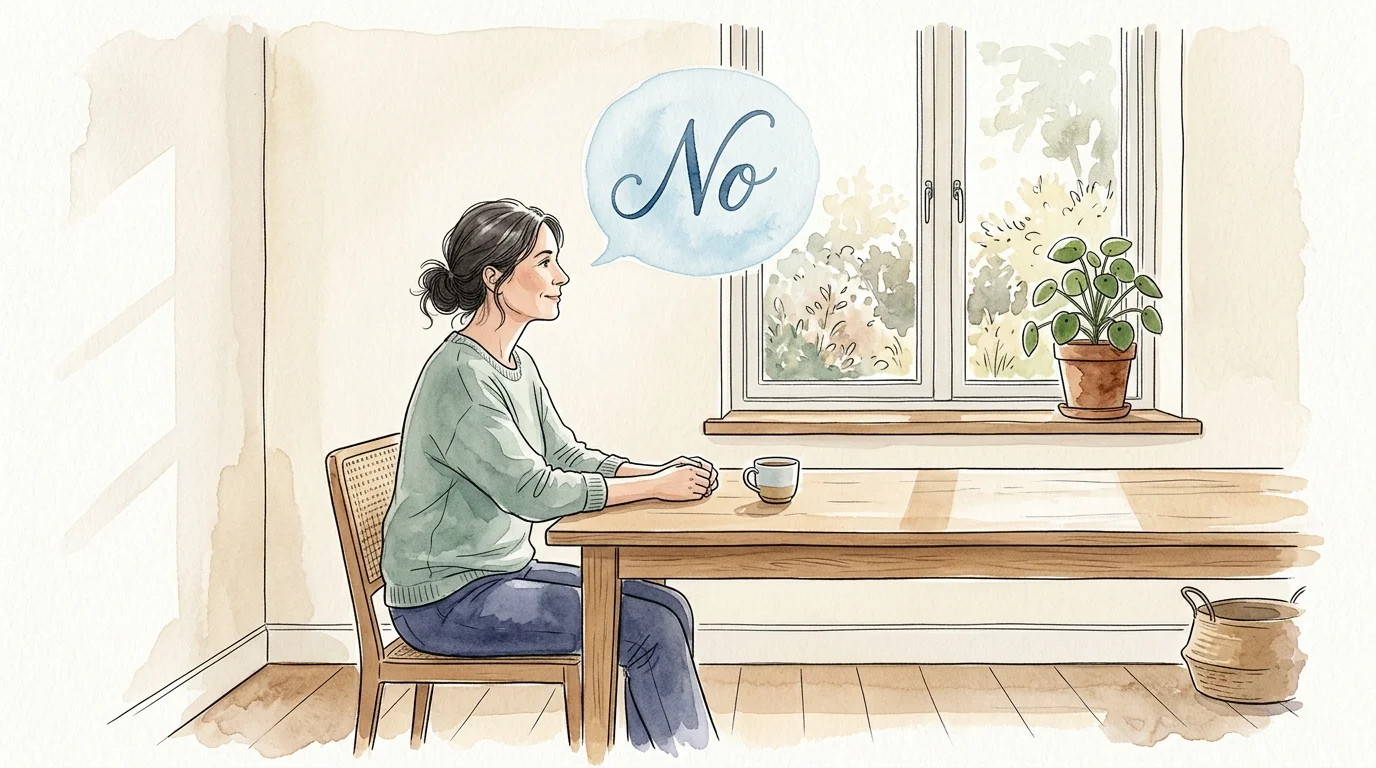
1. You Say “No” Without Experiencing Overwhelming Guilt
In enmeshed or high-obligation family systems, declining a request often triggers intense guilt, self-doubt, or catastrophic fears of rejection. Family members may have conditioned you to believe that love equals total compliance, viewing personal limits as acts of betrayal. A definitive sign of progress occurs when you can decline an invitation, refuse a loan, or pass on a family obligation and let your “no” stand on its own.
According to family systems theory formulated by Murray Bowen, this milestone represents a high level of differentiation of self—the psychological capacity to maintain your individual beliefs, values, and emotional autonomy while remaining connected to your family unit. When your differentiation increases, you recognize that adult relatives are responsible for processing their own disappointment. Research published through the American Psychological Association emphasizes that emotional autonomy reduces chronic interpersonal stress, allowing individuals to cultivate authentic relationships rather than compliance-based interactions.
You no longer spend hours drafting elaborate justifications or concocting fake emergencies to soften the blow. You state your decision calmly, validate their perspective if appropriate, and move forward with your day without ruminating on whether you did something wrong.

2. You Respond to Difficult Dynamics Rather Than Reacting Instantly
Unhealthy family patterns thrive on emotional reactivity. An intrusive comment from a parent, a passive-aggressive remark from a sibling, or an unsolicited critique of your parenting style once triggered an immediate defensive response: an explosive argument, tearful shutdown, or intense urge to over-explain yourself.
When you have built healthy boundaries, you gain command over your nervous system during tense exchanges. You notice the bait, acknowledge the emotional trigger internally, and choose how—or even if—you will engage. You recognize that someone else’s provocative statement does not obligate you to participate in a familiar script. Practicing emotional regulation creates a vital gap between stimulus and response, transforming your interpersonal dynamics:
- You pause before speaking: Taking a breath allows your prefrontal cortex to assess whether an issue warrants discussion or silence.
- You abandon the need to defend your choices: You recognize that you do not need parental or sibling validation for your career, partner, finances, or lifestyle.
- You exit circular arguments: Instead of getting pulled into hours of repetitive debate, you use simple reframing phrases like, “We see this differently, and that is okay,” before changing the topic or ending the conversation.

3. Family Disapproval No Longer Threatens Your Sense of Self
Growing up in rigid or invalidating households often teaches children that self-worth depends entirely on parental approval. Carrying that dynamic into adulthood leaves you vulnerable to manipulation, silent treatments, and guilt-tripping. When relatives express dissatisfaction with your choices, it can feel like a direct threat to your safety and identity.
Establishing healthy boundaries breaks this cycle. You separate your internal worth from external feedback. When a relative criticizes your life direction, expresses disappointment, or withholds warmth, you view their reaction as information about their expectations, not a reflection of your character. Clinicians writing for Psychology Today point out that letting go of external validation is essential for mature adulthood; self-validation allows you to make aligned decisions even when family members disagree.
You can love your family while accepting that their worldview, political beliefs, financial philosophies, or lifestyle preferences may never align with yours. Their approval becomes a welcome bonus rather than an emotional prerequisite for your peace of mind.

4. You Communicate Clear Limits Instead of Using Passive Resistance
Before establishing solid boundaries, many people rely on indirect tactics to protect themselves from overwhelming family demands. You might have ignored text messages for days, cancelled plans at the last minute with fabricated excuses, or agreed to favors you resented doing, subsequently expressing your frustration through sarcasm or emotional withdrawal.
Healthy boundaries eliminate the need for indirect avoidance. You communicate with clarity, assertiveness, and respect. You state what you will and will not do without hostility, arrogance, or apology. Assertive communication shifts the dynamic from passive-aggressive avoidance to clean, transparent terms:
“Daring to set boundaries is about having the courage to love ourselves, even when we risk disappointing others.” — Brené Brown, Ph.D., LMSW
Instead of hoping relatives will guess your needs or respect unspoken limits, you articulate your boundaries proactively. For example, rather than silently fuming when a parent drops by unannounced, you establish the standard directly: “I love spending time with you, but I need at least twenty-four hours’ notice before visits. If you arrive without checking first, I won’t be able to open the door.”

5. You Give Up the Compulsion to Fix or Rescue Family Members
Many family dynamics cast one member in the role of the perpetual problem-solver, mediator, or emotional caretaker. If a sibling mismanages money, a parent engages in substance misuse, or relatives constantly fight, you may have felt personally responsible for preventing catastrophe or restoring harmony.
Breaking free from codependency requires understanding the Karpman Drama Triangle—a psychological model illustrating how individuals rotate between the roles of Rescuer, Persecutor, and Victim. When you step out of the Rescuer role, you honor other adults’ right to manage their own lives, make their own mistakes, and experience natural consequences. The National Alliance on Mental Illness (NAMI) emphasizes that stepping back from caretaking in dysfunctional family systems is critical for preventing caregiver burnout and enabling genuine accountability.
You can offer empathy and appropriate encouragement without taking on their logistical, legal, or emotional responsibilities. You recognize that shielding family members from the outcomes of their poor choices prevents them from growing and drains your own vitality.

6. You Protect Your Time and Personal Space Proactively
One of the clearest practical signs of successful family boundary work is how you structure your time, physical space, and digital accessibility. You no longer allow family interactions to derail your daily routines, marriage, work commitments, or rest.
You implement practical operational boundaries that protect your well-being:
- Time-boxed interactions: You set clear start and end times for visits, phone calls, and holiday dinners (e.g., “We can join for dinner between 5:00 PM and 7:30 PM, but then we need to get the kids to bed”).
- Physical autonomy during travel: When visiting relatives from out of town, you book a hotel or vacation rental instead of staying in your childhood bedroom, giving yourself a neutral sanctuary to decompress.
- Digital boundaries: You silence group chats during work or rest hours, respond to non-urgent family texts when convenient, and decline to engage in social media drama.
- Information privacy: You practice selective vulnerability, sharing personal details about your marriage, career, or finances only with relatives who have demonstrated emotional safety and respect.

7. You Can Enjoy Genuine Closeness Without Fearing Enmeshment
When people first begin setting boundaries, they often swing to an extreme of rigid isolation, building high walls out of fear that any warmth will invite manipulation or boundary violations. Over time, healthy boundaries evolve from defensive walls into flexible filters.
As your confidence in holding limits grows, you no longer fear that being kind, attending a family gathering, or sharing an affectionate moment will trap you in old, unhealthy dynamics. Research from The Gottman Institute shows that healthy relational connection relies on mutual respect for individuality; true intimacy cannot exist without clear interpersonal borders.
You know that if a conversation turns toxic, you can leave. You know that if a relative crosses a line, you can reiterate your boundary. Because you trust yourself to protect your own well-being in real time, you can relax, participate in joyful family moments, and appreciate your relatives for who they are without needing them to change.
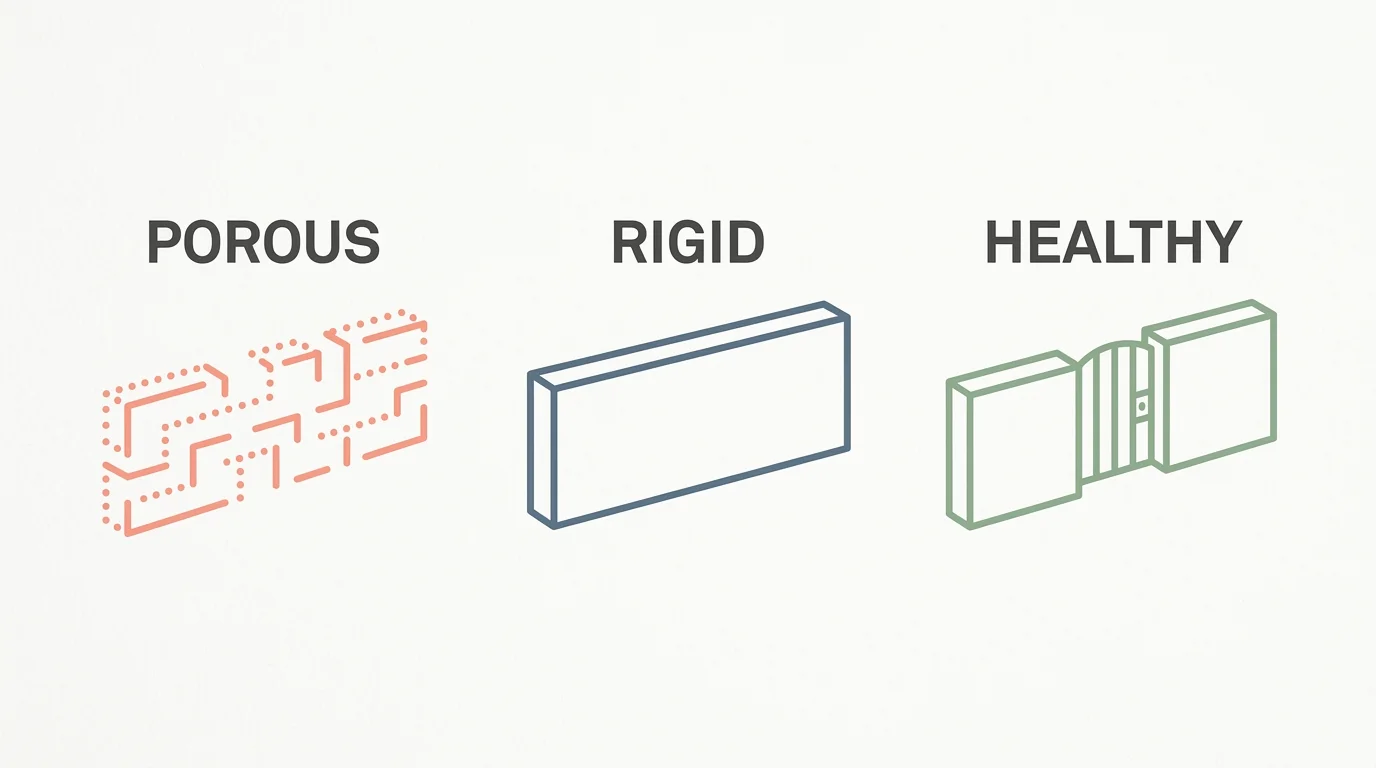
The Spectrum of Family Boundaries: Porous, Rigid, and Healthy
Evaluating your boundary style helps clarify where you currently stand and where your family relationships have room to grow. Family boundaries typically fall along a spectrum between enmeshment and disengagement.
| Boundary Dimension | Porous Boundaries | Rigid Boundaries | Healthy Boundaries |
|---|---|---|---|
| Emotional Autonomy | Absorbs family mood swings; feels responsible for others’ happiness. | Completely emotionally detached; refuses to show vulnerability or care. | Maintains internal calm; offers empathy without taking on emotional weight. |
| Communication Style | Passive, indirect, or people-pleasing; over-explains decisions. | Aggressive, stonewalling, or relies exclusively on cut-offs. | Clear, assertive, and direct; states limits without over-justifying. |
| Handling Disapproval | Paralyzed by guilt; changes course to appease relatives. | Reacts with hostility, defiance, or permanent withdrawal. | Accepts disapproval as a normal difference in adult perspectives. |
| Conflict Navigation | Gives in instantly or uses silent treatment to avoid confrontations. | Engages in explosive arguments or permanently terminates contact over small issues. | De-escalates calmly; exits interactions if respect is violated. |

Myths Worth Debunking About Setting Boundaries With Relatives
Misconceptions about boundaries often stall progress, causing individuals to retreat back into people-pleasing habits. Clearing up these myths reinforces your commitment to healthy family dynamics.
Myth 1: Boundaries are selfish and destroy family unity.
Boundaries preserve relationships; they do not destroy them. Without limits, resentment, passive-aggressive bitterness, and burnout inevitably rot the relationship from within. Establishing boundaries allows you to remain connected to family members without sacrificing your mental health.
Myth 2: A boundary is a rule designed to control someone else’s behavior.
Boundaries are not demands placed on others; they are guidelines for your own behavior. You cannot control whether a parent criticizes your partner, but you can control your response: “If this critique continues, I will end our phone call.” Boundaries govern your actions, space, and choices.
Myth 3: If family members get angry, your boundary was set incorrectly.
Pushback is a normal, predictable reaction when you disrupt a long-standing relational system. When you stop playing your assigned role, the system experiences disequilibrium. Anger or resistance from relatives is evidence that a boundary was needed, not proof that you handled it poorly.
Myth 4: Healthy boundaries always require complete estrangement.
While cutting off contact is sometimes necessary in cases of severe abuse, exploitation, or unyielding toxicity, many family relationships function well with moderate, well-maintained boundaries. Adjusting frequency of contact, conversational topics, and visit formats often creates a sustainable middle ground.
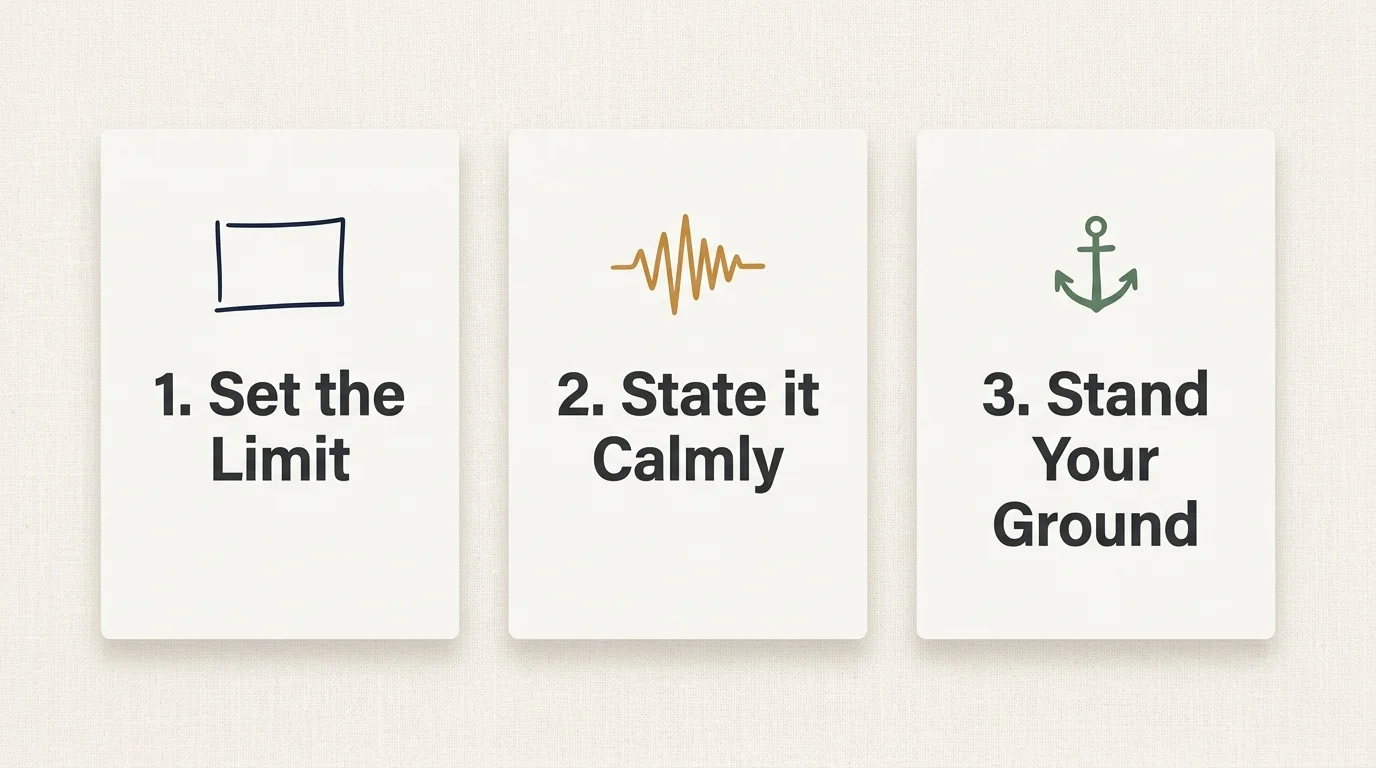
Actionable Strategies for Maintaining Boundaries With Parents or Siblings
Maintaining limits over time requires consistency, clear scripts, and realistic expectations. Use these practical tools when family members test your boundaries:
- Use the “Broken Record” technique: When a relative pressures you to change your mind, repeat your short, neutral statement without adding new arguments or details. For example: “I understand that’s disappointing, but I am not available this weekend.” Repeating the exact phrase neutralizes debate.
- Eliminate the “JADE” response: Avoid Justifying, Arguing, Defending, or Explaining. Over-explaining signals to the other person that your boundary is open for negotiation. Keep statements concise and definitive.
- Establish conversational guardrails: Redirect intrusive or harmful subjects immediately: “I am not discussing my finances today. Let’s talk about your upcoming trip instead.” If they persist, follow through on your consequence by wrapping up the visit.
- Prepare your exit strategy before every gathering: Drive your own vehicle, keep your keys accessible, set a predetermined departure time with your partner, and have a clear reason ready to leave whenever necessary.

Signs It’s Time to Talk to a Therapist
While self-directed boundary setting is powerful, navigating deep-rooted family dysfunction, childhood trauma, or complex relational systems can be overwhelming. Consider working with a licensed mental health professional if you experience any of the following:
- Debilitating guilt or panic: Setting a minor boundary triggers severe physical anxiety, insomnia, obsessive rumination, or depressive symptoms.
- Trauma responses during contact: Interacting with family members causes dissociation, emotional flashbacks, or somatic distress tied to past emotional, verbal, or physical abuse.
- Persistent boundary violations: Relatives continually cross critical safety lines (such as disrespecting your rules regarding your children’s safety or sobriety) and you struggle to enforce consequences.
- Intergenerational enmeshment: You find it impossible to make life choices (regarding marriage, career, faith, or finances) without seeking family permission or fearing disownment.
Frequently Asked Questions
How do I handle boundary pushback from parents who guilt-trip me?
Acknowledge their feelings without compromising your stance. You might say, “I hear that you are upset, but this is the decision that works best for my family.” Allow them to feel disappointed without stepping in to soothe their emotions. Consistency over time teaches relatives that guilt-tripping will not change your outcome.
What is the difference between setting a boundary and issuing an ultimatum?
An ultimatum seeks to force another person to change their behavior under threat of punishment (“If you don’t stop doing X, I will do Y to you”). A boundary clearly defines your own behavioral limits and choices (“I will not stay in a room where someone is yelling. If yelling starts, I am leaving”). Boundaries focus on personal protection and agency, not control.
Can you have healthy boundaries with family without going no-contact?
Yes. The vast majority of boundary work occurs within ongoing relationships through “low-contact” strategies, selective information sharing, shorter visits, and structured communication. Complete estrangement is generally reserved for situations involving persistent abuse, unaddressed addiction, or severe violations of psychological and physical safety.
Why do I feel physically exhausted after setting a simple boundary?
Setting boundaries with family challenges deeply ingrained neural pathways and nervous system conditioning formed in childhood. Standing up for yourself in a system that historically discouraged autonomy triggers a temporary stress response. As boundary enforcement becomes your new normal, the associated physical and emotional exhaustion decreases significantly.
Cultivating Lasting Peace in Family Relationships
Building healthy family boundaries is an ongoing process of self-discovery, practice, and courage. Success is not measured by whether your relatives applaud your new rules; it is measured by the internal freedom, calm, and self-respect you gain along the way. Every time you honor your limits, you reinforce your self-worth and create space for authentic, sustainable connection.
The information in this article is meant for educational purposes and general guidance. It does not replace individual therapy, counseling, or medical treatment. If you or someone you know is in crisis, contact the 988 Suicide & Crisis Lifeline by calling or texting 988.
Last updated: February 2026. Psychology research evolves continuously—verify current findings with professional sources.









Leave a Reply