You hold more influence over your cognitive future than you might realize. According to the 2024 Lancet Commission on Dementia Prevention, Intervention, and Care, 14 modifiable risk factors account for roughly 45% of global dementia cases.
Your daily leisure choices play a powerful role in protecting that reserve. A 2026 study in the European Journal of Ageing linked regular hobby engagement to 6.50 to 9.75 extra years of healthy cognitive life expectancy at age 50.
Whether you want to stay mentally agile in midlife or explore rewarding hobbies for seniors, research points to specific activities that truly work. You can start building stronger memory, sharper focus, and lasting resilience today.
Why Everyday Hobbies Outperform Commercial Brain Games
Many adults spend money on digital apps hoping to protect their memory. However, the Global Council on Brain Health notes that scientific evidence supporting commercial digital “brain games” for overall brain health is “weak to nonexistent.”
Real-world hobbies demand far more from your neural networks than tapping a screen. Learning an instrument, tending a garden, or joining a dance class forces multiple brain regions to coordinate simultaneously.
Large-scale data confirms the payoff of genuine engagement. The August 2026 European Journal of Ageing study tracked 123,802 adults aged 50 and older across 31 countries to measure how hobbies shape aging.
Researchers found that reading, games, arts and crafts, sports, and gardening lowered the risk of progressing from normal cognition to mild decline by 20% to 40% in three of four cohorts. Even better, hobbyists showed a 15% to 37% higher likelihood of reverting from mild decline back to normal cognition.
Another study from November 2025 examined 6,854 adults aged 50 and older in the English Longitudinal Study of Ageing. Participants who kept up hobbies demonstrated stronger baseline memory and executive function, slower decline in orientation, and more than halved odds of persistent low cognitive function.
True cognitive resilience grows when you stretch your mind with unfamiliar, meaningful challenges—not when you repeat easy tasks on autopilot.
Lifestyle variety even helps counteract genetic vulnerability during midlife. An April 2026 study from Trinity College Dublin’s PREVENT-Dementia programme followed 700 cognitively healthy adults aged 40 to 59 across the UK and Ireland.
Researchers discovered that participating in a diverse mix of activities—such as playing an instrument, socializing, and traveling—had a stronger positive link to midlife cognition than the negative link of carrying the high-risk APOE ε4 gene.
To keep those benefits growing, avoid letting your favorite pastime turn into a mechanical habit. The Alzheimer’s Association advises switching to new activities once a mental task becomes too easy so your brain keeps adapting.
The Top Brain Sharp Hobbies Backed by Research
Not every leisure activity stimulates your mind in the same way. Choosing hobbies for brain health works best when you understand what each pursuit trains and how to weave it into your week.
1. Dancing and Coordinated Movement
Movement fuels blood flow to your brain, and dancing adds rapid memory and rhythm demands on top of exercise. You must track music, recall steps, adjust posture, and respond to partners in real time.
In the landmark 2003 Bronx Aging Study published in the New England Journal of Medicine, researchers followed 469 adults over age 75 for a median of 5.1 years. Among 11 physical activities tracked, dancing was the only one tied to reduced dementia risk.
Frequent dancers who hit the floor more than once a week showed a remarkable 76% lower dementia risk than rare dancers. Modern clinical trials reinforce those classic findings across different dance styles.
A 2025 meta-analysis in Medicine & Science in Sports & Exercise pooled 13 randomized controlled trials covering 1,174 adults with a mean age of 71. Dance classes produced statistically significant gains in cognitive test scores while also easing depressive symptoms.
Social dancing protects your physical independence as well. A 2020 meta-analysis of 29 randomized trials showed that social dance cut fall risk by 37% in healthy older adults.
Any active hobby helps you hit essential movement benchmarks for cognitive health. Both the World Health Organization and the Centers for Disease Control and Prevention (CDC) advise 150 minutes of moderate aerobic activity weekly, plus muscle-strengthening work on two or more days.
The CDC warns that cognitive decline appears almost twice as often among inactive adults compared to active ones, yet only about 23% of U.S. adults meet both movement guidelines. If mobility feels tricky, start with seated rhythm classes or beginner line dancing.
2. Playing an Instrument or Active Music Listening
Music lights up auditory, motor, emotional, and memory centers at once. Whether you read sheet music or listen closely to a symphony, your brain tracks patterns and anticipates changes.
A November 2025 Monash University study in the International Journal of Geriatric Psychiatry followed 10,893 cognitively healthy Australians aged 70 and older. Those who always listened to music saw a 39% lower dementia risk and a 17% lower risk of cognitive impairment without dementia.
Picking up an instrument delivered powerful protection too. Participants who often or always played a musical instrument had a 35% lower risk of dementia, while combining playing and listening yielded a 33% lower dementia risk and 22% lower impairment risk.
You do not need conservatory training to benefit from musical brain sharp hobbies. Try relearning chords on an old guitar, joining a community chorus, or dedicating 20 distraction-free minutes daily to active music listening.
3. Visual Arts and Hands-On Crafts
Creating with your hands demands spatial planning, fine motor control, and visual problem-solving. Every brushstroke, clay pinch, or stitch asks your brain to translate an idea into physical form.
A 2015 Mayo Clinic study in Neurology tracked 256 adults with an average baseline age of 87 over four years. Engaging in artistic hobbies—including painting, drawing, and sculpting—in both middle and late life linked to a 73% lower risk of mild cognitive impairment (MCI).
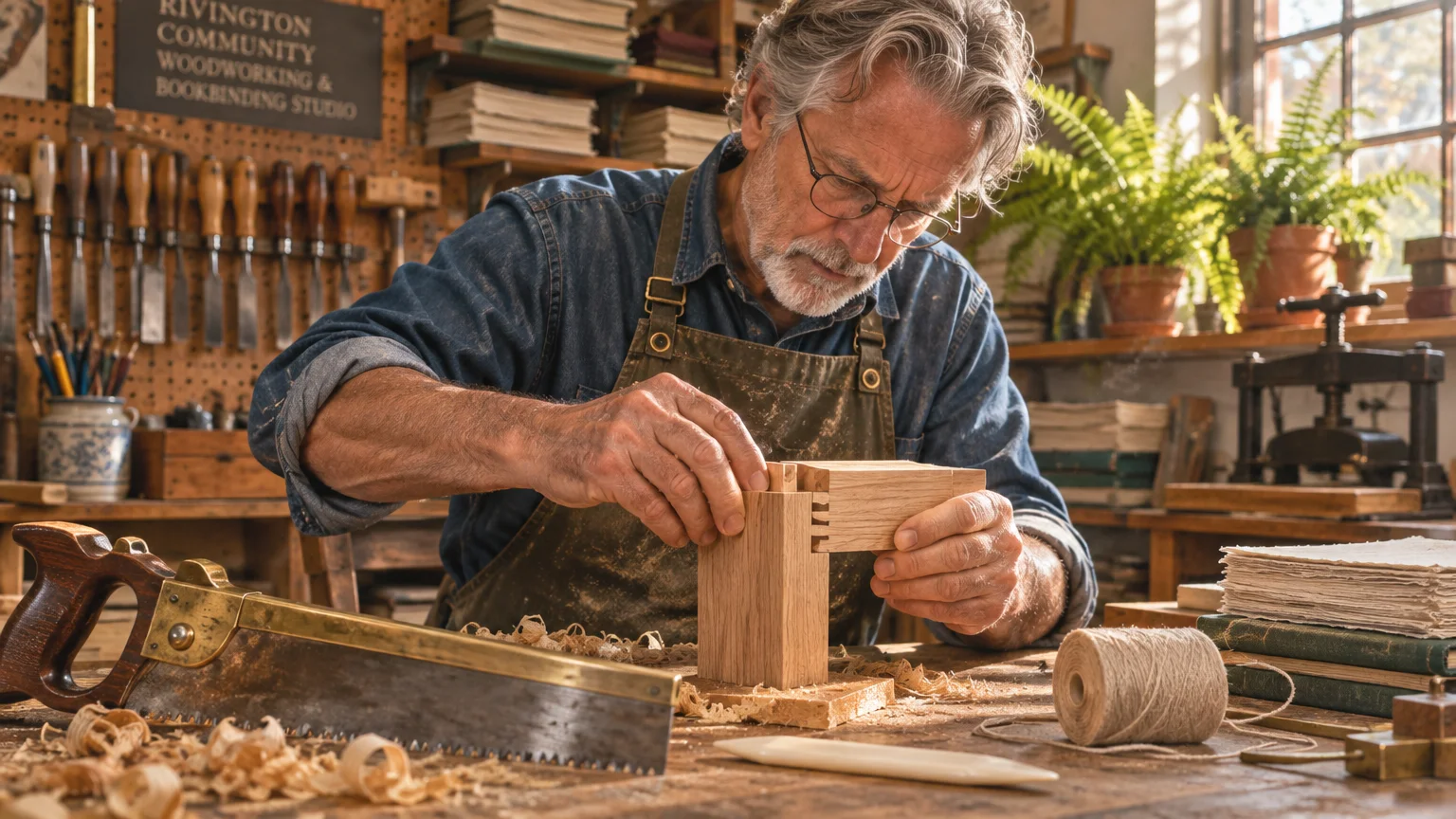
Practical craft hobbies also offered strong protection in the same study. Activities like pottery, woodworking, quilting, and sewing corresponded to a 45% lower risk of developing MCI.
Drop the pressure to create gallery-ready pieces right away. Enroll in a local watercolor workshop, try beginner woodcarving, or follow a fresh knitting pattern that challenges your focus.
4. Reading, Writing, Languages, and Word Games
Language-rich pastimes build deep cognitive reserve over decades. When you read complex books, write essays, or wrestle with unfamiliar grammar, your brain forges dense connections across memory and reasoning networks.
A February 2026 Rush University Medical Center study in Neurology followed 1,939 adults with a mean age of 80 for an average of eight years. Participants in the top 10% of lifetime cognitive enrichment—reading books, writing, visiting libraries or museums, and studying a foreign language for five or more years—saw striking delays in decline.
That top group experienced a 38% lower risk of Alzheimer’s disease and a 36% lower risk of MCI compared to the bottom 10%. On average, highly enriched learners developed Alzheimer’s five years later and MCI seven years later.
These memory boosting activities remain valuable even after mild memory changes begin. In the U.S., nearly 6 million people live with dementia—a number projected to reach 14 million by 2060—and roughly 10% of people with MCI progress to dementia each year.
A September 2024 Texas A&M University study in the Journal of Cognitive Enhancement examined 5,932 adults aged 50 and older already diagnosed with MCI. Frequent engagement in reading, puzzles, and word games correlated with better memory, working memory, attention, and processing speed.
Keep your word habits fresh by rotating genres or formats. Join a library book club, journal about your daily observations, or practice conversational phrases in a new language with a partner.
5. Strategy Board Games
Classic tabletop games combine rule recall, forward planning, probability, and social reading. Watching an opponent’s strategy forces your executive brain circuits to stay flexible and alert.
Population research in adults aged 65 and older from the Paquid cohort found board game players carried a 15% lower risk of dementia than non-players. Newer experimental research shows these gains extend into late life.
A 2025 randomized controlled trial cited by The Washington Post placed nursing home residents into twice-weekly facilitated board game sessions. Players improved significantly in comprehension, memory, and attention compared to control groups.
Consistency across weekly cognitive pastimes compounds over time. In the 2003 Bronx Aging Study, every one-point rise in weekly cognitive-activity score—covering reading, board games, instruments, and dancing—corresponded to a 7% lower dementia risk.
Invite neighbors for weekly card nights, chess matches, or modern tile games. If you live far from family, playing turn-based strategy games over video calls keeps both minds and relationships active.
6. Gardening Outdoors
Gardening blends gentle physical exertion, sensory richness, planning, and mood-lifting time outdoors. You track seasonal timing, lift soil, prune carefully, and troubleshoot plant health.
A June 2024 study in Nutrition Journal analyzed federal survey data from 136,748 U.S. adults aged 45 and older. Gardeners showed 28% lower odds of subjective cognitive decline and 43% lower odds of related functional limitations compared to non-exercisers.
Researchers noted that higher physical energy expenditure explained 39.0% of that cognitive benefit, while lower depression rates explained another 21.5%. Caring for living plants supports both emotional balance and sharp thinking.
You do not need an acre of land to gain these rewards. Start with raised patio beds, container herbs on a sunny windowsill, or a plot at a community garden where neighbors swap tips.
7. Volunteering and Social Clubs
Meaningful connection may be one of the most underrated hobbies for brain health. Conversation requires rapid listening, empathy, word retrieval, and emotional regulation—all while shielding you from isolation.
A 2025 narrative review warns that social isolation raises dementia risk by 26%, while loneliness raises it by 32%. Conversely, mid- and late-life socializing linked to a 55% lower risk of MCI in the 2015 Mayo Clinic study.
Helping others offers measurable protection against cognitive slowing. An August 2025 study from the University of Texas at Austin and UMass Boston tracked over 30,000 U.S. adults across 20 years in Social Science & Medicine.
Formal volunteering or informal helping outside the home slowed age-related cognitive decline by 15% to 20%, with reliable gains starting at two to four hours weekly. Purposeful service can even protect physical brain structure.
In the Baltimore Experience Corps Trial, researchers randomized 111 older adults to two years of intergenerational school tutoring versus a wait-list control. Volunteers preserved and modestly increased cortical and hippocampal brain volumes instead of showing typical age-related shrinkage.
Variety in your social calendar strengthens those effects even further. An October 2026 study across 24 countries in the Journal of Epidemiology & Community Health found older adults participating in three or more social activities scored higher in memory and executive function.
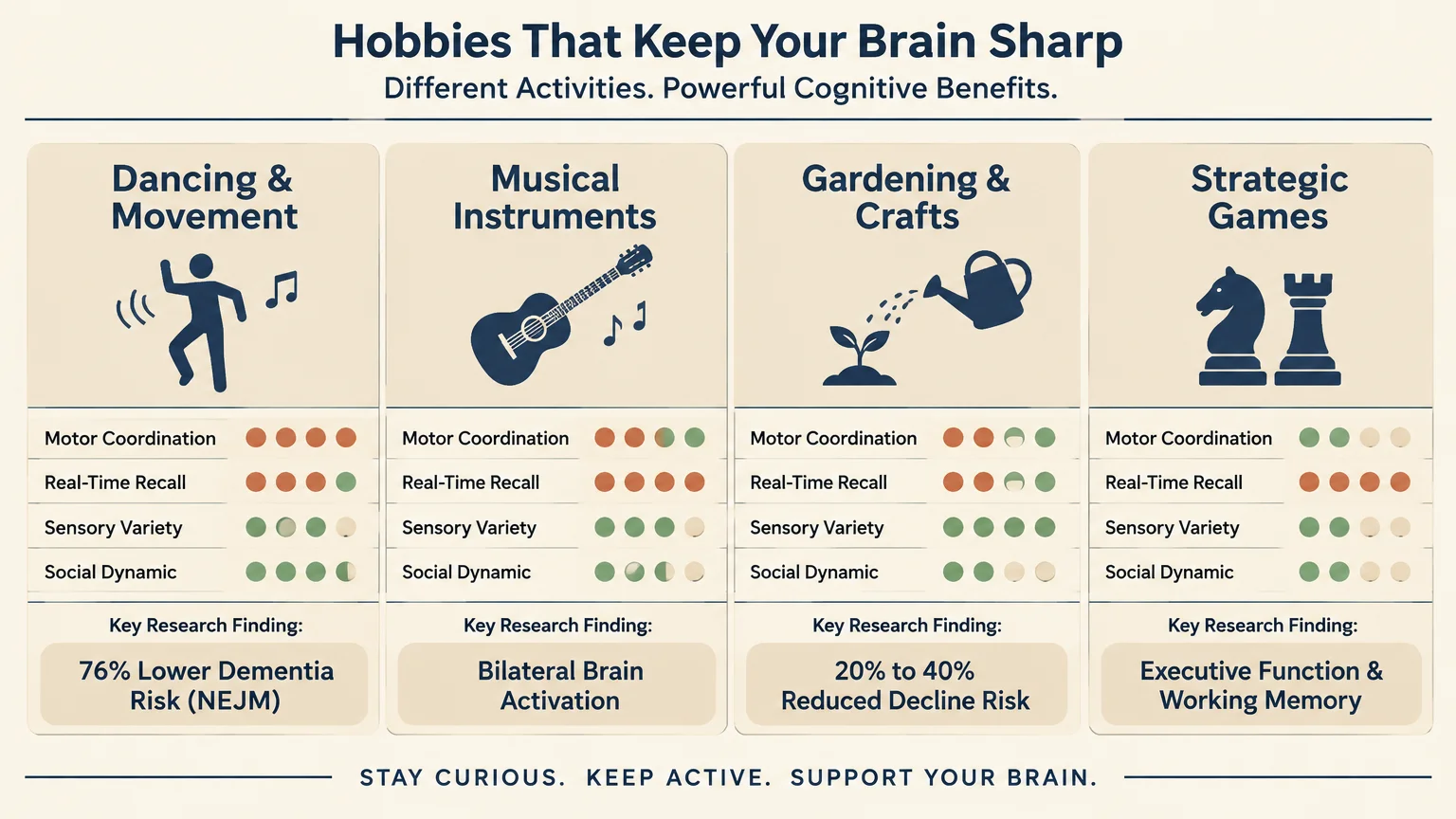
Comparing Brain Sharp Hobbies by Cognitive Demand
Choosing the right mix depends on your current mobility, social goals, and curiosity. The table below compares top research-backed hobbies so you can pair mental challenge with physical and social benefits.
| Hobby Category | Primary Cognitive Skills Trained | Physical or Social Bonus | Research Highlight |
|---|---|---|---|
| Dancing | Sequence memory, spatial awareness, timing | Aerobic fitness, balance, group connection | 76% lower dementia risk in frequent older dancers; 37% lower fall risk |
| Music (Playing or Listening) | Auditory processing, working memory, motor coordination | Stress relief, group ensemble bonding | 35%–39% lower dementia risk in adults aged 70+ |
| Visual Arts & Crafts | Visuospatial planning, focus, fine motor precision | Calming tactile flow, workshop community | 45%–73% lower MCI risk in middle and late life |
| Reading, Writing & Languages | Vocabulary, comprehension, long-term recall | Book clubs, museum visits, conversation | 38% lower Alzheimer’s risk; up to 5-year delay in onset |
| Strategy Board Games | Executive planning, attention, mental flexibility | Face-to-face laughter and social bonding | 15% lower dementia risk; improved memory in 2025 RCT |
| Gardening | Seasonal planning, problem-solving, sensory focus | Moderate outdoor activity, lower depression | 28% lower odds of subjective cognitive decline |
| Volunteering & Social Clubs | Verbal fluency, empathy, multitasking | Deep purpose, reduced loneliness | 15%–20% slower cognitive decline at 2–4 hours weekly |
Notice how the strongest memory boosting activities rarely isolate a single skill. Pairing one hands-on creative or language pursuit with one physical or social hobby covers every major pathway.

Myths Worth Debunking
Popular headlines often oversimplify how aging brains stay sharp. Clearing up common misconceptions helps you invest your time in habits that deliver genuine protection.
- Myth: Five minutes of phone puzzles will protect your brain. Commercial digital brain games show weak to nonexistent evidence for broad brain health, whereas real-world skills like music, crafts, and volunteering build lasting reserve.
- Myth: Repeating the same daily crossword is enough. Once a puzzle feels effortless, your brain runs on routine; switching to harder formats or entirely new subjects restores the challenge your neurons need.
- Myth: It is too late to start after age 60 or mild decline. Studies of adults in their 70s and 80s—plus the 2024 Texas A&M MCI study and 2026 global cohort data—show gains and even cognitive recovery later in life.
- Myth: Memory decline is purely determined by your genes. With 14 modifiable risk factors tied to 45% of global dementia cases and midlife hobby variety outperforming APOE ε4 risk, daily habits hold enormous sway.
How to Build a Sustainable Weekly Routine for Cognitive Health
Knowing which hobbies help is only useful if you enjoy them enough to stick with them. Start small, protect your schedule, and treat curiosity as your guide rather than rigid perfection.
- Anchor your week with movement: Aim for the WHO and CDC benchmark of 150 minutes of moderate aerobic activity weekly—or up to 300 minutes for extra gains—by mixing dance, brisk walking, or vigorous gardening, plus balance work if mobility is limited.
- Reserve two to four hours for helping others: Join a mentoring program, animal shelter, or neighborhood food pantry to capture the 15% to 20% slower decline linked to regular volunteering.
- Layer at least three social touchpoints: Combine a weekly board game group, a choir or art class, and a library book club so social interaction stays effortless and consistent.
- Learn one fresh skill every season: Pick up basic Spanish phrases, try pottery, or swap your usual crossword for strategy games whenever a task stops feeling tricky.
- Pair hobbies with whole-body prevention: Schedule regular hearing and vision checkups and manage midlife LDL cholesterol, because the 2024 Lancet Commission identifies untreated sensory loss and high cholesterol among key modifiable risks.
If you are selecting hobbies for seniors with physical limitations, adapt the environment rather than abandoning the activity. Seated community drumming, raised-bed container gardening, audiobooks paired with discussion groups, and afternoon tabletop games keep every mental pathway active.
Signs It’s Time to Talk to a Therapist
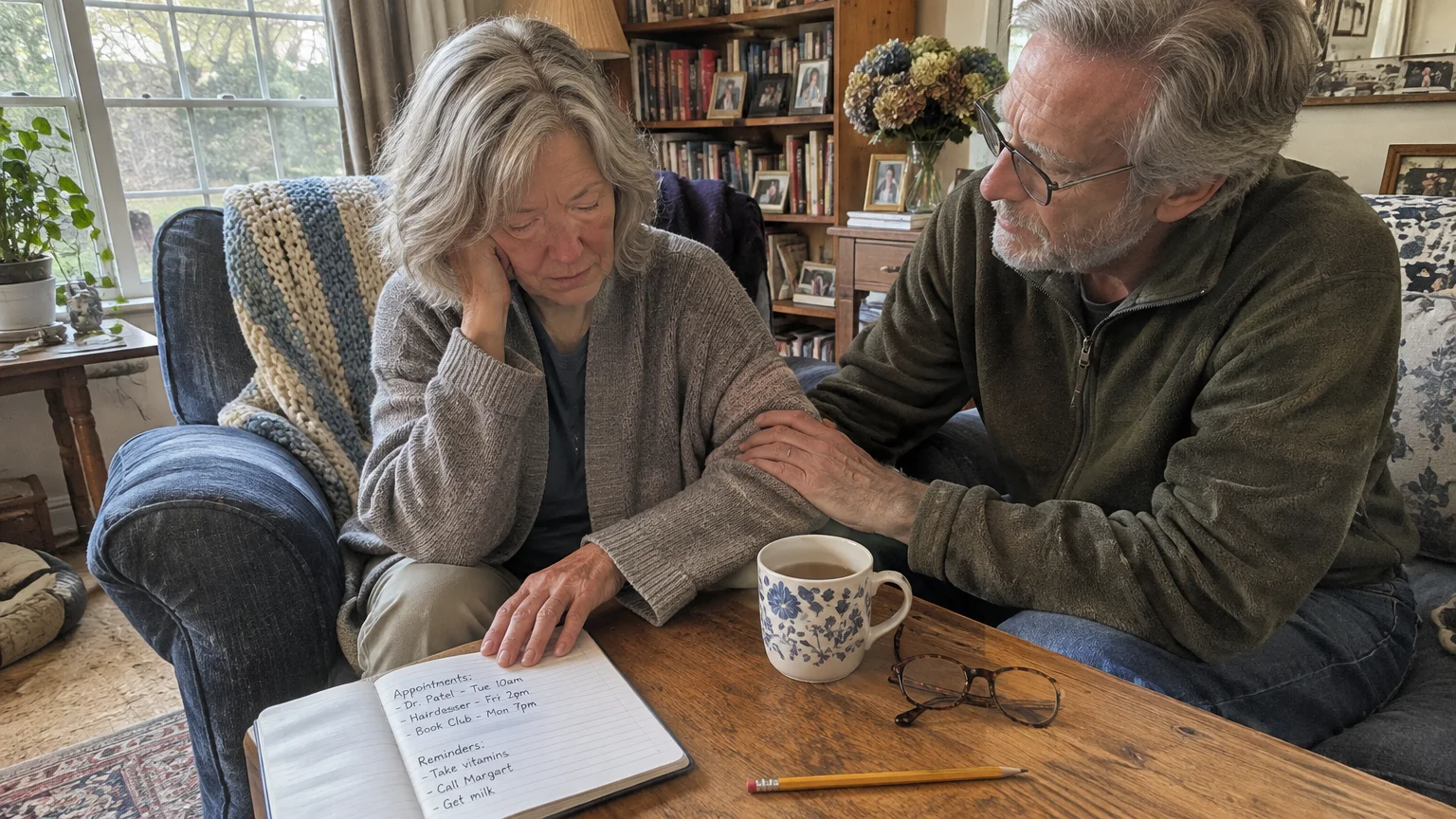
Hobbies nourish cognitive health, yet they cannot replace professional care when emotional or neurological struggles take hold. Reaching out early protects both your quality of life and your long-term brain health.
- Persistent low mood or loss of enjoyment: If sadness, emptiness, or apathy keeps you from starting hobbies for more than two weeks, seek support—especially since depression is one of the 14 modifiable dementia risk factors.
- Painful loneliness or social withdrawal: When anxiety, grief, or major life transitions like retirement make joining groups feel overwhelming, therapy can help you rebuild confidence and connection.
- Memory lapses that disrupt daily living: Repeating questions, missing bills, or getting lost in familiar places warrants a medical evaluation to check for treatable causes or mild cognitive impairment.
- Intense fear about cognitive aging: If constant worry over forgetting names leaves you exhausted or avoiding loved ones, a mental health professional can teach practical coping tools.
You can explore trusted mental health information through the National Institute of Mental Health or locate a licensed clinician via the American Psychological Association. Seeking guidance early is a practical step toward staying well.
Frequently Asked Questions About Hobbies for Brain Health
What are the best memory boosting activities if I have limited mobility?
Playing or actively listening to music, painting, knitting, reading, learning a new language, and playing strategy board games require minimal physical exertion. You can also join intergenerational phone mentoring or seated community clubs to keep social engagement high.
How many hours a week do I need to spend on brain sharp hobbies?
Research points to steady, moderate rhythms rather than exhausting marathons. Aim for 150 minutes of weekly movement like dance or gardening, two to four hours of volunteering, twice-weekly board games, and three or more recurring social activities.
Do crossword puzzles and brain apps prevent dementia?
Traditional word games and reading help maintain attention and processing speed, even in adults with mild cognitive impairment. However, commercial digital brain apps show weak scientific support, and any puzzle loses value once it becomes automatic.
Can you start hobbies for brain health after age 60 or 70?
Yes—studies tracking participants in their 70s, 80s, and beyond consistently show sharper memory, preserved brain volume, and lower dementia risk. Starting late still builds meaningful cognitive resilience and improves daily mood.
Your Next Step for Lifelong Cognitive Health
Pick just one unfamiliar activity that sparks your curiosity this week—sign up for a local dance or art class, plant a small herb box, or volunteer for two hours. Consistency, novelty, and warm human connection will do far more for your mind than any screen ever could.
This is educational content based on psychological research and general principles. Individual experiences vary significantly. For personalized guidance, consult a licensed therapist, psychologist, or counselor.
Last updated: November 2026. Psychology research evolves continuously—verify current findings with professional sources.