

Walking into a room and forgetting why you entered does not mean your mind is failing. Intense emotional pressure hijacks your attention, making routine forgetfulness a direct biological consequence of overload.
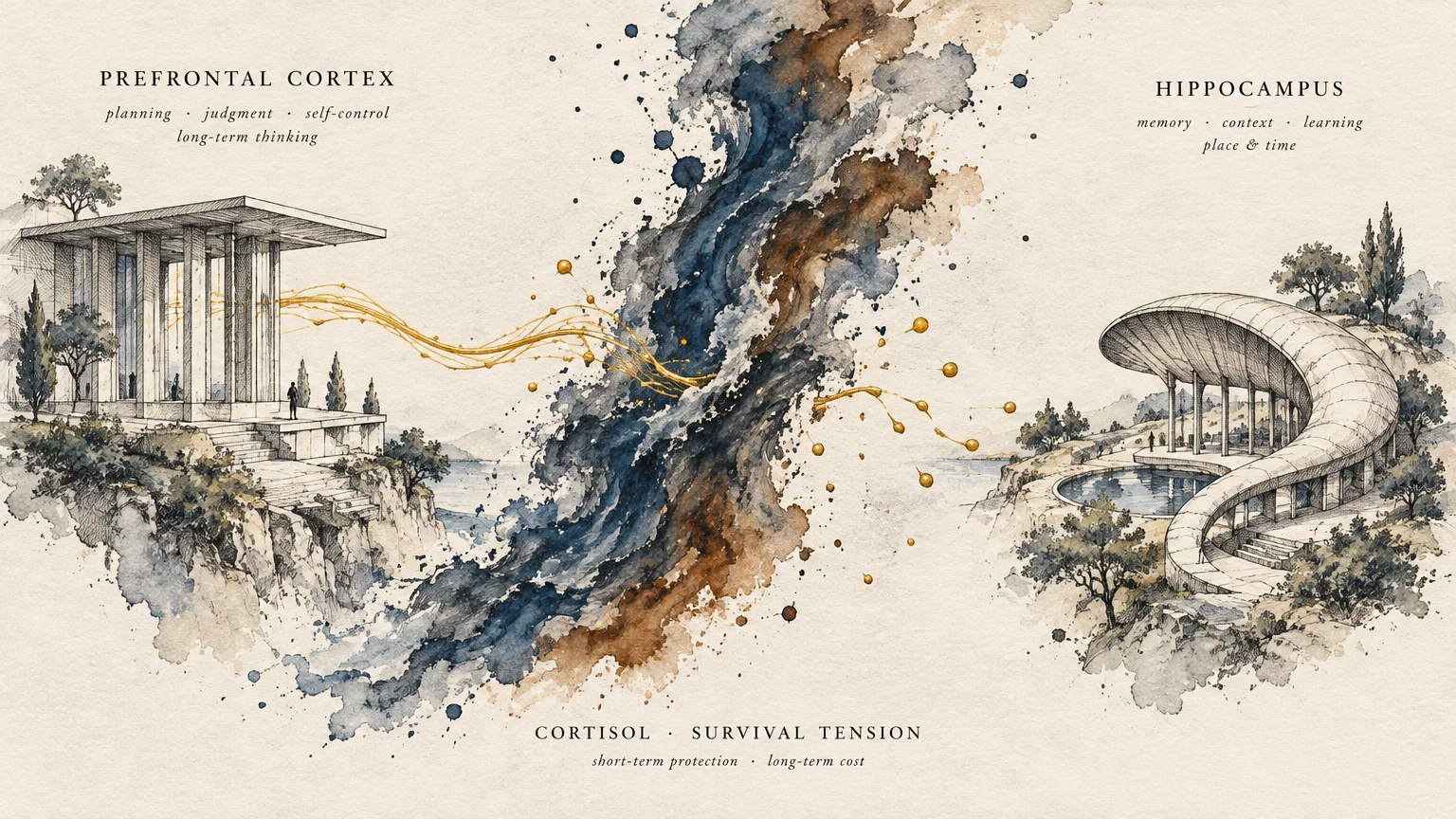
Prolonged exposure to cortisol disrupts communication between your prefrontal cortex and hippocampus. When your nervous system remains in survival mode, your brain actively sacrifices short-term recall to handle perceived immediate threats.
Identifying how tension alters your daily recall helps you differentiate between temporary strain and serious cognitive decline. Reclaiming mental clarity starts with spotting these neurological warning signs early.
How Prolonged Pressure Rewires Your Recall
Persistent emotional pressure alters cognitive architecture much faster than most people realize.
According to research highlighted by Harvard Health Publishing, sustained stress hormones disrupt communication between brain networks that govern memory.
When demands mount, your body triggers an evolutionary fight-or-flight cascade.
This reaction prioritizes immediate survival over the careful encoding of daily conversations or to-do lists.
Understanding this biological shift transforms how you interpret your daily lapses.
Rather than signaling irreversible loss, forgetfulness often acts as your brain’s alarm system indicating excessive mental fatigue.

10 Signs Your Memory Is Affected by Stress
1. You Lose Your Train of Thought Mid-Sentence
You start speaking with confidence, but your sentence evaporates halfway through.
This sudden mental derailment occurs when tension floods your working memory buffers.
Your prefrontal cortex temporarily drops immediate verbal data because racing thoughts consume your processing capacity.
2. The Tip-of-the-Tongue Phenomenon Accelerates
Everyone forgets an occasional acquaintance’s name or a familiar movie title.
However, chronic pressure obstructs the semantic retrieval pathways that connect ideas with verbal labels.
You clearly visualize the concept, yet your neural pathways cannot retrieve the specific word.
3. You Repeatedly Enter Rooms and Forget Your Purpose
Crossing physical doorways frequently wipes your immediate mental agenda clean.
Psychologists document this as the doorway effect, which intensifies when tension fractures your attention span.
Because your nervous system wrestles with internal stress, physical transitions easily displace short-term goals.
4. Daily Routines Demand Unsettling Mental Effort
Automatic tasks like driving home or organizing breakfast suddenly feel strangely complex.
High anxiety dampens the basal ganglia, the brain region that automates familiar behavioral patterns.
When your baseline energy drains into chronic worry, habitual tasks demand active, exhausting concentration.
5. You Re-Read the Same Paragraph Without Retention
You read a work email three times and still cannot absorb its core message.
This frustrating obstacle stems from encoding failure rather than defective memory retrieval.
Because stress floods your mind with background worries, incoming text never registers in short-term storage.
6. You Misplace Essential Items on a Daily Basis
Searching for keys, wallets, or reading glasses becomes an exhausting morning ritual.
You misplace these items because you set them down while your attention remained elsewhere.
Without active conscious presence during the action, your brain creates no original retrieval trace.
7. Simple Multitasking Triggers Mental Freezes
Holding two simple instructions in mind at once suddenly feels overwhelming.
Clinical reports from the American Psychological Association confirm that elevated stress shrinks working memory capacity.
When tasks compete for limited cognitive space, your central executive system freezes and drops operational details.
8. Brain Fog Blurs Timelines and Recent Dates
You struggle to remember whether a team discussion occurred yesterday morning or three days ago.
Emotional exhaustion flattens context cues, stripping memories of their unique time stamps.
This pervasive brain fog blurs distinct days into a single, uniform blur.
9. Stressful Encounters Wipe Surrounding Context
During an intense argument, you recall strong emotions vividly but forget the specific words spoken.
Your amygdala prioritizes emotional threat signals over objective, factual accuracy.
This survival mechanism preserves the emotional warning while discarding logistical nuances.
10. Decision Fatigue Induces Cognitive Paralysis
Choosing what to prepare for dinner feels like an impossible computational challenge.
Evaluating competing options requires rapid working memory retrieval and objective comparison.
When chronic tension depletes prefrontal reserves, your brain shuts down even elementary analytical choices.
Patterns to Watch For: Stress Lapses vs. Neurodegenerative Issues
Many adults worry about dementia or severe neurological decline when memory slips occur.
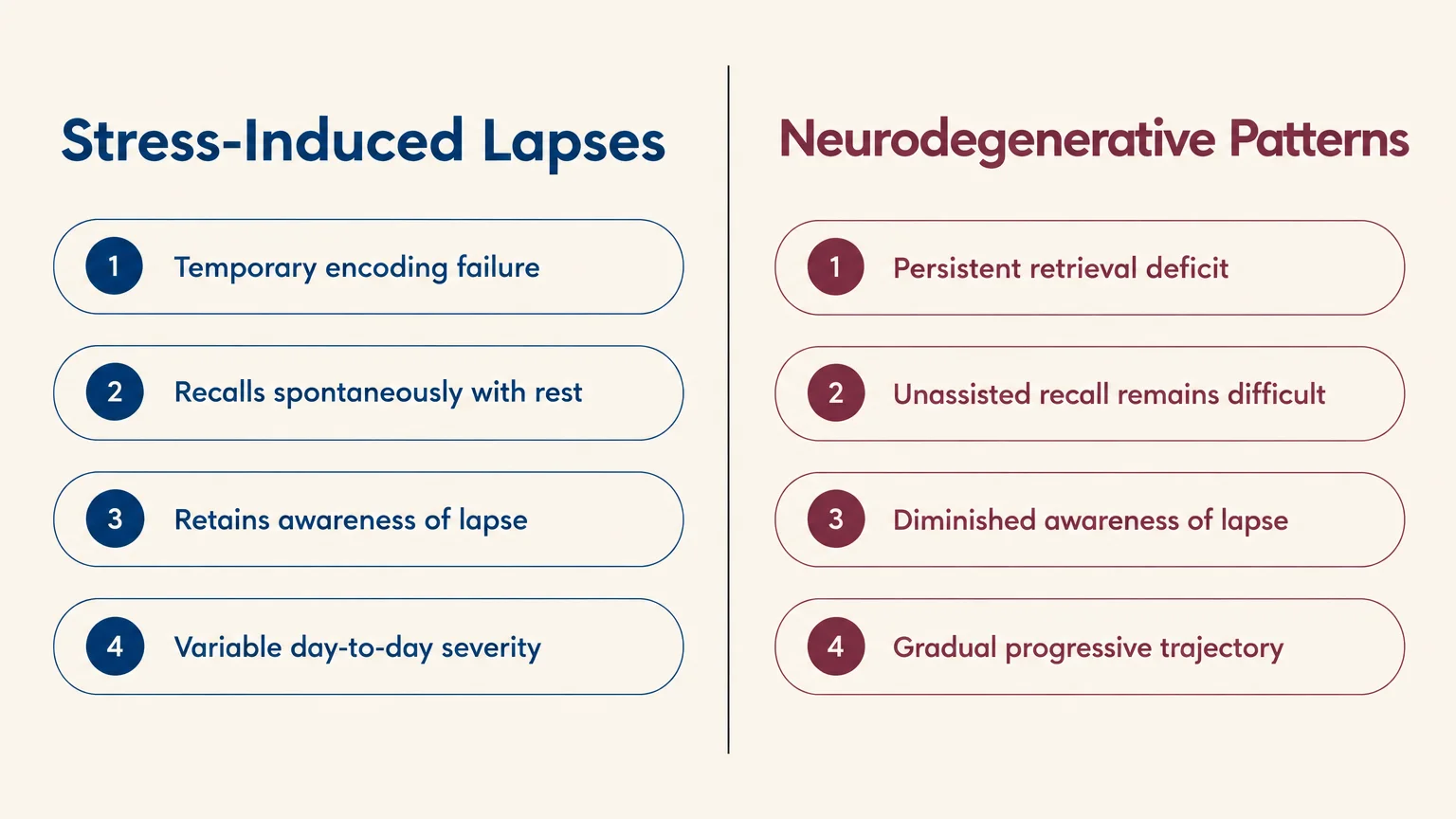
However, stress-induced memory loss exhibits predictable patterns that distinguish it from structural neurodegeneration.
Reviewing these contrasting presentations helps eliminate catastrophic thinking and clarify your cognitive baseline.
| Feature | Stress-Induced Memory Lapses | Clinical Cognitive Decline |
|---|---|---|
| Awareness of Lapses | You notice your forgetfulness immediately and feel acute frustration. | The individual often remains unaware of deficits while family members notice. |
| Memory Retrieval | Details surface later when stress subsides or someone offers a contextual hint. | Information is permanently lost and cues rarely prompt recall. |
| Daily Functioning | Routines take more mental effort, but you remain capable of independent living. | Core independent tasks like managing personal hygiene or basic finances deteriorate. |
| Progression | Symptoms fluctuate directly with stress levels and improve after rest. | Deficits progress consistently over time regardless of emotional relaxation. |
Notice how stress-induced lapses fluctuate alongside your emotional state and sleep quality.
When you reduce your workload or take intentional downtime, your recall typically rebounds.
The Neurobiology: Cortisol and Hippocampal Function
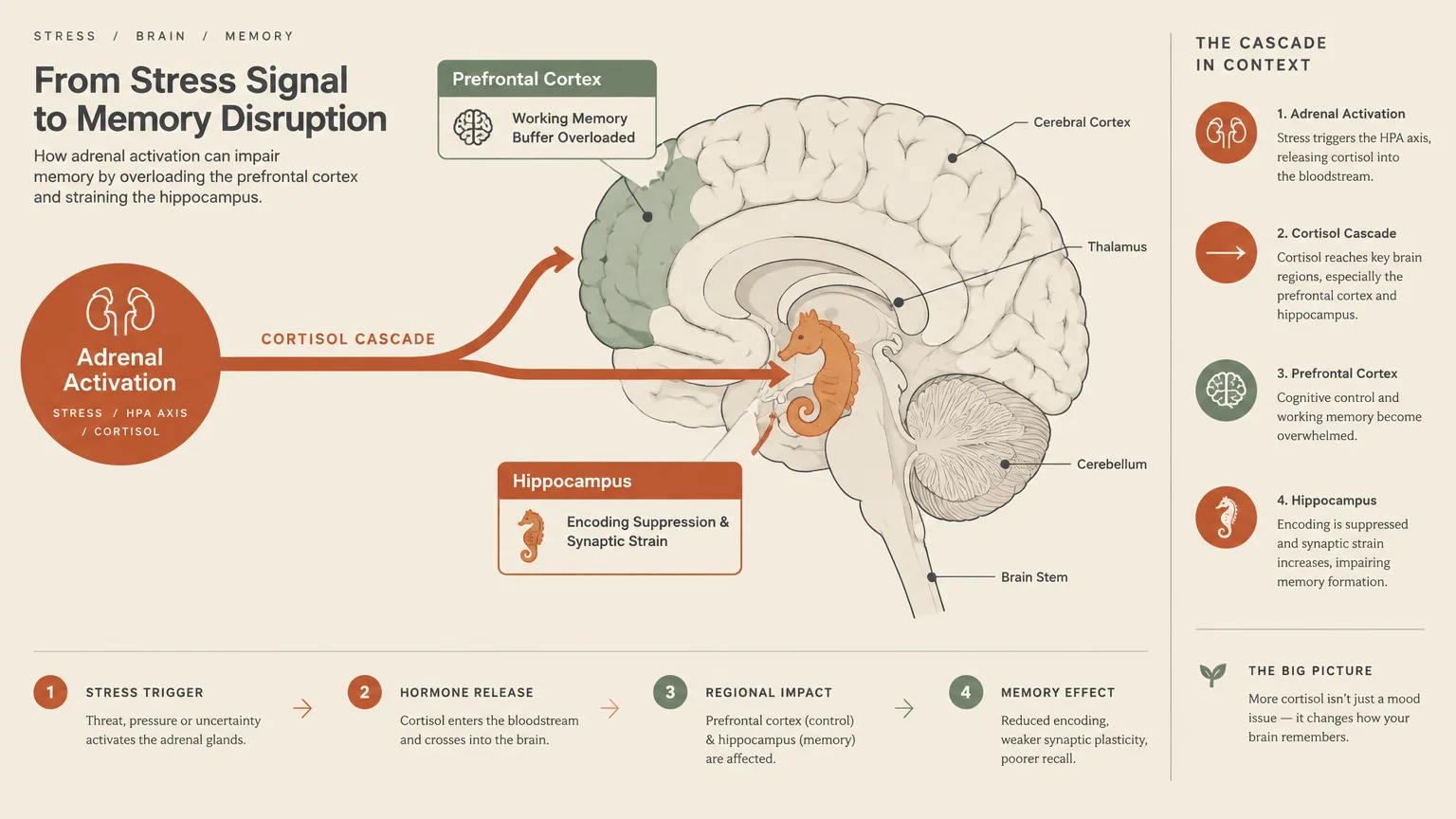
To resolve memory issues, you must examine how stress hormones affect neural wiring.
Data from the National Institutes of Health illustrates that chronic cortisol exposure shrinks dendritic spines in the hippocampus.
The hippocampus acts as your internal librarian, indexing memories and sorting new inputs.
When cortisol floods hippocampal tissue, it suppresses brain-derived neurotrophic factor, a protein vital for synaptic plasticity.
Meanwhile, your amygdala expands its activity, keeping you on edge and impairing calm reflection.
“Between stimulus and response there is a space. In that space is our power to choose our response.” — Viktor E. Frankl, Neurologist and Psychiatrist
Cultivating that intentional space between a stress trigger and your biological reaction helps your brain restore calm.
Evidence-Based Strategies to Restore Mental Clarity
You do not have to accept persistent forgetfulness as your permanent state of being.
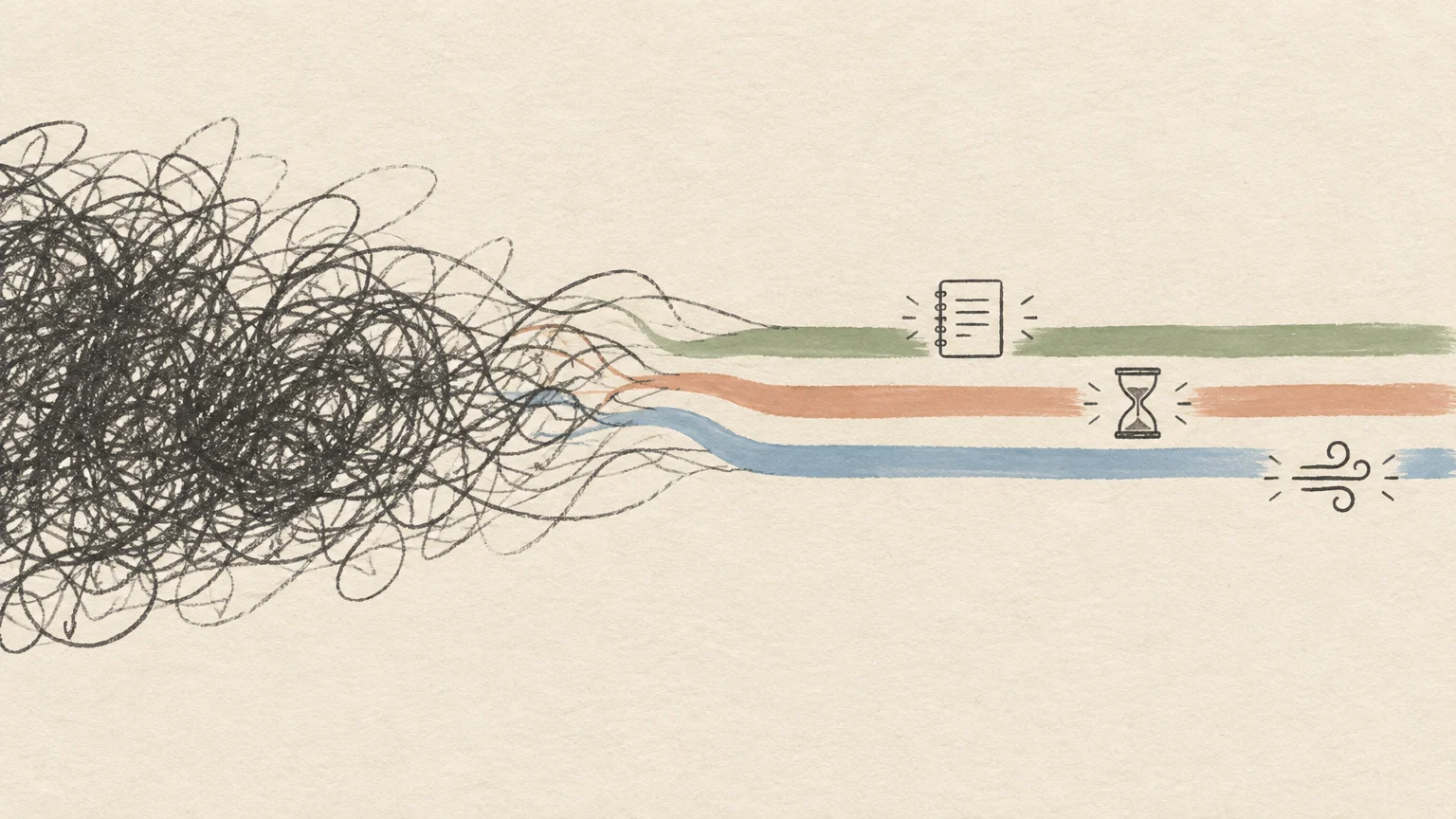
Implementing practical neurological resets will rapidly reduce cognitive strain and sharpen your mental focus.
- Externalize Your Working Memory: Write down non-negotiable tasks immediately using physical paper or simple digital tools to offload cognitive burden.
- Practice Physiological Sighs: Inhale twice through your nose and exhale slowly through your mouth to engage your vagus nerve and slow cortisol production.
- Enforce Strict Sleep Architecture: Protect seven to eight hours of rest, allowing your brain’s glymphatic system to clear metabolic waste and consolidate daily memories.
- Eliminate Chronic Multitasking: Dedicate focused blocks of time to single objectives, preventing context switching from draining your prefrontal cortex.
These systematic changes remove excessive pressure from your prefrontal cortex.
As your nervous system settles, your brain directs metabolic energy back to memory consolidation.

When Self-Help Isn’t Enough
While lifestyle adjustments mitigate common tension, certain cognitive changes require professional medical attention.
According to clinical criteria outlined by the Mayo Clinic, specific patterns indicate a need for comprehensive evaluation.
Consult a healthcare professional or licensed neuropsychologist if you notice any of these signs:
- Getting disoriented or lost in familiar neighborhood environments that you navigate daily.
- Forgetting the identities or essential relationships of close family members and friends.
- Experiencing progressive memory decline that alarms family members while remaining unnoticeable to you.
- Facing severe executive dysfunction that impacts financial management, medication compliance, or personal safety.
Therapeutic interventions like Cognitive Behavioral Therapy can untangle chronic anxiety from underlying cognitive barriers.
The National Institute of Mental Health offers evidence-based resources to connect individuals with qualified psychiatric care.
Frequently Asked Questions
Can memory loss from stress be reversed?
Yes, stress-related memory loss is largely reversible once cortisol levels normalize.
When you reduce systemic tension and restore restorative sleep, hippocampal neurogenesis recovers and recall sharpens.
How long does it take for stress-related brain fog to clear?
Cognitive clarity often improves within several weeks of consistent nervous system regulation.
However, recovery timelines depend on the duration of chronic stress and your individual sleep quality.
Can an acute panic attack cause permanent brain damage?
An acute panic attack does not cause structural brain damage or destroy memory tissue.
It produces a temporary flood of adrenaline that disrupts immediate recall without altering long-term cognitive integrity.
What is the difference between forgetfulness and brain fog?
Forgetfulness refers to the failure to retrieve or encode specific pieces of stored information.
Brain fog describes a pervasive sense of mental sluggishness, slow processing speed, and cloudy thinking.
Reclaiming Your Mental Focus
Experiencing memory lapses during seasons of high pressure reflects normal biological overload, not personal failure.
By prioritizing nervous system recovery and pacing your daily demands, you can rebuild confidence in your mind.
This is educational content based on psychological research and general principles. Individual experiences vary significantly.
For personalized guidance, consult a licensed therapist, psychologist, or counselor.
Last updated: February 2026. Psychology research evolves continuously—verify current findings with professional sources.









Leave a Reply