

You enter a conversation feeling calm, centered, and content. Twenty minutes later, you walk away completely depleted, carrying a sudden, heavy knot of dread in your chest and stomach.
Nothing actually went wrong in your own personal life today. Instead, you subconsciously absorbed someone else’s unexpressed tension and immediately mistook it for your own authentic emotional experience.
When you chronically carry another person’s emotional weight, your nervous system suffers from continuous overload. Identifying these subtle patterns helps you protect your inner peace and restore healthy boundaries.
The Psychology Behind Emotional Contagion
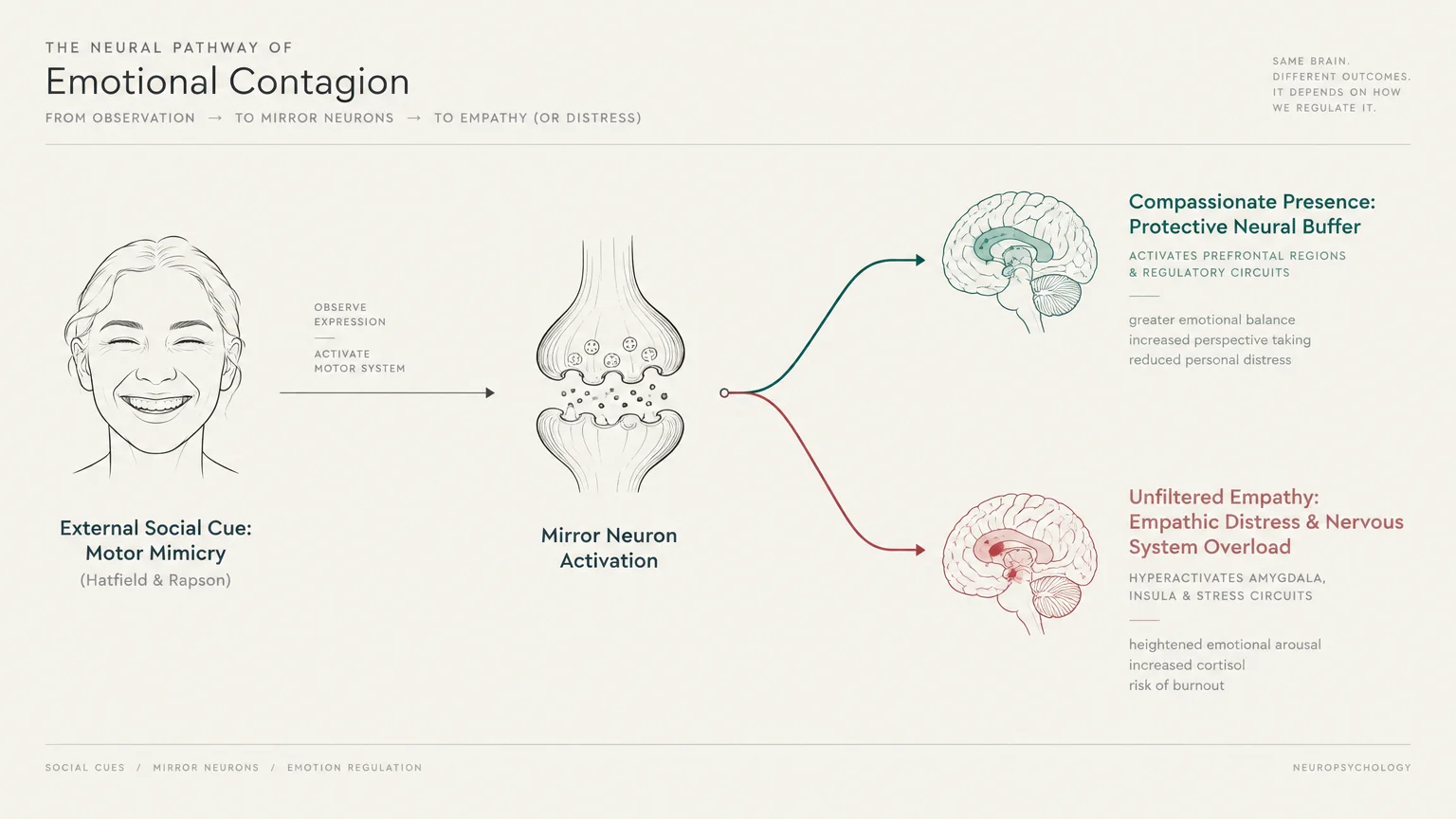
Emotional contagion is the automatic process of catching someone else’s emotional state through subtle social cues.
Psychologists Elaine Hatfield and Richard Rapson first detailed this phenomenon as a primitive form of motor mimicry.
When another person frowns or tightens their jaw, your brain unconsciously mirrors those physical movements.
This physical imitation immediately triggers corresponding neural signals in your own nervous system.
Neuroscientists link this dynamic to mirror neurons, which fire both when you act and when you observe others.
According to the American Psychological Association, social connection relies heavily on this shared emotional resonance.
However, problems emerge when you cannot differentiate between your personal baseline and incoming external signals.
Research by neuroscientist Tania Singer shows that unfiltered empathy often leads to empathic distress and psychological exhaustion.
In contrast, compassionate presence creates a supportive buffer that protects your energy while still allowing you to care.

12 Signs You’re Carrying Someone Else’s Emotions
Recognizing the difference between your own feelings and borrowed distress requires deliberate self-observation.
Watch for these twelve behavioral and somatic indicators in your daily interactions.
1. Sudden, Unexplained Mood Swings
You might start your afternoon feeling cheerful, motivated, and relaxed.
Within minutes of greeting a distressed friend, an intense gloom suddenly settles over your thoughts.
If you cannot trace your emotional shift to a specific personal trigger, you likely caught someone else’s mood.
2. Persistent Fatigue After Casual Socializing
Processing double the emotional data drains your physical reserves rapidly.
You may leave brief, everyday interactions feeling as physically exhausted as if you had completed an intense workout.
Chronic fatigue often signals that your nervous system is working overtime to regulate another person’s unprocessed stress.
3. Physical Symptoms That Mirror Another Person’s Pain
Absorbing others’ emotions frequently manifests as tangible bodily discomfort.
When a loved one describes their severe migraines or chronic nausea, your own body may develop tightness or cramping.
The Cleveland Clinic notes that interpersonal stress regularly produces real somatic reactions like muscle tension and gastrointestinal distress.
4. A Compulsive Urge to Fix Their Pain
When someone suffers near you, you feel an intolerable internal tension.
You rush to offer immediate solutions, reassurance, or tangible help simply to relieve your own inner agitation.
This urgent fixing is rarely about practical support; it is an instinctual attempt to soothe the distress you absorbed.
5. Chronic Guilt When You Experience Joy
You struggle to celebrate personal achievements when a family member or coworker is having a difficult time.
Experiencing happiness feels like an act of betrayal against their ongoing suffering.
Consequently, you downplay your excitement and suppress your wins so you do not make them feel worse.
6. Difficulty Identifying Your Own Baseline Emotions
If someone asks how you feel right now, you might draw a complete blank.
Your internal world resembles a crowded room where multiple external voices drown out your authentic voice.
Lacking strong emotional boundaries slowly erodes your self-awareness until you lose touch with your personal needs.
7. Feeling Responsible for the Emotional Climate
You instinctively monitor room dynamics at family gatherings, team meetings, or dinner dates.
If a prolonged silence falls or someone sighs, your heart rate accelerates immediately.
You adopt the unspoken role of social shock absorber, spending precious energy keeping everyone else comfortable.
8. People-Pleasing Driven by Emotional Self-Defense
Saying no feels dangerous because you cannot tolerate the cold disapproval or disappointment that might follow.
You agree to burdensome favors purely to prevent the other person from projecting uncomfortable resentment toward you.
In this dynamic, appeasement serves as a desperate shield against secondhand negativity.
9. Intense Overwhelm in Crowded Environments
Airports, grocery stores, and open-plan offices feel like sensory and psychological minefields.
You pick up on hurried steps, furrowed brows, and subtle micro-expressions from dozens of strangers simultaneously.
Without conscious filtering, ambient public tension quickly triggers your body’s fight-or-flight response.
10. Mounting Resentment Toward Loved Ones
Over time, carrying invisible emotional baggage breeds silent bitterness toward the people closest to you.
You feel exploited, misunderstood, and emotionally bankrupt; yet you may have never asked them to step back.
Unchecked absorption inevitably damages relationships by turning compassionate empathy into deep-seated resentment.
11. Suppressing Personal Needs to Preserve Harmony
You conceal your own sadness, fear, or anger because you believe others are already too fragile.
You convince yourself that your problems are trivial compared to what everyone else is enduring.
This habitual self-silencing leaves your personal emotional reservoir completely empty.
12. Living in Perpetual “Emotional Sponge” Mode
You operate like an untreated sponge dropped into a basin of dirty water.
You retain the emotional residue of every conflict, venting session, and crisis you witness.
Long after an exchange ends, you continue ruminating on their problems as if they were your own.
Empathy vs. Emotional Absorption: A Key Distinction
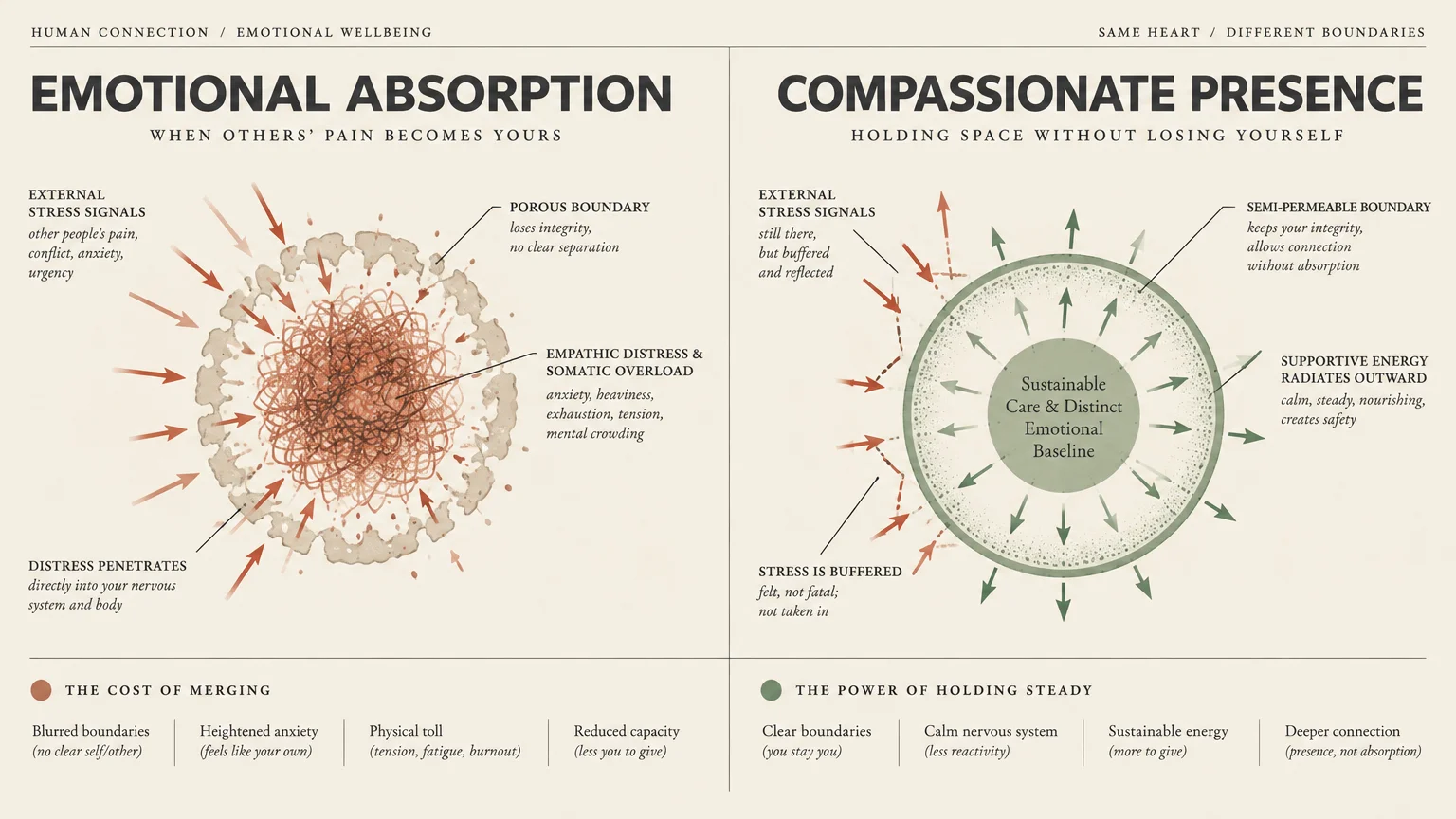
Many people mistake absorbing others’ emotions for genuine empathy.
Healthy empathy allows you to recognize and validate another person’s pain while maintaining your own psychological footing.
Emotional absorption, by contrast, dissolves individual boundaries and treats someone else’s storm as your personal emergency.
“Daring to set boundaries is about having the courage to love ourselves, even when we risk disappointing others.” — Brené Brown, Ph.D., LMSW
When you take on others’ feelings, you surrender the objective clarity required to offer meaningful help.
Examining these patterns side by side clarifies where healthy connection ends and emotional enmeshment begins.
| Dimension | Healthy Empathy | Emotional Absorption |
|---|---|---|
| Boundary Awareness | Maintains a clear distinction between self and other. | Fuses with the other person’s emotional state. |
| Nervous System | Remains grounded, calm, and attentive. | Spikes into distress, anxiety, or fight-or-flight. |
| Internal Goal | Understands and validates their human experience. | Fixes their problem to stop your personal discomfort. |
| Energy Level | Sustains connection without complete depletion. | Experiences acute fatigue and emotional burnout. |
| Aftermath | Returns smoothly to personal baseline feelings. | Carries borrowed stress and rumination for days. |

Common Misconceptions About Absorbing Emotions
Misunderstandings surrounding sensitivity often prevent people from establishing healthy limits.
Deconstructing these myths is essential for building emotional resilience.
Misconception 1: Absorbing Pain Proves How Much You Care
Suffering alongside another person does not lessen their pain; it simply doubles the suffering present.
A lifeguard who jumps into deep water without a flotation device risks drowning alongside the swimmer.
Real support requires holding a sturdy anchor, not getting dragged into the current.
Misconception 2: You Cannot Control How Much You Absorb
While biological sensitivity varies, emotional differentiation is a learnable psychological skill.
Articles published in Psychology Today show that targeted boundary work changes reactive neurological pathways.
You can train your mind to observe external emotions without automatically integrating them into your nervous system.
Misconception 3: Strong Boundaries Make You Cold or Callous
Boundaries do not construct emotional fortresses; they simply place a clear doorway between you and the world.
They allow you to welcome genuine connection while declining to accept unmanaged emotional clutter.
Setting limits actually preserves your warmth, protecting it from turning into bitter exhaustion.

5 Practical Ways to Build Strong Emotional Boundaries
Stopping emotional contagion requires replacing unconscious absorption with deliberate self-regulation.
Practice these five actionable techniques whenever you encounter high-stress environments.
-
Use the “Whose Feeling Is This?” Inventory:
When a heavy wave of sadness or anxiety strikes, pause immediately.
Ask yourself: “Did I feel this way twenty minutes ago?”
Naming the emotion as borrowed allows your brain to release it rather than personalize it. -
Anchor Your Physical Body:
Somatic grounding interrupts mirror neuron overactivity.
Press both feet firmly into the floor, feel the chair beneath your legs, or rub a smooth stone in your pocket.
Physical grounding anchors your focus inside your own body, resisting external pull. -
Set Clear Venting Limits:
You can love your friends while refusing to serve as an emotional dumping site.
Try saying: “I care about what you are dealing with, and I have ten minutes to listen before I need to shift gears.”
Time constraints preserve your bandwidth and encourage the speaker to stay focused. -
Cultivate Compassion Instead of Empathic Distress:
Consciously shift from feeling *with* someone to wishing them well.
Silently repeat: “I acknowledge your struggle, I wish you peace, but this is your journey to navigate.”
This simple mental pivot activates prosocial care circuits instead of personal pain networks. -
Create a Somatic Cleansing Ritual:
Physical transitions signal psychological closure.
Wash your hands with cold water, stretch your arms, or take a short brisk walk after difficult conversations.
These small physical actions remind your nervous system that the interaction is officially over.

Finding the Right Professional Help
Lifelong emotional enmeshment frequently traces back to family conditioning, parentification, or developmental trauma.
Educational resources from the National Alliance on Mental Illness highlight that chronic interpersonal distress warrants structured support.
Consider consulting a licensed therapist if you encounter these four situations:
- You experience severe guilt, panic, or insomnia whenever you attempt to say no to family or friends.
- You cannot identify your personal career goals, relationship desires, or core values independent of other people’s expectations.
- You notice a relentless “fawning” response, sacrificing your physical safety or financial stability to keep others calm.
- Your interpersonal fatigue triggers depressive episodes or persistent somatic illnesses.
Evidence-based modalities like Cognitive Behavioral Therapy (CBT) help dismantle unhelpful codependent assumptions.
Additionally, Acceptance and Commitment Therapy (ACT) and somatic therapies teach you to tolerate interpersonal tension without sacrificing your own peace.
Frequently Asked Questions
Why do I absorb other people’s negative emotions so easily?
You may have high sensory processing sensitivity combined with underdeveloped emotional boundaries.
Growing up in households where you had to manage an adult’s moods often trains your brain to monitor and mirror external emotional shifts.
Is being an emotional sponge the same thing as being an empath?
High sensitivity simply describes an acute awareness of social and sensory inputs.
Being an emotional sponge occurs when that sensitivity lacks boundary regulation, allowing every passing mood to flood your system.
Can absorbing other people’s stress make you physically ill?
Yes; chronic secondhand stress triggers persistent releases of cortisol and adrenaline.
Over extended periods, elevated stress hormones disrupt sleep, weaken your immune system, and exacerbate digestive problems.
How do I stop taking on my partner’s bad mood after work?
Acknowledge their state without stepping in to fix it or cheer them up.
Give them physical space to decompress, and remind yourself that their bad mood is not a critique of you.
Reclaiming Your Emotional Autonomy
Your ability to understand and feel for other people is a profound strength, not an intrinsic flaw.
However, true compassion requires a steady base; you cannot pour comfort from a shattered vessel.
Begin tuning into your physical cues today, and remember that you have every right to return what does not belong to you.
This article provides general educational information about psychology and relationships. It is not a substitute for professional therapy or medical advice.
Everyone’s situation is unique—if you’re struggling, please reach out to a licensed mental health professional.
Last updated: February 2026. Psychology research evolves continuously—verify current findings with professional sources.








Leave a Reply