

True confidence rarely shouts, yet hidden insecurity frequently disguises itself behind polished accomplishments and social charm. When you look closely, subtle defensive habits reveal a quiet struggle with self-worth.
Psychological research shows that people often mask internal self-doubt through strategic compensation. You might spot these coping mechanisms in demanding colleagues, distant partners, or even your own daily routines.
Recognizing these concealed patterns allows you to build genuine emotional resilience instead of exhausting facades. Here are eight key behaviors that signal hidden insecurity and how to navigate them effectively.
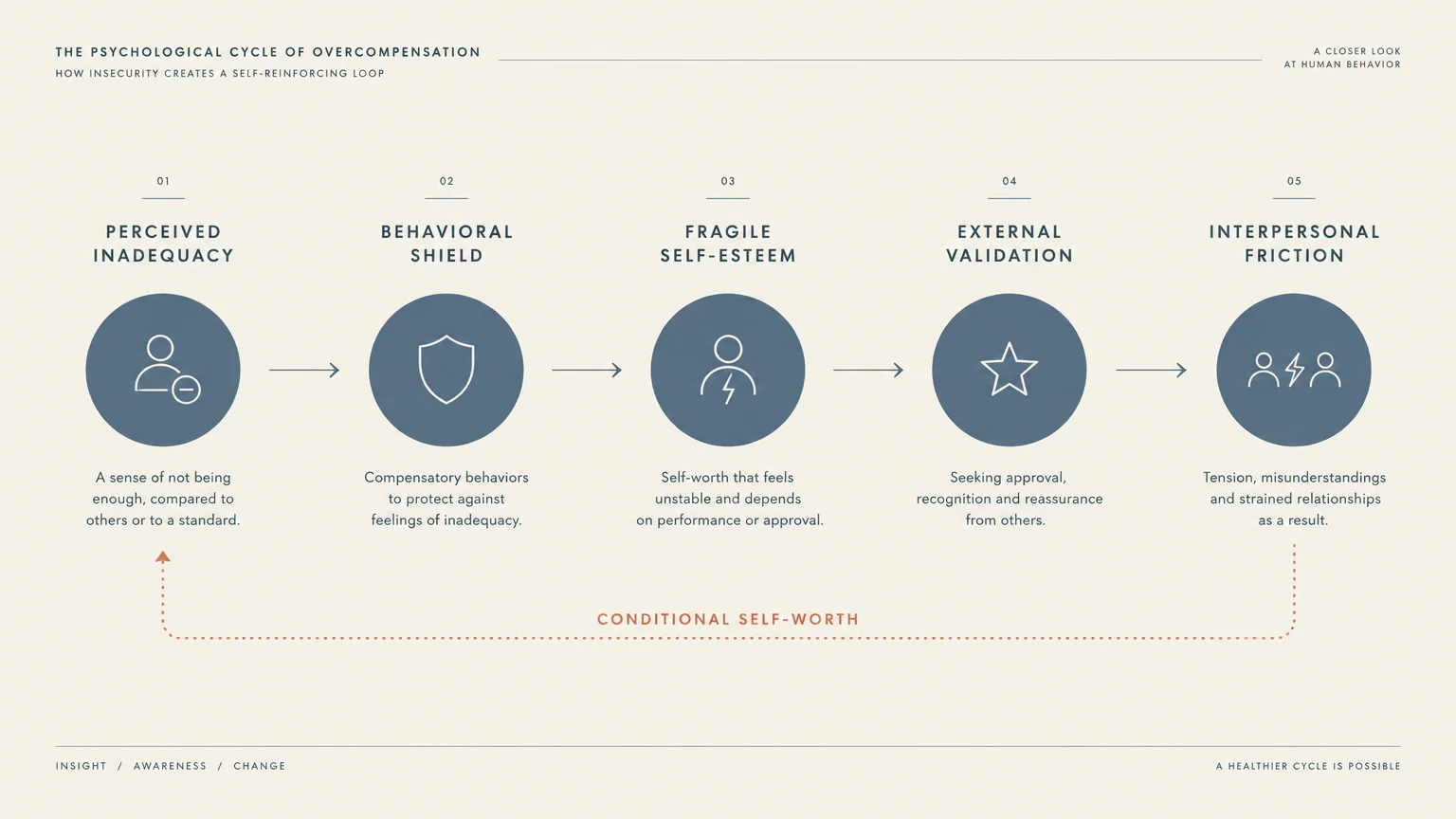
The Psychology Behind Masked Insecurity
Insecurity does not always manifest as social withdrawal or nervous stuttering. In many cases, it operates beneath an outward display of competence, assertiveness, or social poise.
Pioneering psychologist Alfred Adler observed that individuals frequently overcompensate when feeling inadequate. To protect against feelings of helplessness, people create protective behavioral shields.
Modern research highlights the concept of fragile self-esteem. According to research published by the American Psychological Association, fragile self-worth fluctuates dramatically based on external validation and perceived social threats.
When self-worth feels conditional, your brain interprets interpersonal friction as an existential crisis. Defensiveness and status signaling then serve as automatic shields to keep vulnerability hidden from the world.

8 Behaviors That Signal Hidden Insecurity
1. Subtle Humblebragging and Chronic Status Signaling
Some people casually slide accomplishments, luxury purchases, or elite connections into everyday dialogue. This pattern, often called humblebragging, attempts to elicit admiration under the guise of casual conversation or modest self-deprecation.
A study from Harvard Business School found that humblebragging consistently reduces perceived sincerity and likability. The underlying motive is rarely arrogance, but rather an urgent thirst to prove personal worth.
If you notice someone constantly dropping names or exaggerating credentials, examine the underlying motive. These declarations often compensate for a deep-seated fear of being overlooked or considered ordinary.
2. Hyper-Defensiveness Disguised as Righteousness
Receiving feedback requires emotional safety. For someone wrestling with hidden insecurity, even gentle critique feels like an aggressive attack on their identity.
Rather than considering constructive input, they counterattack, deflect responsibility, or lecture others on why their perspective is flawed. This overcompensating behavior shields a fragile ego from facing perceived shortcomings.
Psychologists note that secure individuals view mistakes as learning opportunities. Conversely, insecure individuals experience errors as catastrophic proof of their inadequacy.
3. Compulsive People-Pleasing and Boundary Erosion
Saying “yes” when you mean “no” is not merely kindness; it is often an anxious bid for acceptance. Chronic people-pleasers fear that setting boundaries will result in abandonment or rejection.
They sacrifice personal time, physical energy, and emotional well-being to keep others comfortable. Clinical insights from Psychology Today suggest that this behavior stems from conditional childhood approval.
When your self-worth depends entirely on making everyone happy, assertiveness feels dangerous. You end up trading your authentic identity for temporary external validation.
4. Relentless Nitpicking and Fault-Finding
Have you encountered someone who always finds the single flaw in a brilliant achievement? Chronic fault-finding serves as a psychological defense mechanism known as downward social comparison.
Social comparison theory indicates that diminishing others helps insecure individuals artificially elevate their own standing. By highlighting someone else’s flaws, they temporarily quiet their internal inner critic.
This habit often damages romantic partnerships and workplace teams. The critic rarely recognizes that their sharp scrutiny mirrors their own internalized self-judgment.
5. Rigid Perfectionism and Micromanagement
Perfectionism is frequently celebrated as a badge of honor in professional environments. However, research links clinical perfectionism directly to low self-esteem signs and severe anxiety.
Perfectionistic individuals believe that flawless performance guarantees protection against criticism and rejection. They micromanage team members or romantic partners because any deviation feels like a loss of safety.
Perfectionism functions like heavy armor that claims to protect us while preventing genuine connection.
“The curious paradox is that when I accept myself just as I am, then I can change.” — Carl Rogers, Ph.D.
6. Preemptive Over-Apologizing
Apologizing for normal human behavior signals an underlying belief that your presence imposes on others. Insecure individuals frequently say “I am sorry” for asking questions, speaking up, or simply entering a room.
This reflex attempts to defuse potential conflict before it starts. By holding themselves perpetually at fault, they hope to avoid external anger or judgment.
Over-apologizing subtly undermines your professional credibility and interpersonal authority. It communicates to others that your needs and thoughts hold less value than theirs.
7. Conversational Hijacking and One-Upmanship
Whenever a friend shares a personal story, the insecure listener immediately redirects the spotlight to themselves. If you share a difficult headache, they suffered through a debilitating migraine.
This conversational habit, known as one-upmanship, stems from an inability to sit comfortably in an empathetic supporting role. Sharing the floor feels like an erasure of their importance.
Relationship researchers at The Gottman Institute emphasize that attunement requires holding space for your partner. One-upmanship breaks this connection by prioritizing competitive dominance over emotional intimacy.
8. Chronic Indecision and Outsourcing Validation
Struggling over every small decision—from selecting a dinner entree to choosing a career path—signals deep self-distrust. People with hidden insecurity chronically survey others before committing to a choice.
This tendency avoids personal accountability. If an outsourced decision fails, the insecure individual protects their ego by blaming the advice of others.
Second-guessing every instinct reinforces the belief that your judgment is inherently flawed. Over time, outsourcing choices disconnects you completely from your internal compass.
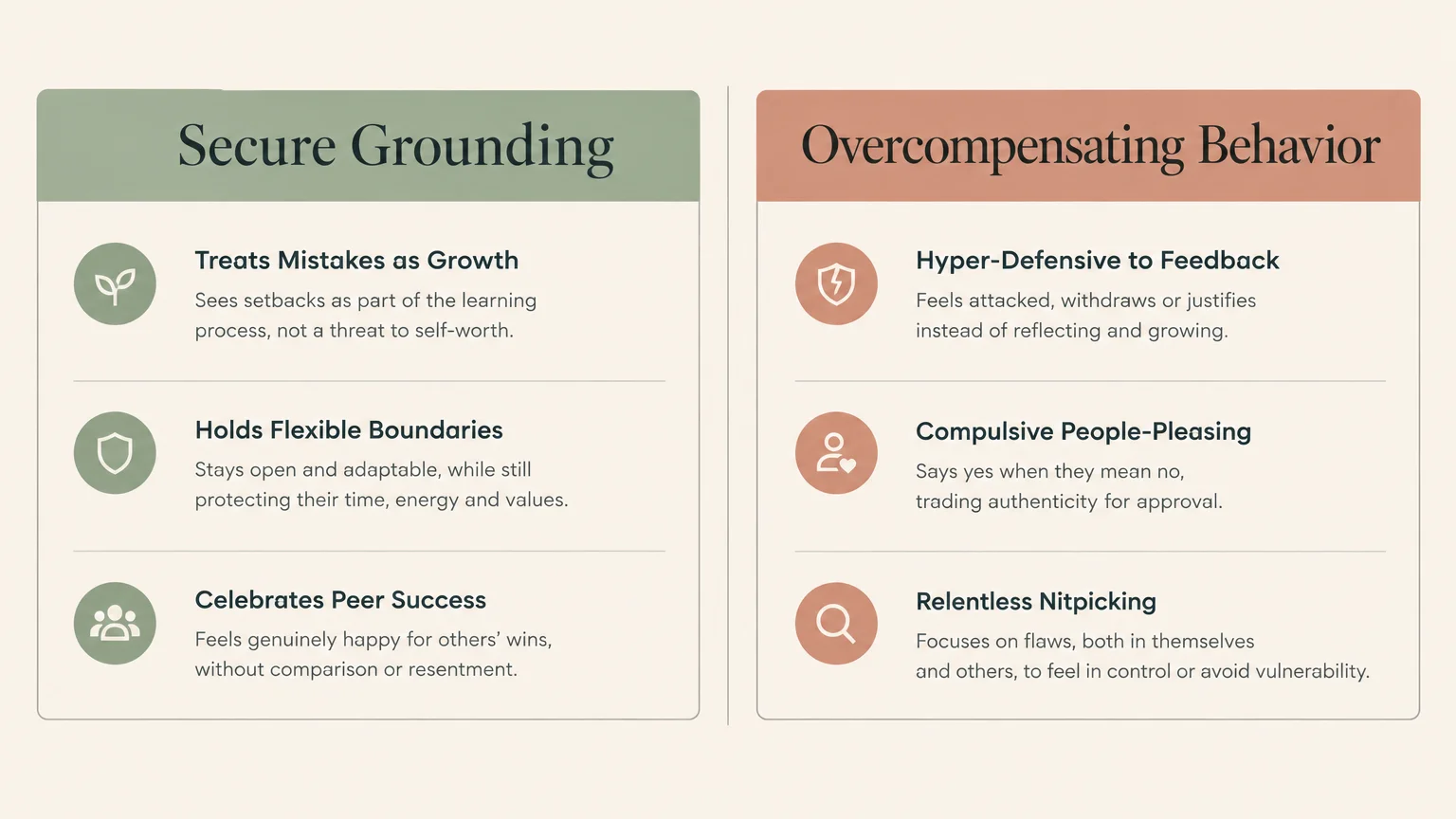
Secure Grounding vs. Overcompensating Behavior
Understanding how insecurity alters interpersonal dynamics helps you identify these behavioral patterns in real time. The contrast between secure coping and overcompensation is distinct.
| Psychological Dimension | Secure Expression | Overcompensating Insecurity |
|---|---|---|
| Handling Feedback | Listens with curiosity; integrates useful critiques without personal defensiveness. | Reacts with hostility, counter-arguments, or immediate deflection. |
| Celebrating Others | Offers genuine praise; feels unthreatened by peer accomplishments. | Minimizes others’ success through nitpicking or subtle humblebragging. |
| Establishing Boundaries | Communicates limits clearly and respects interpersonal friction. | Engages in chronic people-pleasing out of intense fear of abandonment. |
| Making Decisions | Trusts personal judgment while seeking input when genuinely needed. | Outsources minor choices to evade responsibility and possible criticism. |
As the comparison reveals, secure behavior relies on internal stability. Insecure behaviors, meanwhile, expend significant energy attempting to control external perceptions.

What Can Go Wrong: Misinterpreting Insecure Habits
Labeling someone as arrogant or malicious when they are actually terrified often worsens communication breakdowns. When you mistake hidden insecurity for pure malice, your natural reaction is confrontation.
Confronting an insecure individual with aggressive accusations triggers their psychological defenses. This escalation causes them to double down on self-promotion or hostile withdrawal.
Similarly, self-diagnosing without nuance can foster excessive self-criticism. Recognizing your own insecure behaviors should spark self-compassion, not harsh self-punishment.
Another pitfall is playing therapist for an insecure partner or coworker. You cannot fix someone else’s fragile self-esteem through endless reassurance, as external validation rarely heals internal wounds.

Practical Strategies to Build Authentic Security
Transforming hidden insecurity into grounded self-trust requires deliberate, daily shifts in perspective and behavior. You can disrupt defensive loops by practicing specific emotional regulation skills.
Begin by noticing your physiological responses during moments of perceived judgment. When your heart rate climbs, pause before responding or over-explaining yourself.
- Practice the Ten-Second Pause: When you feel the urge to justify yourself or one-up a story, breathe deeply and stay silent.
- Embrace Imperfect Outcomes: Complete a minor task to 85 percent perfection to desensitize your fear of perceived failure.
- State Boundaries Directly: Say a polite “no” to low-stakes requests without providing exhaustive excuses.
- Audit Your Validation Sources: Journal about what you value in yourself independent of career status or social approval.
Consistent practice retrains your nervous system to tolerate vulnerability. As published by Harvard Health, cognitive behavioral strategies help reframe automatic cognitive distortions that fuel chronic insecurity.
Over time, your brain learns that minor mistakes and differing opinions do not threaten your fundamental self-worth.

When to Seek Professional Support
While occasional insecurity is a standard human experience, pervasive self-doubt can undermine your quality of life. Professional guidance becomes essential when defensive behaviors damage your relationships and health.
Consider consulting a licensed mental health professional if you experience any of the following patterns:
- Paralyzing Social Anxiety: You avoid career opportunities, networking, or personal relationships due to intense fear of judgment.
- Relationship Sabotage: Insecurity fuels chronic jealousy, possessiveness, or explosive conflicts with your partner.
- Exhaustion from Perfectionism: The relentless pressure to perform results in clinical burnout, insomnia, or depressive episodes.
- Loss of Personal Identity: You realize you no longer know what you want because you constantly conform to others’ expectations.
Evidence-based modalities like Cognitive Behavioral Therapy (CBT) and Acceptance and Commitment Therapy (ACT) produce reliable results. According to the National Institute of Mental Health, therapeutic interventions help rewire persistent cognitive distortions.
Frequently Asked Questions
How can you tell the difference between confidence and overcompensating insecurity?
Confident individuals speak comfortably about their shortcomings and do not require constant admiration. Insecure individuals, conversely, dominate conversations, steer topics back to themselves, and react defensively to minor critiques.
Can hidden insecurity cause physical health symptoms?
Yes, chronic insecurity maintains a constant state of hyperarousal in your sympathetic nervous system. Over time, prolonged cortisol elevation can lead to tension headaches, digestive issues, chronic fatigue, and poor sleep quality.
How should you respond to someone who displays insecure behaviors?
Maintain calm, firm boundaries without attacking their character or offering patronizing reassurance. Acknowledge their strengths when appropriate, but refuse to engage in competitive one-upmanship or tolerate abusive defensiveness.
Can someone overcome deep-rooted insecurity on their own?
Self-reflection, journaling, and behavioral experiments build meaningful confidence. However, working with a therapist often accelerates healing by uncovering early attachment wounds and breaking entrenched relational habits.
Moving Forward Toward Lasting Confidence
Uncovering the behaviors of hidden insecurity is not an exercise in assigning blame. Instead, it offers a roadmap for understanding the defensive strategies you or those around you developed to feel safe.
True self-worth begins when you dismantle the need to appear flawless, superior, or universally pleasing. By embracing your authentic humanity, you create room for deeper connections and genuine peace of mind.
The information in this article is meant for educational purposes and general guidance; it does not replace individual therapy, counseling, or medical treatment. If you or someone you know is in crisis, contact the 988 Suicide & Crisis Lifeline by calling or texting 988.
Last updated: February 2026. Psychology research evolves continuously—verify current findings with professional sources.









Leave a Reply