

What are the traits most criminals share?
People like John Wayne Gacy, Jeffrey Dahmer, and Ted Bundy have committed some of the most cruel crimes on numerous occasions. As a result of many interviews when tons of psychologists tried to enter their minds after speaking with them, we have some answers. However, there is a question that still lingers inside our heads: “How can a human being be so ruthless and feel no remorse after taking the lives of others?”
The answer is somewhat simple: serial killers or even those who commit one crime only might have experienced trauma or even abuse during their childhood years that led them to commit such atrocities.
In this article, we will try to dig deeper into the topic, and with some luck, by the end, we can pinpoint a couple of common traits most criminals share.

Antisocial anatomy
Numerous court cases throughout the years have added informal proof supporting a biological foundation for criminality. These fall into two categories: either they claim that the brain was anatomically different from other living things, or they claim that damage from a tumor or traumatic brain injury led to a notable alteration in personality.
Changes in the structure of the brain can cause personality disorders such as increased impulsivity, sadness, hostility, improper intimacy, loss of mental control, and violence. This type of person lacks regret and frequently places the blame for their bad actions on other people.
Furthermore, criminals also tend to isolate themselves from others and have quiet lives; at least this is how it looks from the outside, and even if they don’t have empathy or remorse, they can possess better social skills than others. That’s why most of the time, the most notorious serial killers were perceived as friendly, sociable, and often as pleasant neighbors.
Narcissistic personality disorder
Psychologists have found that narcissistic personality disorder is a common trait among most criminals. They claim that narcissists have no capacity for empathy. This concept explains why serial killers’ misconduct persists. Many mass murderers and serial killers exhibit a pathological form of narcissism, and this shouldn’t be a surprise knowing how bad a narcissist can be.
The societal perception of narcissistic individuals is that they are the outcome of severe setbacks and extreme disillusionment with their early romantic partners. People who are serial killers most likely got their start in life from all of the things they went through.
Dysfunctional family background
One of the most frequent characteristics is the absence of emotional and other support from family members. Family members frequently struggle with good communication and are incapable of solving problems. They often do not have the skills required to effectively communicate their feelings.
Abuse or neglect are among the many painful childhood experiences that many serial killers have had. These early interactions may have influenced their unbalanced psychological growth.
Superficial charm
The capacity to seduce and control people is a characteristic shared by most serial killers. They frequently acquire their victims’ trust by putting on a charming front that hides their actual motivations.
Ted Bundy, for example, was seen by many women as friendly, charming, and very handsome. He knew what he was doing; that’s why he used his physique to manipulate the victims into believing his intentions were pure. Little did they know…
Traumatic brain injuries
Few studies have been conducted on this, but those who were made underline that there is a link between traumatic brain injuries and the mental health issues of criminals. If the person has suffered from brain injuries in their early days, it will increase the risk of violent behavior. Studies show that the rate of violence and aggression towards others may range from 30 to 90% for individuals who suffer from traumatic brain injuries.
Low to zero self-control
This has to do with managing one’s impulsivity and temperament. This type of person frequently acts without planning and doesn’t stop to consider their actions before taking them. The focus is on the present moment rather than the long-term effects of the actions.
That’s why low self-control might be one of the common traits most criminals share that lead authorities to catch them. In their rush to do things, not all of them think straight about what to do after the murder. Most probably they get greedy and start being sloppy with how well they hide or get rid of the bodies. Among many other things that made neighbors suspicious, this is what gave away Dahmer, ending with him being caught by the police.
Pathological lying
For those who are unfamiliar, a pathological liar is someone who lies on a regular or obsessive basis, frequently for no apparent purpose or advantage. Pathological liars often engage in this chronic activity, and they will lie even when telling the truth would be simpler.
And you’ve probably guessed that pathological lying is one of the common traits criminals share. Only in this case, they do that with a very precise purpose: to lure the victims into their trap that will end with them taking their lives.
Low serotonin levels
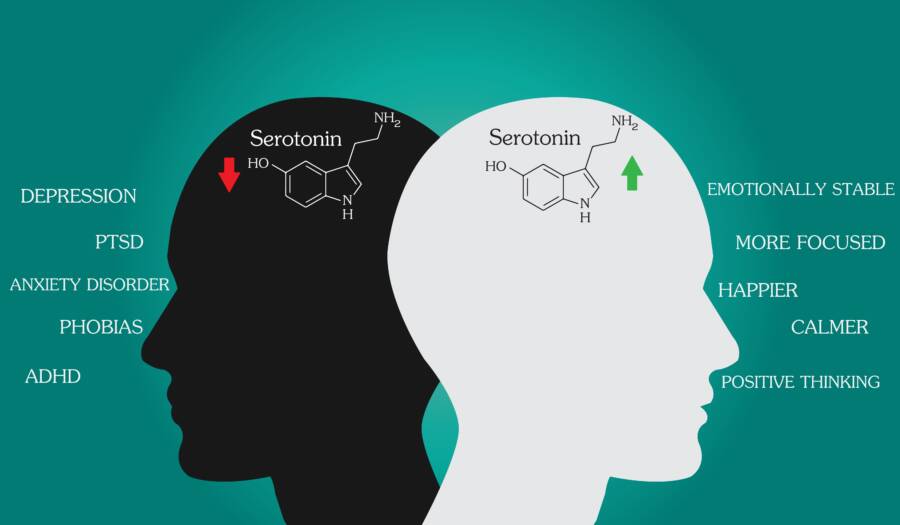
Serotonin levels may potentially have a role in the motivations of serial killers. A neurochemical produced directly in the brain called serotonin is thought to have important functions in mood regulation, social behavior, and other brain areas.
Studies found that impulsive personalities are associated with low serotonin levels; and when the brain has low serotonin levels dysfunctional orbitofrontal cortex function, leads to aggressive behavior. This concept clarifies why serial killers don’t feel regret or empathy for those who are hurt. Abnormally low serotonin levels are also linked to various mental health conditions such as pathological shyness, OCD, anxiety, sadness, and certain addictions.
Need for control
A strong need for control is often the driving force behind the actions of serial killers. Their sense of power and fulfillment stems from their ability to dictate the path their victims take. The need for control also boosts their confidence, which can spike their drive to be violent even worse. This might be a reason why most criminals pick fragile victims with a weak physique—those who can’t fight to escape.
Conclusion:
We can’t sugarcoat this because this is the only truth: we will never know how many dangerous individuals are around us. There is no way we could spot a criminal from afar. And they will continue to exist as long as we live on this planet. Although there can never be a precise justification for these atrocities, understanding the psychology behind a serial killer could be useful in preventing similar situations in the future.
Another way to stop these aggressive impulses in children is to give them a safe, caring environment and good mental health. Maybe also take into consideration therapy from an early age if you notice certain things that might be a red flag.
Are you interested in this topic, but this article wasn’t exactly enough to satisfy your curiosity? Why not start a TV series about it called Criminal Minds? If you’re not sure you’re going to like it, start easily by buying only the first 4 seasons available on DVD at the price of $32.26.
You didn’t like Criminal Minds? For a more in-depth approach to the topic, Mindhunter is another great TV series that you can try, also based solely on serial killers. The acting is so good you will definitely start binging as soon as you finish the first episode.
Related topic: 8 Shocking Traits All Active Shooters Have in Common.









Leave a Reply