
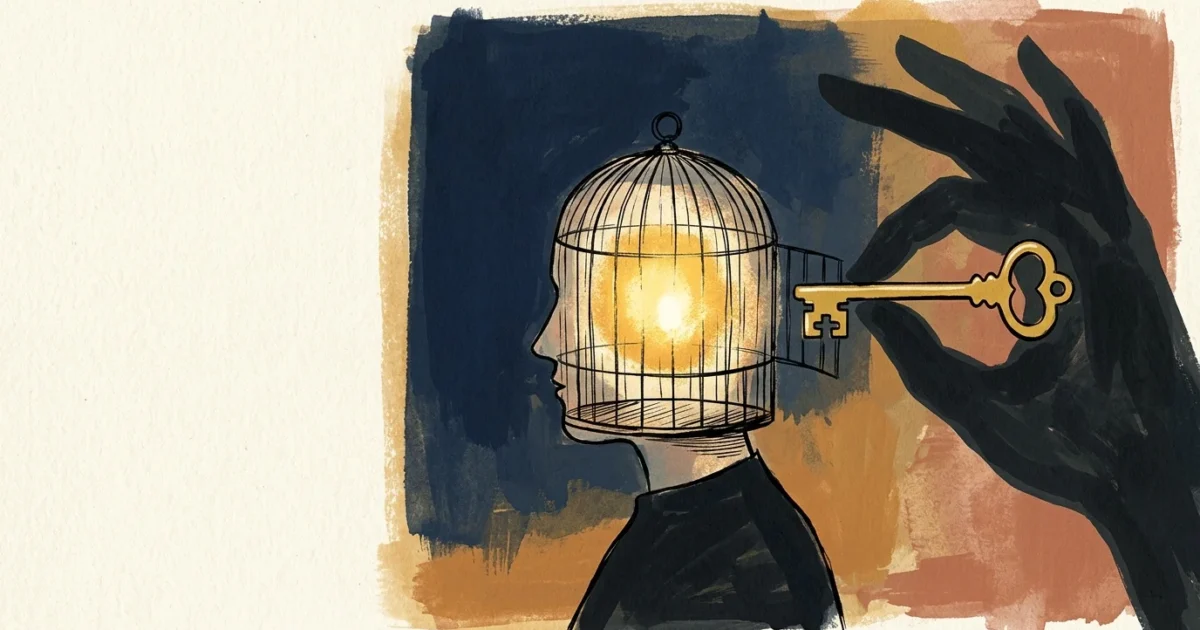
When your mood, self-worth, and daily choices hinge entirely on another person’s reaction, you exist in a state of hyper-vigilance that drains your identity. Constantly seeking approval from others creates an invisible cage where genuine self-expression feels dangerous and quiet disagreement feels like rejection. Emotional dependency transforms healthy connections into high-stakes negotiations for validation, leaving you exhausted and disconnected from your true desires. Recognizing this dynamic marks the essential first step toward regaining your personal autonomy. By identifying the subtle behavioral patterns that fuel external validation seeking, you can rebuild trust in your own judgment and cultivate authentic, resilient relationships.

Understanding Emotional Dependency and External Validation
At its core, emotional dependency occurs when you outsource your emotional regulation and self-esteem to external sources. Rather than possessing an internal anchor that stabilizes your self-worth, you rely on the verbal praise, positive body language, or explicit permission of partner, parent, boss, or friend. In psychological literature, this dynamic often ties to an external locus of control—a concept first developed by psychologist Julian Rotter in 1954. When you operate from an external locus, you believe that external forces, circumstances, or other people dictate your intrinsic value and emotional state.
Human beings possess an innate social need for connection, belonging, and healthy affirmation. Evolutionary psychology demonstrates that seeking approval from others once ensured survival within small social groups; exclusion from the tribe carried life-threatening consequences. However, emotional dependence in relationships goes far beyond basic social cohesion. It transforms healthy interpersonal feedback into an absolute requirement for psychological safety. When you cannot validate your own experiences, decisions, or worth, every interaction carries high risk—leaving you perpetually vulnerable to the mood swings, shifting opinions, or silent withdrawals of those around you.
Clinical perspectives supported by the American Psychological Association emphasize that emotional dependency frequently roots itself in early attachment patterns. If childhood caregivers offered conditional affection—rewarding compliance while punishing independence—you likely learned that personal safety requires hyper-attunement to other people’s emotional signals. As an adult, this survival strategy manifests as chronic approval seeking, self-silencing, and an intense fear of perceived disappointment.

The 7 Clear Signs You’re Emotionally Dependent on Someone Else’s Approval
Recognizing the behavioral patterns of emotional dependency requires rigorous self-honesty. Because approval seeking often masquerades as kindness, empathy, or humility, you might initially overlook its destructive impact on your psychological well-being. Below are the seven key signs of validation seeking that signal a shift from healthy connection to emotional reliance.
1. Your Emotional State Mirrors Someone Else’s Mood or Responsiveness
If your mood plunges the moment a partner appears quiet or a coworker sends a brief text message, you are experiencing high emotional reactivity rooted in dependency. Instead of allowing others to process their own emotions independently, you interpret their neutral or negative states as a direct reflection of your performance or worth. You immediately think, “What did I do wrong?” or “Are they upset with me?” Your entire day hinges on receiving a warm signal that restores your baseline emotional equilibrium.
2. Paralyzing Indecision Without External Input
When making choices—ranging from career transitions to choosing what to wear—you experience intense anxiety unless someone validates your plan. You repeatedly poll friends, partners, or online forums, searching for a consensus that grants you “permission” to proceed. This decision paralysis stems from a deep distrust of your own intellect and intuition. Because you fear making a “wrong” choice that invites criticism, you delegate your agency to external authorities.
3. Chronic People-Pleasing and Boundary Erasure
You find yourself agreeing to requests that drain your physical, financial, or emotional bandwidth simply because saying “no” triggers unbearable guilt. When you prioritize maintaining someone else’s comfort over honoring your own personal limits, you erase your boundaries to secure their approval. Over time, this chronic self-abandonment breeds underlying resentment, emotional exhaustion, and a eroded sense of identity.
4. Catastrophizing Minor Disagreements or Conflict
In healthy relationships, conflict offers an opportunity for deeper understanding and collaborative problem-solving. For an emotionally dependent individual, disagreement feels like an existential threat. A opposing opinion from a partner or friend triggers immediate panic, leading you to quickly back down, apologize profusely for holding a different view, or abandon your stance altogether just to restore harmony. You view non-alignment as an immediate precursor to abandonment.
5. Shape-Shifting Your Opinions and Persona
Notice whether your interests, political stances, speech patterns, or core values shift depending on the company you keep. Known as social chameleon behavior, shape-shifting allows you to minimize friction and maximize instant acceptance. While flexibility is a useful social skill, completely abandoning your authentic preferences to match those of an admired figure reveals a deep-seated need for external validation.
6. Compulsive Reassurance Seeking
You frequently ask variations of questions like: “Are you mad at me?” “Did I do okay on that project?” “Are we alright?” These repetitive inquiries serve as a temporary band-aid for internal anxiety. While receiving a positive answer brings immediate relief, that comfort quickly evaporates, sending you back into a cycle of uncertainty. This behavior burdens your relationships, as loved ones eventually feel exhausted by the demand to continually shore up your self-worth.
7. Profound Emptiness and Anxiety When Alone
Solitude offers an authentic gauge of emotional autonomy. When you are alone, do you feel centered and restful, or do you experience severe restlessness, anxiety, and a feeling of void? An emotionally dependent individual struggles in solitude because the primary source of their internal validation is physically absent. Without an audience or validator present, you struggle to feel grounded or valuable in your own skin.
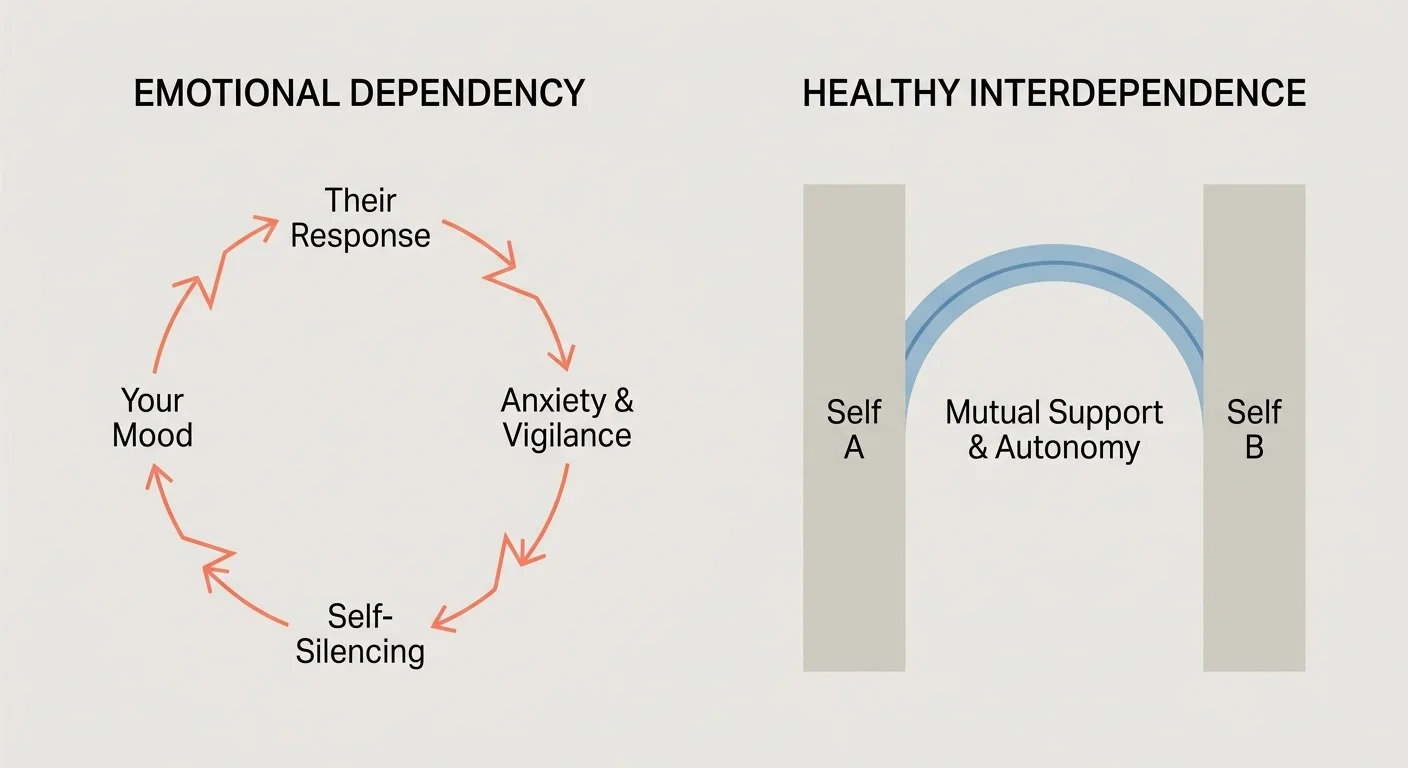
Emotional Dependency vs. Healthy Interdependence
Understanding the distinction between emotional dependency and healthy emotional connection helps clarify what healthy boundaries look like in action. Research published in outlets like Psychology Today highlights that healthy relationships do not demand total self-sufficiency; rather, they thrive on mutual support between two autonomous individuals.
| Dimension | Emotional Dependency | Healthy Interdependence |
|---|---|---|
| Source of Self-Worth | External: Relies on praise, consensus, and approval from others. | Internal: Rooted in personal values, self-compassion, and self-efficacy. |
| Response to Conflict | Panic, appeasement, self-silencing, or total emotional collapse. | Curiosity, active listening, clear boundary setting, and mutual resolution. |
| Decision-Making | Requires external consensus; high anxiety over solo choices. | Seeks input when useful, but retains personal responsibility for final choices. |
| Boundaries | Porous or non-existent; fears setting limits will cause rejection. | Clear and flexible; respects personal limits and honors the limits of others. |
| Sense of Identity | Fluctuates based on social environment and partner feedback. | Stable, authentic sense of self that persists across varied settings. |

Myths Worth Debunking About Approval Seeking
Misconceptions surrounding approval seeking often prevent people from seeking appropriate help or cultivating true self-worth. Clearing away these myths allows you to approach your emotional recovery with clarity and compassion.
Myth 1: Seeking approval means you are exceptionally empathetic and caring.
While approval seekers often possess high emotional attunement, chronic validation seeking is fundamentally driven by self-preservation and fear, not pure altruism. When you monitor others to secure safety or avoid rejection, your primary focus remains managing your own internal anxiety rather than genuinely attending to the other person’s actual needs.
Myth 2: Breaking emotional dependency requires total emotional detachment.
Hyper-independence—the belief that you must rely on no one and hide all vulnerability—is simply the opposite extreme of dependency, often representing an avoidant trauma response. True psychological health involves interdependence: staying grounded in your self-worth while allowing mutual, vulnerable connection with trusted individuals.
Myth 3: You can cure emotional dependence simply by telling yourself “I don’t care what anyone thinks.”
Dismissing human social connection is neither realistic nor healthy. You do not need to eradicate all concern for social feedback; instead, you need to balance external feedback with a dominant, supportive internal voice.

5 Actionable Steps to Break the Cycle of External Validation
Transitioning from an external locus of control to an internal anchor requires deliberate daily practice. Use these evidence-based techniques to cultivate self-reliance and reduce your dependence on external approval.
1. Practice the “Validation Pause”
Before asking someone else for their opinion on a decision, habituate a mandatory pause. Ask yourself: “What do I think about this? What does my intuition tell me?” Write down your own stance before consulting anyone else. This exercise builds neural pathways that reinforce your internal decision-making authority.
2. Perform Low-Stakes Boundary Experiments
Rebuild self-trust by asserting small, low-stakes boundaries where the risk of conflict is minimal. Practice saying, “I actually prefer a different restaurant tonight,” or “I won’t be able to make that call today, but I can catch up tomorrow.” Experiencing small moments where you hold your boundary without catastrophic social fallout rewires your nervous system’s threat response.
3. Cultivate Self-Compassion Over Self-Criticism
Humanistic psychologist Carl Rogers famously noted the foundational requirement for personal growth:
“The curious paradox is that when I accept myself just as I am, then I can change.” — Carl Rogers, PhD, Humanistic Psychologist
When you catch yourself seeking external reassurance, avoid punishing yourself with negative self-talk. Acknowledge the underlying fear with warmth. Replace internal criticism with supportive phrases like: “It makes sense that I want validation right now, but I am capable of soothing my own anxiety.”
4. Identify and Clarify Your Core Values
Emotional dependency thrives when you don’t know what you personally stand for. Dedicate time to defining your primary values—such as honesty, creativity, autonomy, or kindness. When faced with a choice, evaluate it against your personal value system rather than predicting whether it will win external applause. Leading researcher Dr. Brené Brown underscores the power of authentic living:
“True belonging doesn’t require you to change who you are; it requires you to be who you are.” — Brené Brown, PhD, LMSW, Research Professor
5. Utilize Somatic Self-Soothing Techniques
Approval seeking is often an automated somatic reaction to physical anxiety. When you feel the intense urge to ask for reassurance or appease someone, ground your physical body. Use box breathing (inhale for 4 seconds, hold for 4, exhale for 4, hold for 4) or splash cold water on your face to stimulate the vagus nerve. By lowering your nervous system’s fight-or-flight activation, you can make conscious choices rather than reacting out of distress. Additional stress-reduction techniques supported by Harvard Health offer valuable tools for emotional self-regulation.

Signs It’s Time to Talk to a Therapist
While self-directed strategies yield significant progress, overcoming deep-seated emotional dependency signs often requires professional clinical guidance. Consider partnering with a licensed mental health professional if you experience any of the following scenarios:
- Severe Relational Burnout: You repeatedly find yourself in one-sided, controlling, or emotionally abusive dynamics because the thought of ending the relationship feels unbearable.
- Pervasive Anxiety and Panic: The threat of someone being displeased with you triggers physiological panic attacks, chronic insomnia, or intrusive thoughts that interfere with daily functioning.
- Complete Loss of Personal Identity: You realize you no longer know your personal preferences, values, goals, or hobbies independent of the important figures in your life.
- Unresolved Childhood Trauma: Your need for validation stems from early childhood neglect, emotional volatility in your family of origin, or severe abandonment experiences that require structured trauma-informed care (such as CBT, EMDR, or Schema Therapy).
If you are looking for evidence-based mental health resources or professional directories, organizations like the National Alliance on Mental Illness (NAMI) provide guidance for finding qualified therapeutic support in your area.
Frequently Asked Questions
What is the primary root cause of emotional dependency?
Emotional dependency typically stems from early developmental experiences where conditional love, emotional neglect, or unpredictable caregiving forced a child to prioritize pleasing others to feel safe. In adulthood, these attachment strategies persist as chronic approval seeking and fear of rejection.
Can you be emotionally dependent on someone without realizing it?
Yes. Many individuals misinterpret emotional dependency as high empathy, loyalty, or relational devotion. You might only realize you are dependent when you experience sudden panic during a disagreement, or when a relationship ends and you suffer a severe crisis of personal identity.
How does emotional dependence impact romantic relationships?
While dependency may initially look like deep passion, it eventually strains romantic partnerships. Relationship experts at The Gottman Institute emphasize that healthy intimacy requires two distinct selves. Dependency forces one partner into the role of constant validator, leading to caretaker fatigue, loss of romantic desire, and resentment.
How long does it take to build internal validation skills?
Rewiring long-standing patterns takes consistent practice over several months. As you repeatedly practice setting small boundaries, pausing before seeking input, and self-soothing your anxiety, your brain strengthens new pathways, making self-trust your default response over time.
Moving Forward with Self-Compassion
Reclaiming your personal autonomy is not about becoming cold, detached, or entirely self-sufficient. It is about shifting your foundation so that other people’s opinions inform your perspective rather than dictate your worth. As you learn to validate your own experiences and hold firm boundaries, your relationships transform from high-stakes survival tests into spaces of genuine, mutual connection.
Start small today. Pick one decision, honor your own internal preference, and offer yourself the validation you have been waiting to receive from others.
The information in this article is meant for educational purposes and general guidance. It does not replace individual therapy, counseling, or medical treatment. If you or someone you know is in crisis, contact the 988 Suicide & Crisis Lifeline by calling or texting 988.
Last updated: February 2026. Psychology research evolves continuously—verify current findings with professional sources.








Leave a Reply