

When someone plays psychological mind games, they chip away at your self-trust while keeping you constantly off-balance. Recognizing these deceptive behavioral patterns empowers you to set firm boundaries and protect your peace.
Emotional manipulation rarely arrives with clear warning labels. Instead, it surfaces through subtle conversational shifts, unexpressed demands, and confusing power dynamics that leave you questioning your instincts.
Identifying covert manipulation is the first step toward reclaiming your agency. Here are ten psychological patterns to watch for and concrete ways to respond effectively.

1. Shifting Reality Through Subtle Gaslighting
Gaslighting occurs when an individual systematically distorts the truth to make you doubt your perception, memory, or sanity. According to clinical definitions supported by the American Psychological Association, gaslighting represents a form of psychological abuse where a person manipulates another into questioning their own reality.
In everyday conversations, this tactic does not always appear as outright fabrications. A partner, coworker, or family member might use phrases like “You are remembering that completely wrong,” “You are taking things way too personally,” or “I never said that; you are imagining things.” When someone repeatedly invalidates concrete events, you begin relying on their version of reality rather than your own senses—which is precisely the balance of power they want.

2. Hot-and-Cold Intermittent Reinforcement
One of the most addictive mind games relies on intermittent reinforcement—a behavioral principle where rewards appear unpredictably. One day, this person showers you with affection, praise, and undivided attention; the next, they become distant, cold, and aloof without explanation.
Psychologists note that unpredictable relationship dynamics trigger spikes in dopamine similar to the neurological reward patterns observed in gambling. You find yourself constantly working to regain their approval, analyzing your every move to recreate the initial warmth. This dynamic creates a powerful emotional dependency, keeping you focused entirely on managing their moods.

3. Weaponized Guilt and the Perpetual Victim Role
People who play psychological mind games rarely take direct accountability for their mistakes. Instead, they invert interpersonal conflicts so that they consistently emerge as the wronged party. If you express hurt over a broken promise, they might respond by highlighting their exhausting week, an old emotional wound, or how unsupportive you are being.
By shifting focus onto their emotional distress, they force you into a caretaker role. You end up comforting and apologizing to them, completely abandoning the legitimate issue you originally raised. Over time, weaponized guilt trains you to suppress your needs to avoid triggering their defensive reactions.

4. Moving Goalposts to Keep You Off-Balance
Have you ever worked tirelessly to meet someone’s expectations, only to find that the requirements changed the moment you succeeded? Moving the goalposts is a deliberate strategy designed to maintain psychological leverage.
In manipulative relationships, satisfaction remains permanently out of reach. If you adjust your communication style to please them, they will criticize your tone; if you fix your tone, they will attack your timing. This perpetual dissatisfaction ensures you remain in a state of performance anxiety, striving for validation that they never intend to grant.

5. The Silent Treatment as a Punishment Mechanism
While taking a brief, communicated pause during a heated argument is healthy emotional self-regulation, the silent treatment is fundamentally different. It involves abruptly cutting off communication, affection, and presence to punish you, demand submission, or regain control.
Research from The Gottman Institute identifies stonewalling and emotional withdrawal as destructive behaviors that severely erode relationship stability. When someone gives you the cold shoulder without explaining what is wrong or when they will resume communication, they force you to endure agonizing uncertainty until you capitulate.
“Stonewalling occurs when the listener withdraws from the interaction, shuts down, and simply stops responding to their partner.” — John Gottman, Ph.D., Clinical Psychologist and Relationship Researcher

6. Triangulation and Manufactured Insecurity
Triangulation happens when a manipulator introduces a third party into your relationship dynamic to create jealousy, insecurity, or a false sense of competition. This third party could be an ex-partner, a charming colleague, a charismatic friend, or even a critical family member.
The manipulator might drop casual comparisons: “Alex always knows how to handle these situations without getting upset,” or “My coworker thought my idea was brilliant, unlike you.” By placing you in unspoken competition with someone else, they weaken your confidence and position themselves as the ultimate prize whose favor you must constantly earn.

7. Disguised Insults and “Just Joking” Sarcasm
Covert insults often arrive disguised as playful teasing, constructive criticism, or backhanded compliments. When an offensive remark visibly stings, the manipulator quickly defuses the situation by accusing you of being overly sensitive or unable to take a joke.
This tactic gives the individual plausible deniability; they deliver sharp emotional jabs while maintaining the illusion of innocence. When someone repeatedly targets your insecurities under the guise of humor, pay attention to the pattern—genuine humor builds connection, whereas weaponized sarcasm establishes superiority.
8. Strategic Vulnerability Used as Leverage
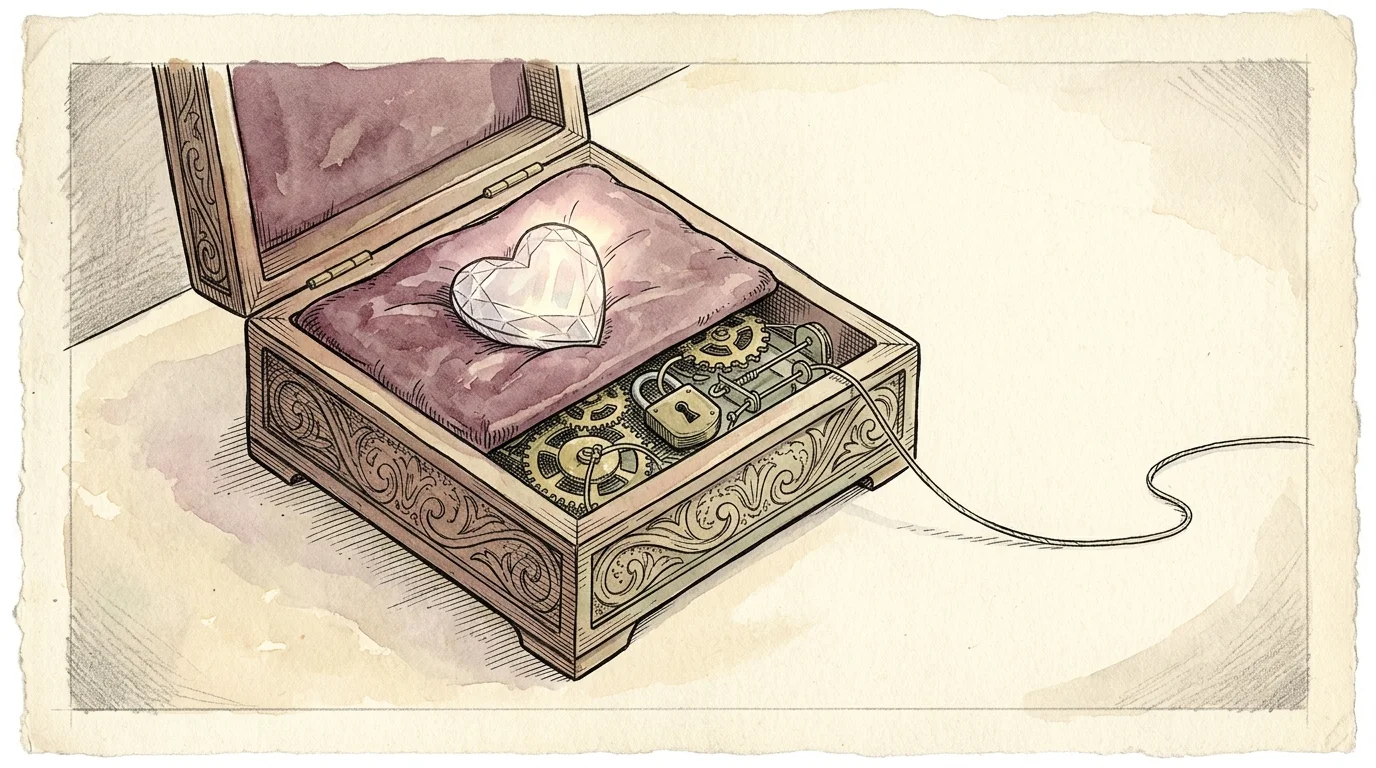
Healthy intimacy develops through reciprocal, gradual sharing. Manipulative individuals, however, often deploy intense personal disclosures very early in a connection to fabricate an instant, artificial bond. They share their deepest traumas, secrets, or past relationship failures to solicit your immediate trust and empathy.
Later, this strategic vulnerability becomes leverage in two distinct ways:
- They use their past trauma as an all-purpose excuse for bad behavior (“You know what my ex did to me, so you should understand why I act this way”).
- They weaponize the private vulnerabilities you shared with them during arguments to strike where it hurts most.
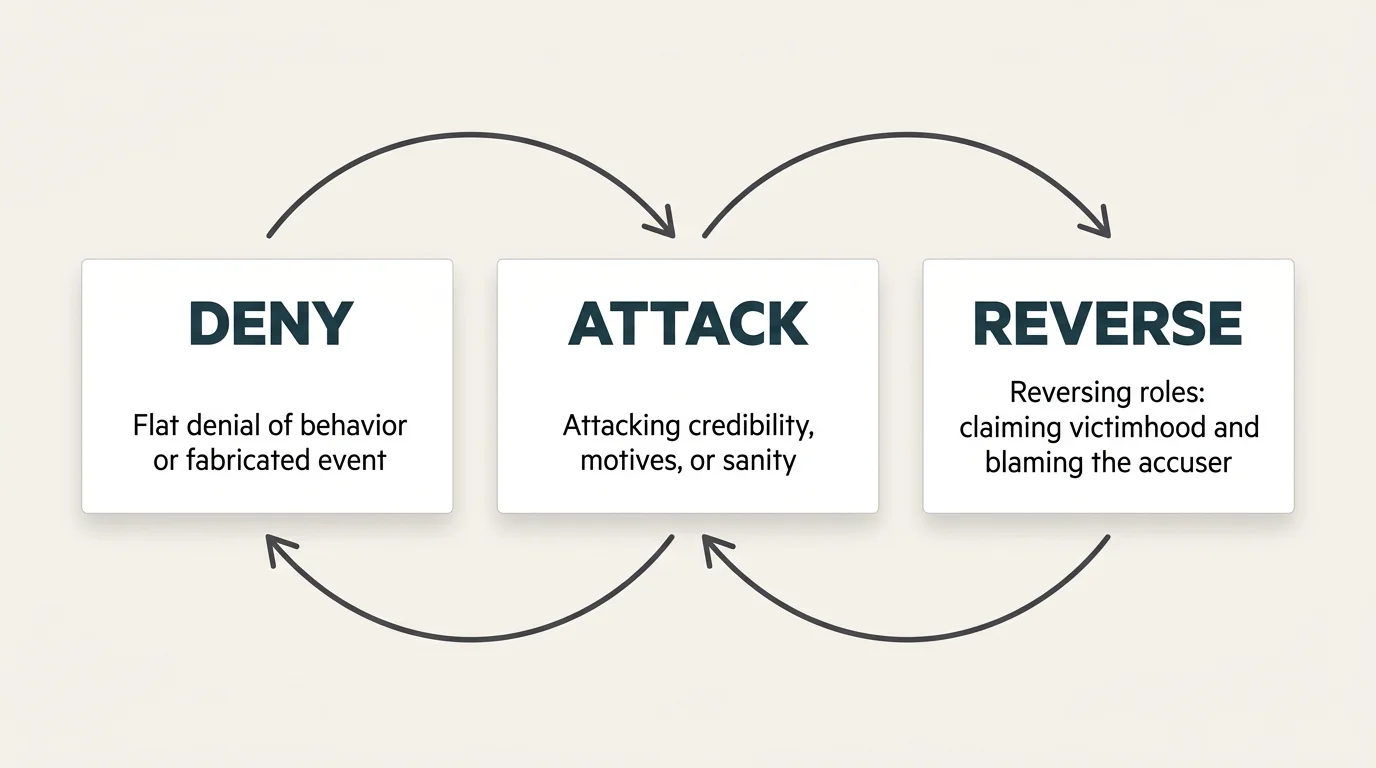
9. DARVO: Denying, Attacking, and Reversing Victim and Offender
DARVO is an acronym established by psychological researchers to describe a common manipulation sequence: Deny the behavior, Attack the person confronting it, and Reverse the roles of Victim and Offender. When you bring up a specific concern, the person immediately follows this script.
First, they deny the infraction ever occurred. Next, they attack your credibility, motives, or emotional stability. Finally, they frame themselves as the true victim of your “unreasonable” attacks. This disorienting sequence derails the conversation, leaving you defending your character rather than resolving the core issue.

10. Double Binds and “No-Win” Dilemmas
A double bind occurs when someone constructs a situation with conflicting demands, ensuring that whatever choice you make is incorrect. For instance, an individual might criticize you for not taking enough initiative, but when you make an independent decision, they reprimand you for being selfish or excluding them.
These paradoxical expectations create a state of learned helplessness. Because no action produces a positive outcome, you become paralyzed by indecision, ultimately surrendering full control of choices to the manipulator.
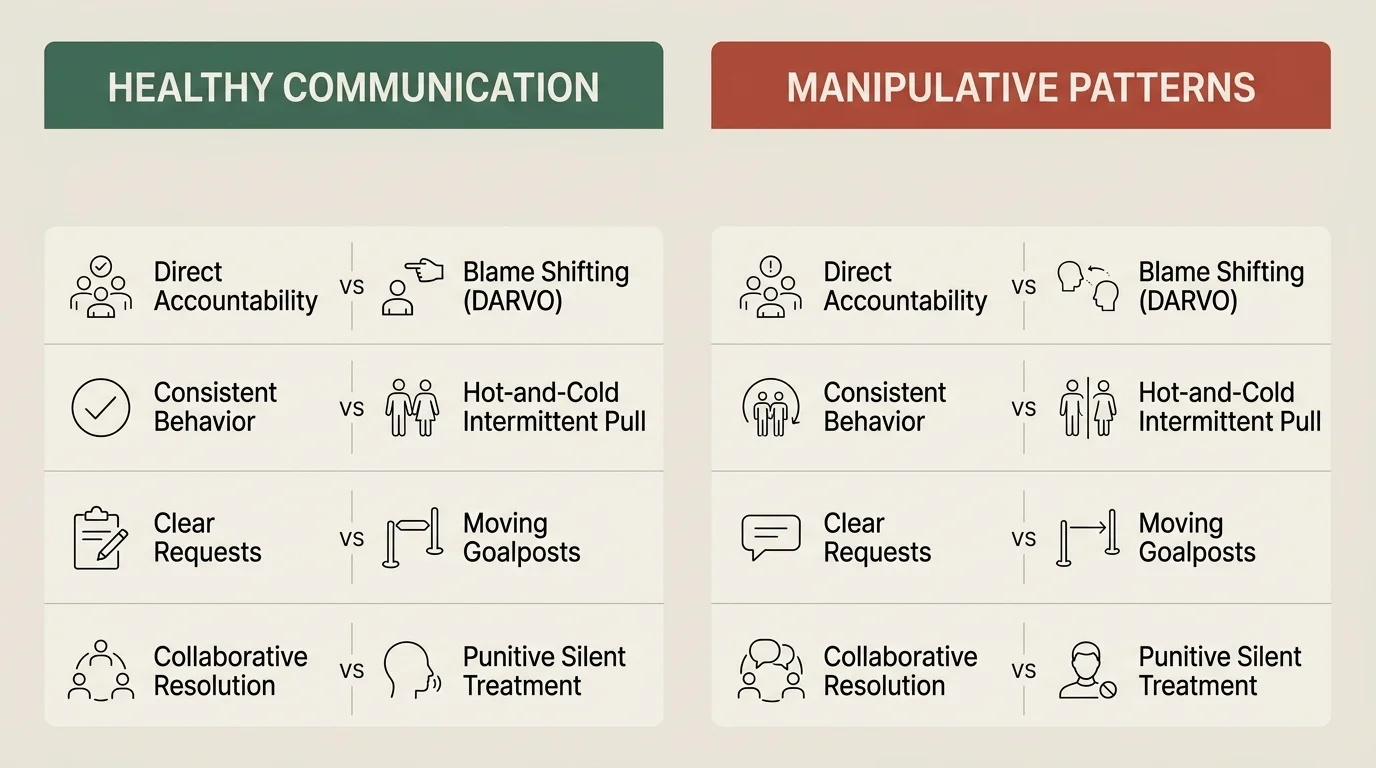
Healthy Communication vs. Manipulative Mind Games
To distinguish between genuine relationship friction and toxic relationship red flags, review how healthy partners interact compared to those who employ psychological manipulation signs:
| Dynamic | Healthy Communication | Manipulative Mind Games |
|---|---|---|
| Addressing Mistakes | Takes ownership, offers genuine apologies, and changes behavior. | Employs DARVO, shifts blame, and plays the perpetual victim. |
| Handling Disagreements | Focuses on solving the shared problem collaboratively. | Uses personal attacks, moving goalposts, and disguised insults. |
| Emotional Consistency | Predictable, emotionally safe, and transparent across interactions. | Hot-and-cold reinforcement, sudden silence, and unpredictable moods. |
| Respect for Boundaries | Acknowledges limits without resentment or punishment. | Guilt-trips, tests limits repeatedly, and weaponizes shared secrets. |
| Third-Party Dynamics | Maintains clear relational boundaries with outside individuals. | Uses triangulation to manufacture jealousy and insecurity. |

Actionable Steps to Reclaim Your Psychological Safety
If you recognize signs of manipulation in your interactions, shifting your response pattern is critical. You cannot control another person’s tactics, but you can alter how you engage with them.
- Practice the “Gray Rock” Technique: When dealing with someone fishing for emotional reactions, respond with flat, neutral, and uninteresting statements. Dispassionate responses like “I see your perspective” or “That is one way to look at it” deny them the emotional fuel they seek.
- Keep Objective Records: If gaslighting has eroded your confidence, write down dates, conversations, and agreed-upon plans in a private journal or digital note. Having a factual record anchors you in reality when someone attempts to rewrite history.
- Set Concrete, Consequence-Based Boundaries: Move beyond simple requests to defined boundaries. Clearly state what you will do if manipulative behavior continues: “If you continue to raise your voice and use sarcasm, I am stepping out of this room until we can speak calmly.”
- Rely on an External Sounding Board: Psychological manipulation thrives in isolation. Consult grounded friends, mentors, or mental health resources on Psychology Today to gain objective perspectives on confusing interactions.
“Clear is kind. Unclear is unkind.” — Brené Brown, Ph.D., LMSW, Research Professor and Author

What Can Go Wrong: Misinterpreting Clumsy Communication
When learning about psychological manipulation signs, it is easy to overcorrect and label every awkward interaction as malicious. Poor communication does not automatically equal sinister intent. An exhausted partner might withdraw emotionally without intending to execute the silent treatment; a stressed colleague might forget an agreement without actively gaslighting you.
The distinction lies in pattern, intent, and receptivity. Clumsy communicators show genuine remorse when they realize they caused harm, and they work collaboratively to improve. In contrast, individuals who play mind games in relationships repeat manipulative patterns consistently, resist accountability, and exploit your vulnerabilities to maintain dominance.

When to Seek Professional Support
While establishing self-directed boundaries is valuable, certain relational dynamics require clinical intervention. Consider consulting a licensed therapist or reaching out to organizations like the National Alliance on Mental Illness under the following conditions:
- You experience chronic hypervigilance, severe anxiety, or sleep disruption surrounding interactions with this person.
- Your self-esteem has eroded to the point where you distrust your basic judgment, memory, or decision-making capabilities.
- You feel systematically isolated from your friends, family, and supportive communities.
- The psychological mind games escalate into emotional coercion, financial control, or threats to your safety.
Frequently Asked Questions
Why do people play mind games instead of communicating directly?
People typically resort to mind games due to deep-seated insecurities, fear of vulnerability, or an unhealthy desire for control. Direct communication requires emotional maturity, self-awareness, and the risk of rejection. For individuals with manipulative tendencies, covert tactics feel safer because they preserve an illusion of power while avoiding true accountability.
How do you tell the difference between bad communication and intentional manipulation?
Look at how the person responds when you address the issue. A poor communicator listens, validates your distress, and attempts to change their behavior over time. A manipulative person dismisses your feelings, uses tactics like DARVO, blames you for bringing it up, and continues the pattern indefinitely.
Can someone play mind games without realizing it?
Yes. Many individuals adopt manipulative behaviors as learned coping mechanisms from their family of origin or past relationship trauma. While their subconscious motives do not excuse the damage caused, these behaviors often run on autopilot until the person undergoes intensive self-reflection or therapy.
What is the most effective way to shut down a mind game immediately?
Refuse to play. Name the dynamic calmly and disengage from the emotional trap. Stating “We seem to be remembering this differently, so let’s revisit it later,” or “I will not participate in a conversation involving personal insults” stops the manipulator from gaining the reaction they intended.
Moving Forward with Clarity
Navigating deceptive relationship dynamics can feel exhausting, but recognizing these toxic relationship red flags restores your power. As you begin trusting your intuition, setting firm limits, and demanding direct honesty, you create space for authentic, emotionally safe connections in every area of your life.
This article provides general educational information about psychology and relationships. It is not a substitute for professional therapy or medical advice. Everyone’s situation is unique—if you’re struggling, please reach out to a licensed mental health professional.
Last updated: February 2026. Psychology research evolves continuously—verify current findings with professional sources.









Leave a Reply