
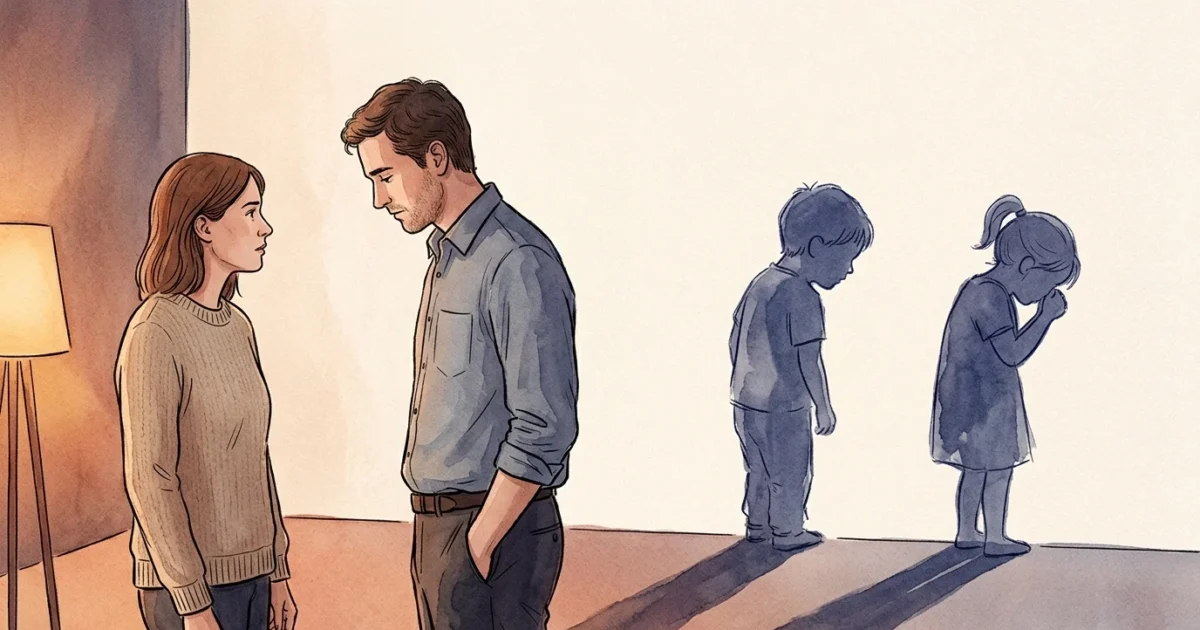
When you repeatedly find yourself having the exact same argument with your partner, walking on eggshells, or taking on the role of an exhausted caregiver, you are likely re-enacting early developmental dynamics. Sigmund Freud termed this phenomenon the repetition compulsion, while modern attachment researchers view it as an unconscious drive to repair childhood wounds in present-day intimacy. You select partners who unconsciously mirror your early caregivers because your brain interprets familiar relational patterns as safe—even when those patterns cause severe emotional distress. Recognizing these invisible scripts gives you the power to break habitual defense mechanisms, rewire your attachment responses, and build genuine, conscious emotional intimacy.
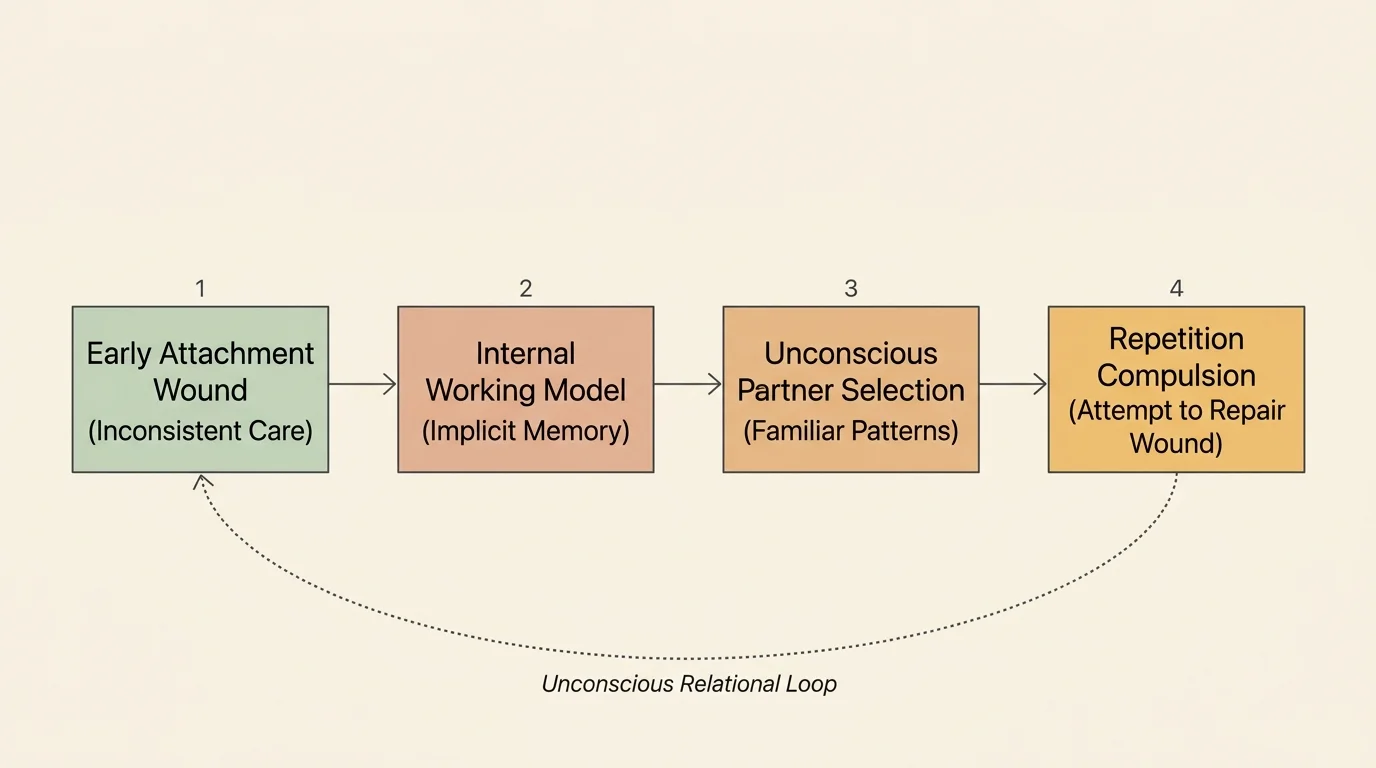
1. The Psychological Mechanics of Relational Repetition
Your brain naturally seeks predictability. During early childhood, your brain builds an internal working model of love, safety, and human connection based on interactions with your primary caregivers. Developmental psychologist John Bowlby established that these early attachment bonds create lifelong templates for how you expect others to treat you and how you react to emotional intimacy. When caregivers offer consistent warmth, you build a secure attachment template. However, when caregiving involves emotional inconsistency, neglect, volatility, or conditional approval, your implicit memory links love with anxiety, struggle, or hypervigilance.
In adult romantic relationships, a drive called the repetition compulsion often takes over. Sigmund Freud originally identified this concept to describe the subconscious urge to repeat painful experiences rather than simply remember them. Modern clinical psychology, particularly Schema Therapy developed by Jeffrey Young (2003), explains that early maladaptive schemas lead individuals to choose partners who trigger their familiar childhood emotional states. You unconsciously choose a partner who mirrors an emotionally distant, critical, or unpredictable parent because your adult brain seeks a second chance to master the situation and secure the love you were originally denied.
According to long-term relational research from The Gottman Institute, 69% of relationship conflicts represent perpetual problems rooted in fundamental differences in personality and personal history. When you lack awareness of your early conditioning, you end up locked in perpetual battles that are actually echoes of your past. Recognizing these unconscious scripts allows you to transition from reactive childhood self-defense to conscious adult choice.

2. 9 Signs You’re Recreating a Childhood Dynamic
1. You Fixate on Emotionally Distant or Unavailable Partners
If you grew up earning approval from a cold or preoccupied parent, emotional warmth from a stable partner may initially feel boring or unrewarding. You misinterpret emotional distance as depth and anxiety as passionate chemistry. You feel driven to pursue partners who withhold affection, believing that if you just perform better, listen more attentively, or remain patient, you will finally win their unconditional love.
2. You Slip Into a Caretaking or Parentified Role
Parentification occurs during childhood when a parent abdicates their emotional or physical duties, forcing you to act as the adult in the household. In your adult relationships, you recreate this dynamic by taking charge of your partner’s mental health, finances, or daily routines. You manage their life while neglecting your own core needs. While you may feel crucial to their survival, this over-functioning dynamic fosters deep resentment and undermines real intimacy between equals.
3. You Walk on Eggshells and Suppress Your Core Needs
In families where anger led to explosive outbursts or emotional withdrawal, children quickly learn to suppress their own voice to maintain safety. As an adult, you continue this survival strategy. You habitually say “I do not care” or “everything is fine” when you feel deeply upset. You monitor your partner’s body language, breathing, and tone of voice for subtle shifts, sacrificing your authenticity to preserve external peace.
4. Your Emotional Reactions Are Disproportionate to the Present Situation
When a minor disagreement over daily chores causes intense panic, severe rage, or complete emotional shutdown, you are experiencing an emotional flashback. According to research published by the National Institute of Mental Health, acute stress triggers primitive survival centers in the brain, bypassing rational thought. Your nervous system reacts to your partner’s tone not as a simple adult discussion, but as the overwhelming threat you experienced as a helpless child.
5. You Expect Your Partner to Read Your Mind Without Direct Communication
Young children depend entirely on caregivers to recognize their unspoken signals. When you carry this developmental phase into adulthood, you assume that if your partner truly loves you, they should automatically know what you feel without explicit communication. When your partner inevitably fails this silent test, you feel profoundly misunderstood and unloved, mirroring the emotional isolation of your upbringing.
6. You Unconsciously Test Your Partner’s Commitment
If your early caregivers abandoned, betrayed, or rejected you, accepting steady affection feels dangerous. To protect yourself, you implement subconscious tests. You might start fights, push your partner away, threaten to break up, or act out emotionally to see if they will abandon you. If they stay, relief is temporary; if they leave, your brain considers its painful core belief—”everyone leaves eventually”—fully validated.
7. You Feel Solely Responsible for Your Partner’s Emotional State
Children raised by volatile or depressed parents often believe their actions directly cause their parent’s mood swings. As an adult, you carry this hypervigilance into your romantic life. If your partner enters the room quiet or frustrated after a stressful workday, you immediately assume you did something wrong. You spend tremendous energy attempting to fix their emotional state, feeling personally responsible for their happiness.
8. You Re-Enact the Same Cyclical Script Without Resolution
You find yourself having the exact same fight every few weeks with no meaningful changes or closure. The surface topic—chores, finances, or scheduling—may change, but the underlying emotional script stays identical. One partner pursues and demands while the other withdraws and defends. Research from the American Psychological Association emphasizes that unresolved conflicts repeatedly resurface when individuals fight from childhood attachment fears rather than current adult concerns.
9. You Suffer from Intense Fears of Either Enmeshment or Abandonment
Early environments characterized by overbearing, intrusive parenting make emotional closeness feel suffocating, driving a desperate need for independence. Conversely, early neglect instills a terrifying fear of being abandoned. If you alternate between craving deep closeness and panicking the moment things get close, you are caught in the classic approach-avoidance cycle rooted in early developmental trauma.
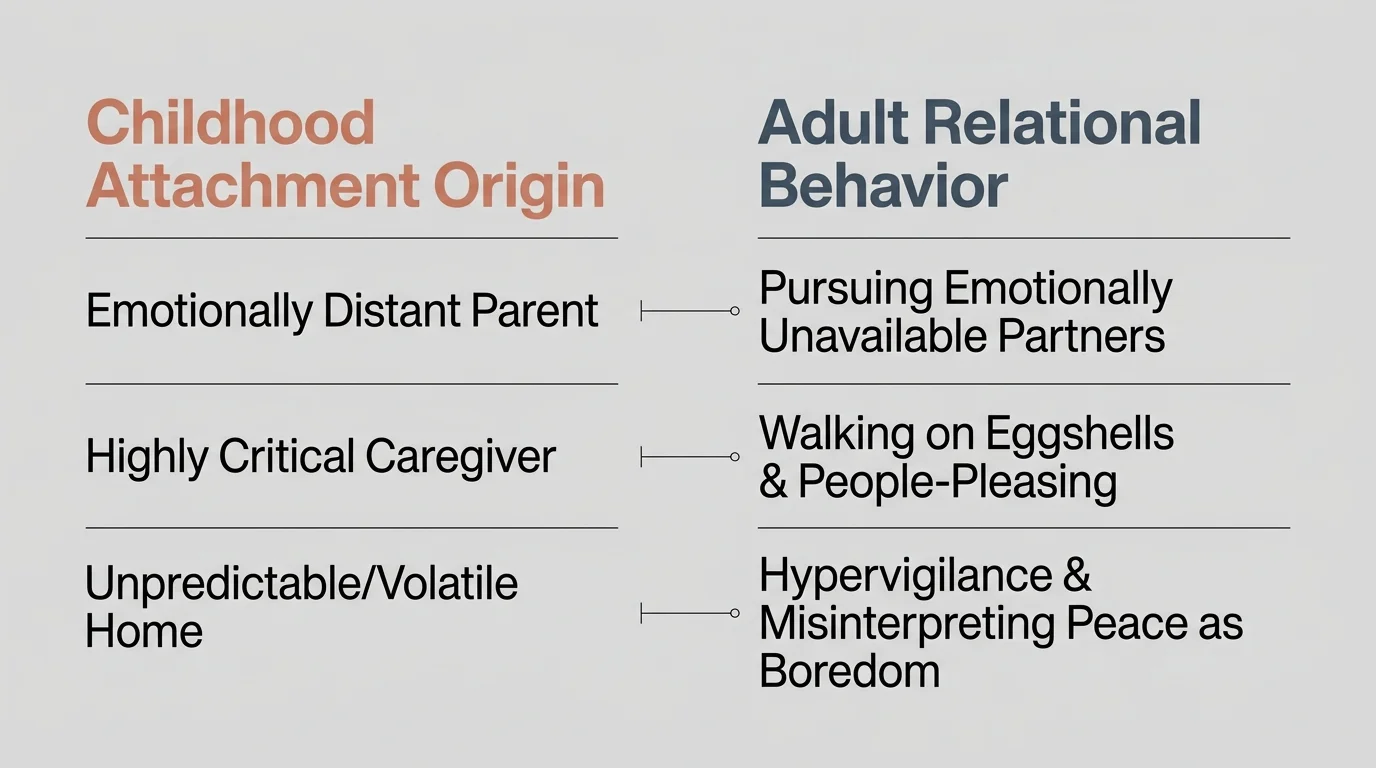
3. Mapping Childhood Origins to Adult Behaviors
Understanding how early home environments translate into adult relationship behaviors helps you recognize your unique patterns. The comparison table below highlights common childhood environments, their adult re-enactments, and the conscious behaviors required to heal them.
| Childhood Environment | Adult Re-Enactment Pattern | Conscious Adult Shift |
|---|---|---|
| Unpredictable or explosive parental moods | Hypervigilance, walking on eggshells, suppressing personal needs | Communicating needs directly and tolerating non-destructive emotional disagreement |
| Conditional love based on high achievement or caretaking | Parentification, over-functioning, choosing needy or dependent partners | Setting healthy boundaries and accepting love without having to earn it |
| Emotional distance, neglect, or physical absence | Pursuing distant partners, misinterpreting anxiety as romantic spark | Choosing reliable, emotionally available partners and tolerating calm stability |
| Over-controlling or suffocating parent-child dynamics | Pushing partners away when intimacy deepens, fear of enmeshment | Maintaining individual identity while practicing safe emotional closeness |
4. Common Misconceptions About Relationship Patterns
Misunderstandings about relationship psychology can prevent you from breaking out of unhealthy cycles. Addressing these myths helps build a realistic framework for personal growth.
Misconception 1: Intense, instantaneous chemistry means you met your soulmate.
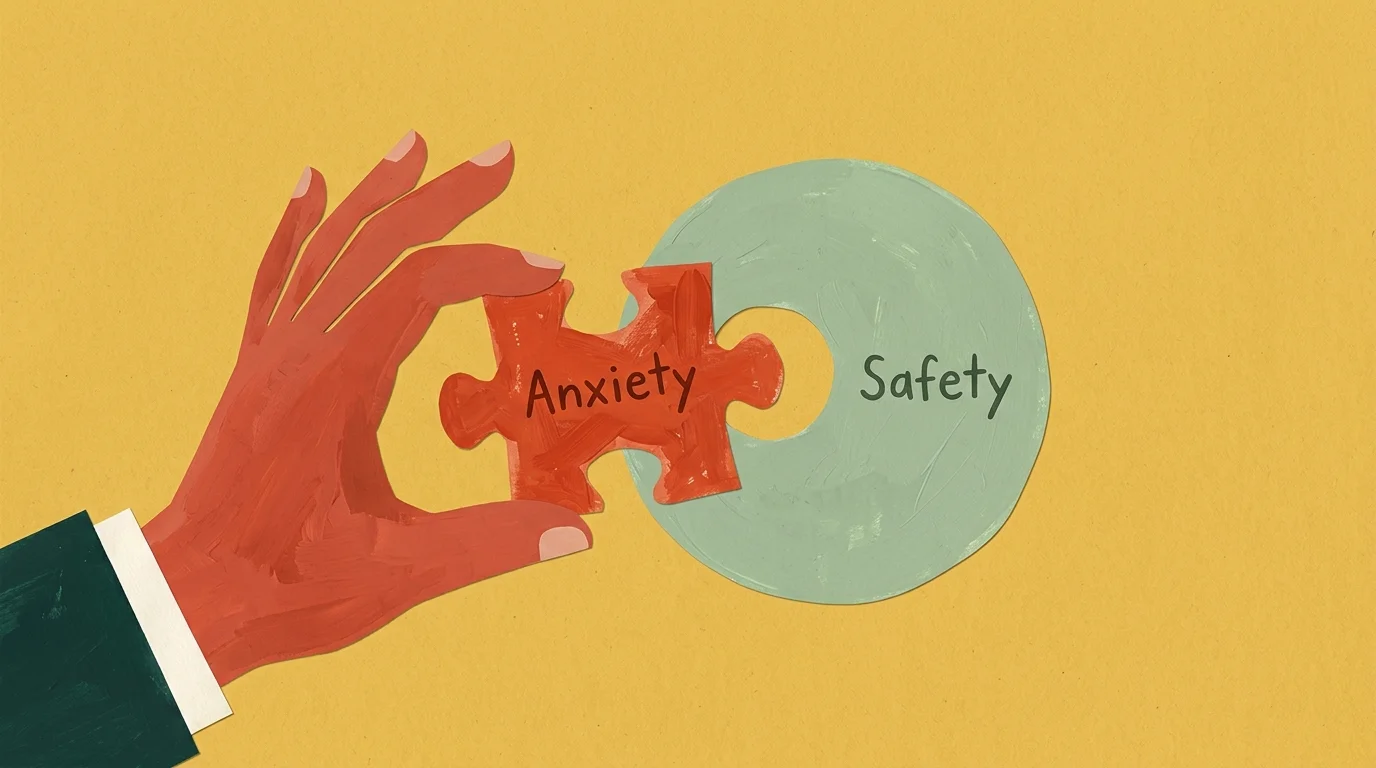
High emotional intensity at the start of a relationship often signifies familiar nervous system activation rather than genuine love. The immediate “spark” is frequently your implicit memory recognizing someone who matches your unhealed childhood dynamics. Real compatibility and emotional safety often feel calm, clear, and steady rather than chaotic or intoxicating.
Misconception 2: Ending your current relationship automatically breaks the pattern.
Changing your partner does not change your internal relational template. Unless you actively address your underlying schemas and attachment responses, you will likely choose a new partner who triggers the exact same childhood dynamic. Healing requires internal reflection, not just external shifts.
Misconception 3: You only recreate patterns if you survived extreme childhood abuse.
Repetition compulsion does not require severe abuse. Subtle developmental issues—such as a well-meaning parent who was chronically distracted, emotionally unavailable due to work, or overprotective—are fully capable of shaping your adult romantic choices.

5. How to Rewire Your Relational Script
Transforming ingrained childhood dynamics into healthy adult relationships requires deliberate effort, self-compassion, and practical boundary work. Use the following evidence-based steps to update your relational scripts:
- Track your somatic triggers: Before you react emotionally, pay attention to physical signals in your body—such as a tight chest, shallow breathing, or a clenched jaw. These somatic markers indicate that your nervous system is entering a defensive flashback state.
- Practice the 20-minute pause: When an argument activates severe emotional distress, request a structured 20-minute break. Psychological research indicates that it takes at least 20 minutes for your nervous system to regulate after a stress trigger.
- Separate past hurts from present reality: Ask yourself: “How much of my current reaction belongs to this moment, and how much belongs to my past?” Expressing this awareness explicitly to your partner helps defuse defensiveness.
- Shift from implicit expectations to explicit requests: Replace silent tests with direct language. Instead of expecting your partner to know why you are upset, state clearly: “I am feeling overwhelmed and would appreciate your help with dinner tonight.”
- Build internal self-soothing practices: Learn to soothe your own anxious or avoidant responses through deep breathing, emotional journaling, and self-compassion, rather than relying exclusively on your partner to fix your feelings.
“The quality of your relationships is what determines the quality of your life.” — Esther Perel, LMFT
“Vulnerability is not winning or losing; it’s having the courage to show up and be seen when you have no control over the outcome.” — Brené Brown, PhD, LMSW
6. Finding the Right Professional Help
While self-awareness is essential, breaking deeply rooted relational habits often requires guidance from a trained mental health professional. Consider seeking individual or couples therapy in the following situations:
- You repeatedly select abusive, overly controlling, or chronically addicted partners despite your best intentions.
- Conflict triggers severe emotional dysregulation, self-harming urges, panic attacks, or total emotional shutdown.
- You and your partner are locked in a persistent pursuer-distancer cycle that sabotages your quality of life.
- You suffer from deep-seated unresolved trauma that makes emotional intimacy feel unsafe.
Evidence-based modalities like Schema Therapy, Emotionally Focused Therapy (EFT), Internal Family Systems (IFS), and Eye Movement Desensitization and Reprocessing (EMDR) offer effective tools for resolving early attachment injuries. You can find comprehensive directories of licensed therapists through resources provided by Psychology Today and Verywell Mind.
7. Frequently Asked Questions
Can two people with active childhood wounds build a healthy relationship?
Yes. Relationship success depends less on having a clear emotional history and more on both partners committing to self-awareness and personal growth. When both partners recognize their individual triggers, apologize sincerely, and practice repair, a relationship can become a therapeutic environment for mutual healing.
How long does it take to break childhood patterns in adult relationships?
Rewiring long-standing neural pathways requires consistent practice over time. While noticeable improvements in emotional regulation and communication can happen within a few months of therapy, fully shifting core attachment responses typically takes a year or more of dedicated self-work.
Why do I feel bored when I date someone who treats me well?
If your early life linked love with emotional unpredictability or earning approval, healthy stability can initially register as boring. Your nervous system confuses anxiety with emotional connection. Sticking with a stable partner allows your nervous system time to adjust and re-learn that safety is desirable.
Is it possible to heal childhood patterns while staying in my current relationship?
Yes. As long as your relationship is free from physical or severe emotional abuse, changing your own responses alters the overall relationship dynamic. When you stop playing your side of an old relational script, your partner must adapt, often disrupting the dynamic for the better.
8. Stepping Into Conscious Intimacy
Recognizing that you are recreating a childhood dynamic is not a sign of failure; it is the first step toward true emotional freedom. Your brain adopted these survival patterns during childhood to protect you from pain. By approaching your defense mechanisms with gentle curiosity rather than self-judgment, you gain the clarity needed to choose conscious adult connection over familiar childhood scripts.
The information in this article is meant for educational purposes and general guidance. It does not replace individual therapy, counseling, or medical treatment. If you or someone you know is in crisis, contact the 988 Suicide & Crisis Lifeline by calling or texting 988.
Last updated: February 2026. Psychology research evolves continuously—verify current findings with professional sources.









Leave a Reply