

Caring for someone you love often begins as an act of devotion, but it can quickly erode your physical and emotional reserves. Recognizing early caregiver stress signs allows you to intervene before exhaustion transforms into complete collapse.
When your daily routine revolves around medical appointments, medication schedules, and another person’s needs, your body registers the strain before your mind acknowledges it. Overlooking these warnings threatens both your health and the care you provide.
Learning to spot these warning signs empowers you to establish essential boundaries, access family caregiver support, and protect your well-being without guilt.
The Growing Reality of Caregiver Fatigue
Family caregiving represents an enormous emotional commitment that touches millions of households every day.
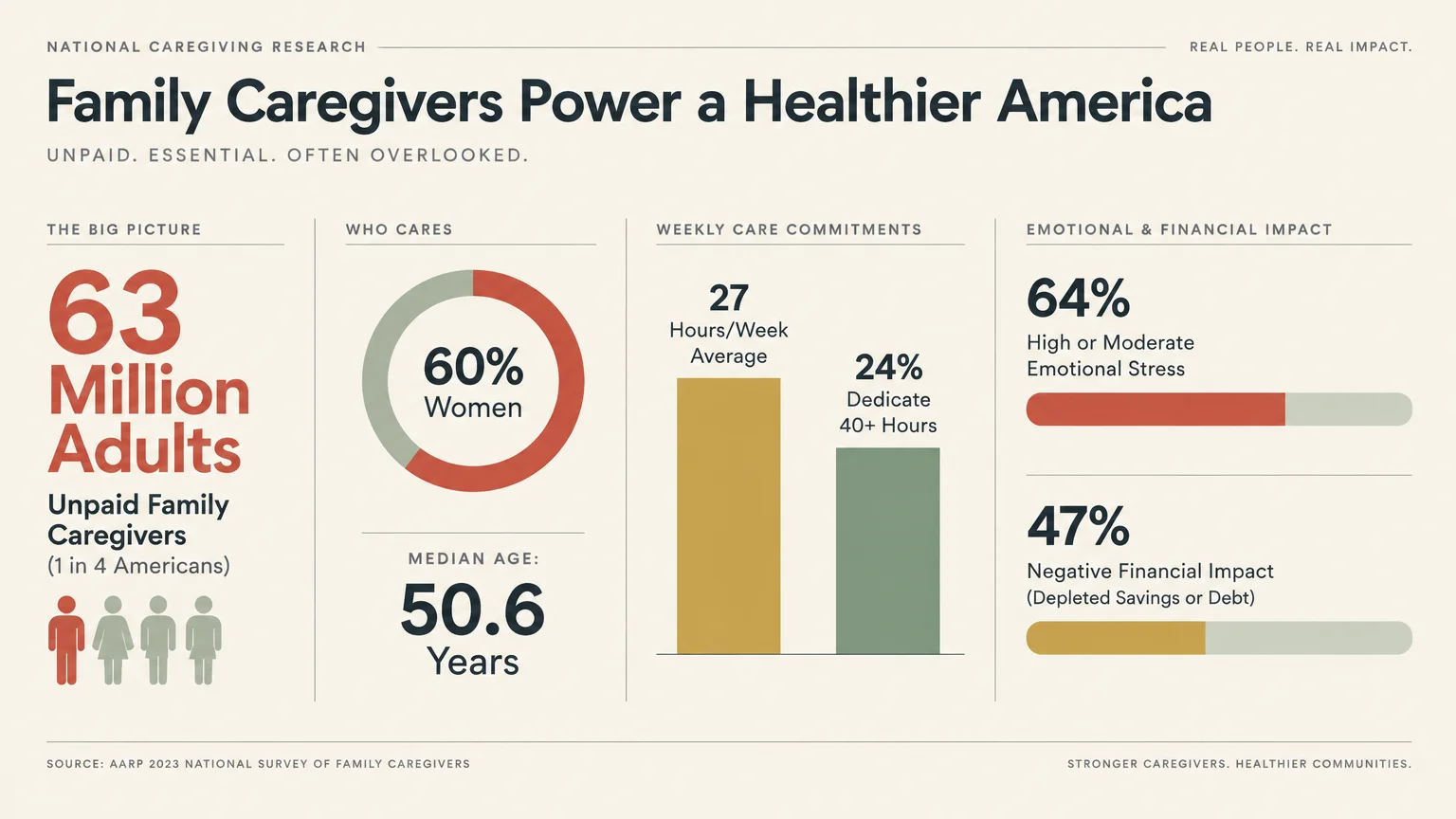
According to research from the National Alliance for Caregiving and AARP (2025), approximately 63 million American adults—nearly one in four—serve as unpaid family caregivers.
More than 50 million of these individuals support adults aged 50 and older, frequently managing complex chronic health conditions.
Women represent roughly 60% of this caregiving workforce, with a median age of 50.6 years old across all adult caregivers.
Nearly one-third of caregivers belong to the sandwich generation, actively raising dependent children while simultaneously caring for aging parents.
The emotional pressure of these competing responsibilities accumulates quietly over months and years.
Data from AARP and the NAC (2025) reveals that 64% of family caregivers report moderate to high emotional stress, with 38% reporting high emotional stress.
Additionally, 45% report moderate to high physical strain as they balance personal obligations with demanding care routines.
Caregivers invest an average of 27 hours per week in caregiving tasks, while 24% dedicate 40 or more hours weekly.
Furthermore, 55% perform complex medical and nursing tasks alongside basic daily living assistance, often without prior clinical training.
Financial strain intensifies this pressure; 47% of caregivers experience negative financial repercussions, including depleted savings or accumulated personal debt.
Among caregivers under age 65, 70% hold paid jobs, and 61% report that caregiving duties directly disrupt their professional careers.
Understanding these widespread pressures validates your personal fatigue and confirms that your daily challenges are genuine.
10 Critical Signs You’re Dealing With Caregiver Stress
Caregiver stress rarely appears overnight; rather, it accumulates through subtle physiological and emotional shifts that you might dismiss as routine tiredness.
Learning to identify these ten indicators gives you the awareness needed to alter course before reaching full caregiver burnout.
1. Persistent and Heavy Physical Exhaustion
Caregiver fatigue goes far beyond feeling sleepy after a busy afternoon.
You wake up feeling depleted, even after spending seven or eight hours in bed.
Physical tasks that once felt effortless—such as folding laundry, grocery shopping, or preparing a meal—now require immense willpower.
This deep depletion occurs because chronic stress keeps your sympathetic nervous system constantly activated.
When cortisol remains elevated for extended periods, your body loses its ability to restore energy efficiently.
2. Short-Tempered Irritability and Resentment
You may notice your patience fraying over minor inconveniences or routine requests.
Snapping at your loved one, your partner, or your children often triggers an immediate wave of remorse.
Resentment frequently emerges when you feel trapped by continuous demands and lack external assistance.
You might resent the person receiving care, other family members who offer little help, or the loss of your personal freedom.
These feelings do not mean you lack compassion; they signal that your emotional capacity is overextended.
3. Sleep Disruptions and Nighttime Hypervigilance
Caregiving often disrupts the neurological mechanisms responsible for restful sleep.
You might struggle to fall asleep because racing thoughts about tomorrow’s schedule keep your mind active.
Alternatively, you wake up at odd hours, listening for footsteps, falls, or labored breathing from the other room.
This state of nighttime hypervigilance prevents your brain from entering deep, restorative sleep cycles.
Over time, sleep deprivation impairs emotional regulation, memory consolidation, and cardiovascular health.
4. Social Withdrawal and Deepening Isolation
Maintaining friendships often feels like an impossible luxury when you manage caregiving schedules.
Data from AARP and the NAC (2025) highlights that 25% of family caregivers experience profound social isolation.
You might decline social invitations because coordinating substitute care feels more exhausting than staying home.
Gradually, friends stop calling, and your social circle contracts until your world shrinks to the walls of the care environment.
Isolation amplifies emotional distress, depriving you of external perspectives and emotional validation.
5. Neglecting Your Own Healthcare and Medical Needs
When someone else’s health dominates your calendar, your own well-being usually falls to the bottom of the list.
Research from AARP and the NAC (2025) indicates that 20% of caregivers rate their personal health as fair or poor.
Furthermore, nearly 25% report significant difficulty managing their own healthcare while assisting a loved one.
You might skip your annual physicals, postpone dental cleanings, or ignore concerning physical symptoms.
Routinely sacrificing your medical care creates severe long-term risks for your physical survival.
6. Anhedonia and Loss of Personal Identity
Anhedonia refers to the biological inability to experience pleasure from activities you typically enjoy.
Books, hobbies, gardening, or walks in the park may suddenly feel pointless or burdensome.
Your self-concept often narrows until you view yourself solely as a nurse, chauffeur, and administrator.
When caregiving consumes your entire identity, your sense of personal meaning and agency diminishes.
Clinical resources from Psychology Today emphasize that preserving personal identity protects mental stability during extended caregiving.
7. Pervasive Anxiety and Catastrophic Thinking
Chronic caregiver stress generates continuous worry about medical crises, financial collapse, or worsening prognoses.
Every ringing telephone makes your heart race, triggering an immediate surge of adrenaline.
You find yourself mentally rehearsing worst-case scenarios, unable to ground your attention in the present moment.
This persistent dread is especially common when caring for aging parents with progressive neurological disorders.
According to the Alzheimer’s Association (2026), 59% of dementia caregivers report high or very high emotional stress, often driven by ambiguous loss.
More than 12 million unpaid caregivers provide nearly 19.6 billion hours of care annually to people living with dementia, facing immense cognitive and emotional strain.
8. Unexplained Weight Shifts and Physical Symptoms
Chronic stress directly influences your endocrine system, digestion, and metabolic health.
You might lose your appetite entirely, skipping meals because you feel constantly nauseated or rushed.
Conversely, you may turn to high-sugar or ultra-processed foods for rapid energy and emotional soothing.
Frequent tension headaches, digestive issues, chronic back pain, and recurring infections often appear alongside weight changes.
The Mayo Clinic notes that chronic caregiver stress elevates inflammation, weakening immune defense against common pathogens.
9. Brain Fog and Diminished Executive Function
Cognitive overload occurs when your mental bandwidth is continuously consumed by organizational details.
You miss routine appointments, misplace everyday objects, or struggle to find words during conversations.
Decision fatigue makes even simple choices—such as what to make for dinner—feel insurmountable.
This mental haze is not early dementia; it is your prefrontal cortex buckling under prolonged operational strain.
When working memory is flooded with medical logistics, processing new information becomes extraordinarily difficult.
10. Toxic Caregiver Guilt and Inadequacy
Guilt is one of the most pervasive and destructive dimensions of caregiver stress.
You feel guilty when you lose your patience, guilty when you take time off, and guilty that you cannot cure your loved one.
You criticize yourself constantly, believing that a more capable or loving person would handle everything without feeling tired.
This internalized shame creates a relentless loop that drives you to overcompensate until you collapse.
Recognizing guilt as an irrational symptom of stress—rather than a moral failing—is vital for your recovery.
Caregiver Stress vs. Caregiver Burnout: A Practical Comparison
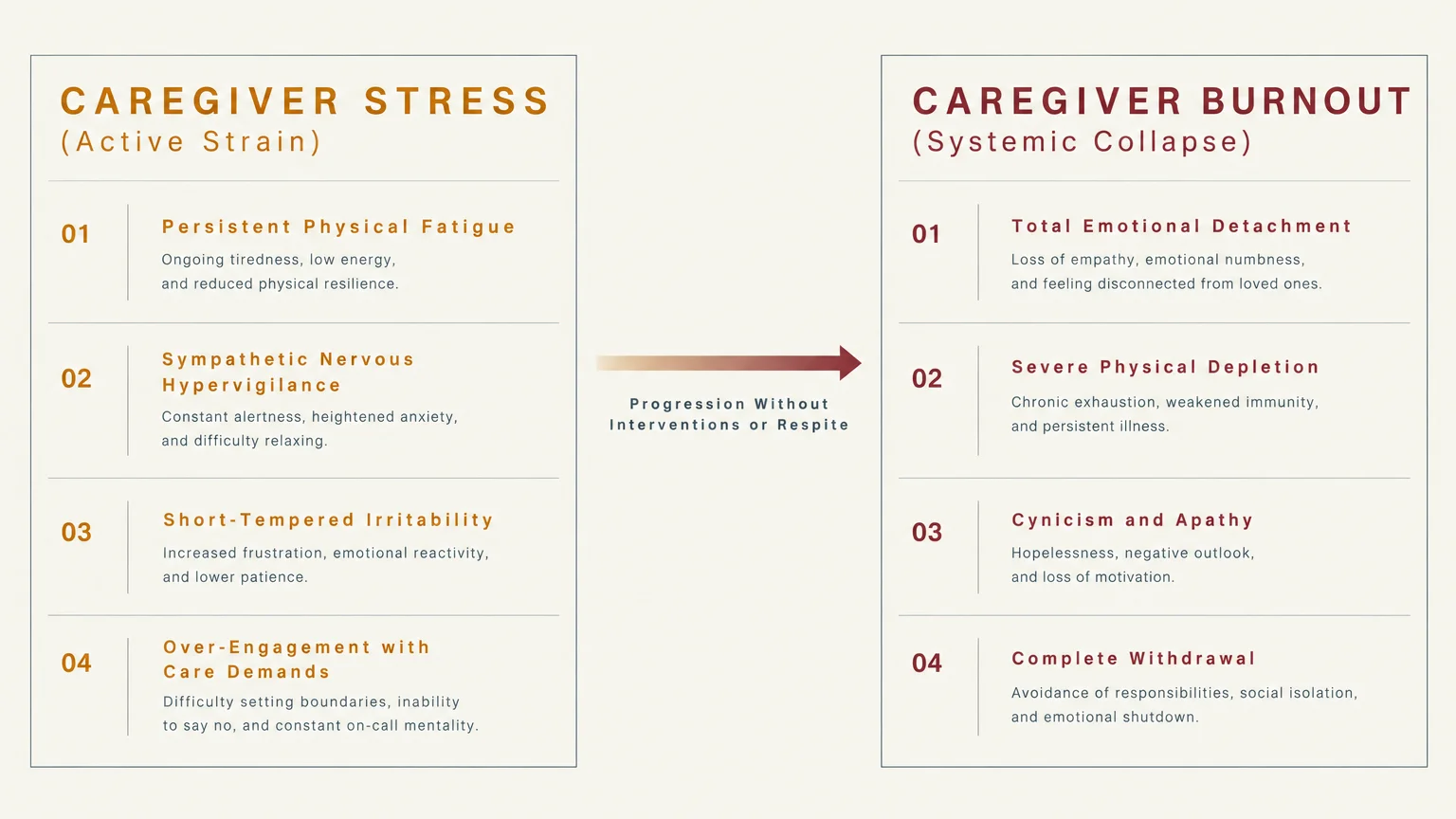
Caregiver stress and caregiver burnout exist on the same continuum, but they require different therapeutic interventions.
Stress involves an experience of having too much: too many tasks, excessive pressure, and overflowing urgency.
Burnout, by contrast, involves a profound sense of empty depletion: emotional detachment, hopelessness, and complete apathy.
The comparison table below clarifies where your experiences fall along this critical spectrum.
| Dimension | Caregiver Stress | Caregiver Burnout |
|---|---|---|
| Emotional State | Heightened anxiety, reactive frustration, frequent worry. | Emotional numbness, profound apathy, total detachment. |
| Energy Profile | Overstimulated, restless, difficulty unwinding. | Deep physical and psychological exhaustion; inability to recharge. |
| View of Recipient | Loving but occasionally impatient; guilt over negative feelings. | Cynicism, mechanical care delivery, depersonalization. |
| Sense of Efficacy | Believes more effort could solve the logistical challenges. | Believes nothing matters and that effort is entirely futile. |
| Intervention Needed | Boundary setting, respite hours, daily nervous system regulation. | Immediate crisis intervention, formal care reassignment, professional therapy. |
If you recognize symptoms of acute burnout, you cannot resolve the problem simply by resting for an extra hour.
Burnout requires restructuring the entire care environment and delegating essential responsibilities to professional services or community programs.

Myths Worth Debunking About Caregiver Demands
Cultural expectations often burden family caregivers with harmful assumptions that accelerate mental breakdown.
Dismantling these myths is essential for building sustainable care practices and protecting your personal life.
Myth 1: Asking for Help Means You Have Failed
Many family members believe that seeking outside assistance signifies a lack of devotion or competence.
In reality, attempting to provide round-the-clock specialized care entirely alone is structurally unsustainable.
Bringing in adult day services, home health aides, or family assistance ensures your loved one receives safe, consistent care.
Delegating caregiving tasks demonstrates strategic maturity rather than personal weakness.
Myth 2: Self-Care Is an Unaffordable Luxury
Popular culture often mischaracterizes self-care as self-indulgent pampering or expensive spa days.
True self-care involves meeting basic biological necessities: sleeping, eating balanced meals, and taking prescribed medications.
Treating your health as optional compromises the foundation of your caregiving capacity.
When you protect your physical stamina, you directly preserve your ability to support others effectively.
Myth 3: You Must Suppress Your Negative Emotions
Caregivers frequently feel ashamed of feeling anger, boredom, grief, or longing for their past life.
Suppressing these natural reactions does not make them disappear; it forces them into somatic symptoms and explosive outbursts.
Experiencing complex emotions is a normal human response to prolonged, uncontrollable hardship.
Acknowledging your painful emotions allows you to process them constructively without directing them at your loved one.

Actionable Strategies to Reclaim Your Well-Being
Recovering from chronic stress requires implementing concrete behavioral habits rather than waiting for circumstances to improve.
You can begin restoring your mental baseline by incorporating small, manageable boundary practices into your daily routine.
- Establish micro-boundaries around communications: Designate specific hours for responding to non-emergency family updates rather than answering inquiries instantly.
- Schedule non-negotiable respite blocks: Secure at least two uninterrupted hours each week where another person or program assumes complete care responsibility.
- Implement somatic regulation techniques: Practice five minutes of box breathing or progressive muscle relaxation before transitioning between caregiving and personal tasks.
- Join an evidence-based caregiver support group: Organizations like the National Alliance on Mental Illness provide peer groups where you can share practical tools and honest experiences.
- Audit daily responsibilities ruthlessly: Identify non-essential tasks that can be automated, postponed, or permanently discarded to conserve energy.
Setting realistic boundaries protects both your relationships and your emotional longevity.
“Daring to set boundaries is about having the courage to love ourselves, even when we risk disappointing others.” — Brené Brown, Ph.D., LMSW
When you establish clear parameters around your time, you teach others how to support you effectively.
Boundaries prevent chronic resentment from destroying the love that initially inspired your caregiving commitment.

Signs It’s Time to Talk to a Therapist
While peer support and lifestyle modifications provide relief, certain clinical situations require structured psychological therapy.
A licensed mental health professional can help you process anticipatory grief, manage traumatic stress, and dismantle pervasive guilt.
Seek professional guidance promptly if you encounter any of the following four scenarios:
First, you experience persistent symptoms of major depression, such as crying spells, pervasive hopelessness, or an inability to function.
The American Psychological Association highlights Cognitive Behavioral Therapy (CBT) and Acceptance and Commitment Therapy (ACT) as highly effective for caregiver distress.
Second, you experience explosive rage, violent impulses, or fantasies of abandoning your vulnerable family member completely.
These intense reactions indicate that your nervous system is in an acute state of survival overdrive.
Third, you rely on alcohol, prescription sedatives, or emotional bingeing to numb your feelings or get through the day.
Using maladaptive coping mechanisms accelerates physiological breakdown and impairs your decision-making capacity.
Fourth, you experience physical panic attacks, debilitating chest tightness, or severe gastrointestinal issues linked to care duties.
Healthcare professionals at the Cleveland Clinic recommend comprehensive medical and psychological evaluation when somatic symptoms interfere with daily functioning.
Frequently Asked Questions About Caregiver Stress
How can I differentiate between normal caregiving stress and clinical depression?
Caregiver stress typically ebbs and flows in direct response to immediate logistical demands and care emergencies.
When you secure a full night of sleep or take an afternoon off, your energy and mood temporarily improve.
Clinical depression, conversely, casts a persistent shadow across all settings, regardless of whether your caregiving duties are active.
If you experience pervasive numbness, despair, and an inability to feel joy for more than two consecutive weeks, seek a professional mental health evaluation.
What should I do if my family members refuse to help with caregiving duties?
Start by holding a structured family meeting focused on specific tasks rather than general pleas for assistance.
Present a clear, itemized list of needs, including grocery deliveries, bill paying, medical transport, and financial contributions.
Allow relatives to choose concrete tasks that align with their schedules and abilities rather than demanding emotional labor they cannot provide.
If they continue to refuse, stop shielding them from the reality by scaling back non-essential services and consulting an elder law attorney or social worker.
How do I manage intense feelings of resentment toward an aging parent?
First, recognize that resentment is a universal response to boundary violations and chronic exhaustion.
Acknowledge the feeling without judging yourself; your anger does not erase your genuine care for your parent.
Identify the specific unmet need driving your anger, whether it is physical rest, autonomy, or emotional appreciation.
Address that need by stepping back from non-essential duties or arranging temporary adult daycare to create physical distance.
Are there financial programs that pay family members for caregiving?
Yes, several federal and state programs offer financial compensation for eligible family caregivers.
Many state Medicaid programs feature self-directed care options that allow qualifying seniors to hire family members as paid personal care aides.
Additionally, the Department of Veterans Affairs offers programs such as the Program of Comprehensive Assistance for Family Caregivers (PCAFC) for eligible veterans.
Contact your local Area Agency on Aging to explore state-specific caregiver stipends and legal respite programs.
Moving Forward With Sustainable Care
You cannot pour from an empty vessel, no matter how profound your dedication to your family member may be.
Sustainable caregiving requires viewing your own mental and physical health as an essential part of the care plan.
Take one small action today: call a community resource, schedule a medical appointment, or take a quiet thirty-minute walk.
Honoring your personal limits preserves your dignity and ensures that your caregiving remains grounded in authentic compassion.
The information in this article is meant for educational purposes and general guidance. It does not replace individual therapy, counseling, or medical treatment. If you or someone you know is in crisis, contact the 988 Suicide & Crisis Lifeline by calling or texting 988.
Last updated: February 2026. Psychology research evolves continuously—verify current findings with professional sources.









Leave a Reply