

You feel invisible, disconnected, or perpetually exhausted from self-reliance, yet you cannot pinpoint an obvious childhood trauma. That quiet ache often stems from childhood emotional neglect—a subtle wound of omission rather than overt harm.
When caregivers repeatedly fail to notice, validate, or soothe your feelings, your developing nervous system adapts. You learn to silence your inner world before anyone else can dismiss it.
Recognizing these protective adaptations allows you to dismantle them. Below, explore twelve distinct adult behaviors linked to emotional neglect, backed by psychiatric research and practical steps toward emotional recovery.
Understanding Childhood Emotional Neglect
Childhood emotional neglect (CEN) happens when parents repeatedly fail to respond adequately to your emotional needs. Unlike overt physical or verbal abuse, neglect is an act of omission rather than commission.
Dr. Jonice Webb formalized this concept in her 2012 book Running on Empty. She highlighted that CEN is invisible because it represents what did not happen in your childhood home.
Your parents may have provided nutritious food, safe housing, and clean clothes. However, they consistently overlooked your feelings, fears, and triumphs.
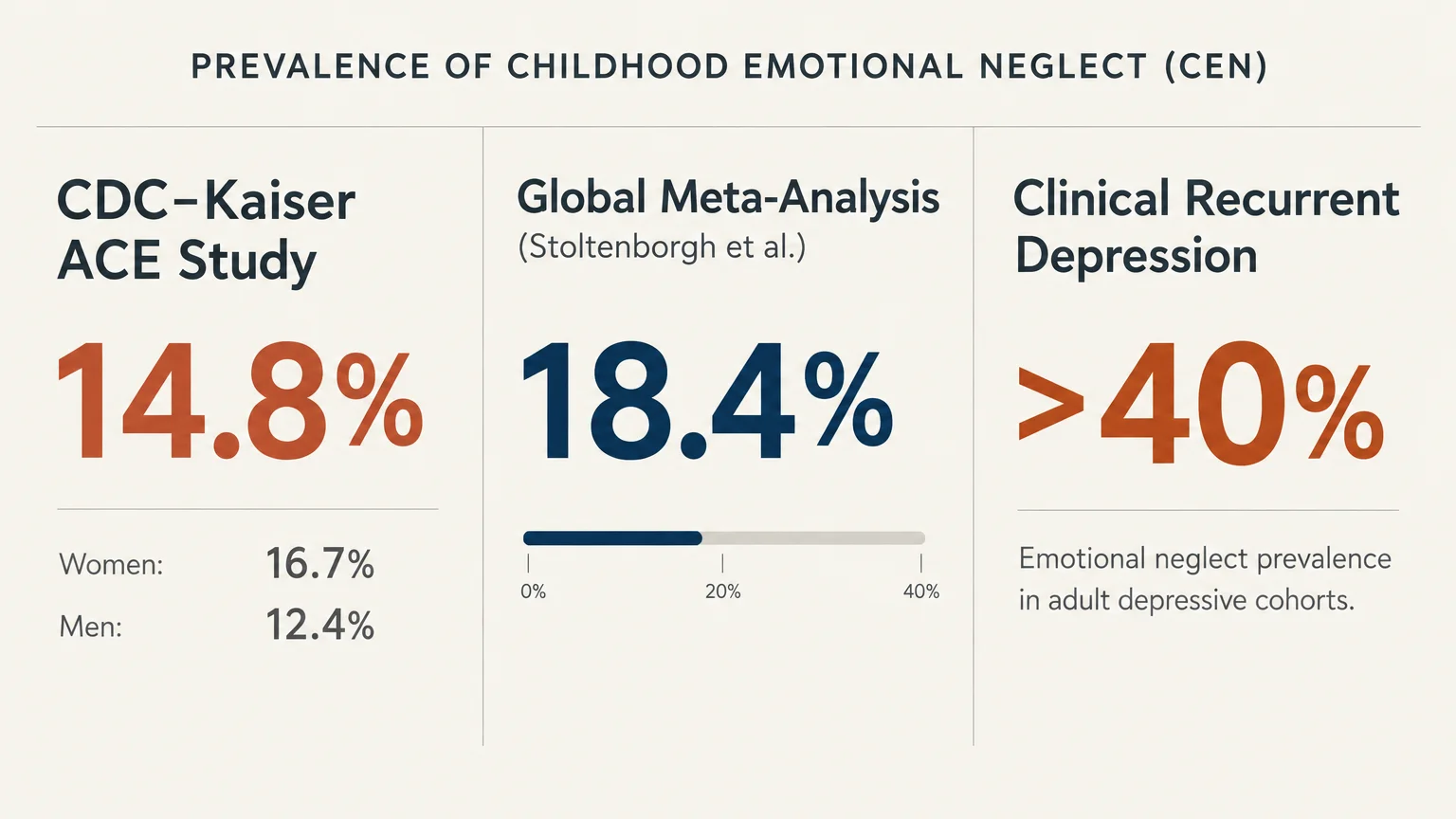
Research reveals this quiet childhood wound is widespread. According to the CDC–Kaiser Permanente Adverse Childhood Experiences (ACE) Study, 14.8% of adults experienced childhood emotional neglect, including 16.7% of women and 12.4% of men.
A global meta-analysis by Stoltenborgh and colleagues documented an even higher rate of 18.4%. Researchers clinically identify this pattern using validated tools like David P. Bernstein’s Childhood Trauma Questionnaire (CTQ).
Psychiatric research also connects CEN to mood disorders. In clinical adult populations with recurrent major depressive disorder, emotional neglect rates frequently exceed 40%.

12 Behaviors Linked to Childhood Emotional Neglect
1. Fierce, Counter-Dependent Independence
You insist on handling every personal and professional crisis without assistance. Asking someone for help triggers deep discomfort, vulnerability, or feelings of inadequacy.
Psychologists call this counter-dependence. It acts as an armor built to shield you from the pain of emotional abandonment.
Because your early caregivers failed to offer consistent support, your nervous system learned a rigid rule: relying on others is dangerous. You survive by needing nobody.
2. Difficulty Identifying and Expressing Feelings (Alexithymia)
When someone asks how you feel, your mind might go blank. You might describe physical sensations like fatigue or muscle tension instead of emotional states.
Clinical researchers define this difficulty identifying and verbalizing emotions as alexithymia. Meta-analyses reveal strong associations between childhood emotional neglect and adult alexithymia.
Children learn emotional literacy through parental mirroring. Without caregivers who label and validate your distress, your emotional vocabulary remains underdeveloped into adulthood.
3. Chronic Feelings of Emptiness or Numbness
You experience an intangible sense of hollowness inside your chest or stomach. Life can look successful on paper, yet you feel like a detached spectator.
This pervasive emptiness is a hallmark of emotional neglect. It represents the emotional vitality you shut down during childhood to survive emotional isolation.
When you numb painful feelings like loneliness or fear, you also extinguish positive feelings like joy and passion. The resulting emotional flatline feels like an internal void.
4. Habitual Guilt and Self-Directed Blame
You apologize reflexively throughout the day, even when minor accidents are not your fault. When conflicts arise in relationships, you assume the failure belongs to you.
Young children naturally depend on their parents for physical survival. A child cannot tolerate seeing their caregiver as deficient or emotionally absent.
To preserve safety, your developing mind internalized the neglect as your own flaw. You decided your needs were bad, creating a persistent adult habit of self-blame.
5. Compulsive People-Pleasing and Poor Boundaries
You bend over backward to keep everyone around you happy, often at the expense of your own health. Setting a firm boundary triggers intense waves of panic.
In neglectful households, children frequently become parentified or learn that warmth only arrives when they cause zero trouble. You became a chameleon to stay safe.
As an adult, you unconsciously believe that your worth depends on your usefulness. You worry that expressing your true limits will cause people to abandon you.
6. Severe Discomfort with Compliments and Attention
When peers or supervisors praise your achievements, you immediately deflect the compliment. You attribute your accomplishments to luck, good timing, or someone else’s guidance.
Genuine praise feels dissonant when you grew up emotionally unseen. You developed a habit of shrinking to avoid drawing attention to yourself.
Positive feedback challenges your internal baseline. Staying unnoticed feels far safer than standing out, because visibility carried little validation in your childhood home.
7. The “Fatal Flaw” Belief and Toxic Shame
You harbor a persistent fear that you are fundamentally broken or unlovable at your core. You worry that if people see the real you, they will leave.
Clinical psychologist Dr. Jonice Webb identifies this fatal flaw belief as a defining feature of emotional neglect. It stems directly from unmet attachment needs.
When parents ignore a child’s inner world, the child concludes that their core self is defective. You internalize their silence as proof of your inadequacy.
8. Disrupted Self-Discipline and Chronic Procrastination
You set ambitious goals, but struggle to maintain momentum, finish projects, or build healthy daily habits. You frequently beat yourself up and label yourself lazy.
Self-discipline is an emotional skill, not an innate personality trait. Parents teach self-regulation by co-regulating with their children during difficult, frustrating tasks.
Without that parental guidance, you never developed the neurological circuitry to tolerate frustration smoothly. Procrastination becomes your default defense against overwhelming emotional discomfort.
9. Fear of Emotional Intimacy and Vulnerability
You enjoy casual conversations, but withdraw the moment a romantic partner or close friend seeks deeper emotional connection. You guard your secrets vigilantly.
According to relationship research from the Gottman Institute, emotional vulnerability serves as the bedrock of lasting connection.
If early vulnerability was met with silence, mockery, or indifference, sharing your heart feels terrifying. You maintain emotional distance to protect yourself from predicted disappointment.
10. Chronic Indecisiveness and Lost Identity
Choosing a restaurant, selecting a career path, or naming a hobby feels paralyzing. When people ask what you want, you genuinely do not have an answer.
Your authentic preferences develop through parental inquiry and validation. When caregivers ask what you enjoy and value, they help you carve out an identity.
In an emotionally neglectful environment, your desires went unnoticed. Over time, you stopped consulting your internal compass, leaving you disconnected from your genuine wants.
11. Periodic Emotional Outbursts Followed by Shame
You pride yourself on staying calm under pressure, but occasionally explode over minor annoyances. A lost set of keys or a minor delay triggers tears or fury.
Emotions do not disappear when you ignore them; they accumulate beneath your conscious awareness. When your emotional threshold is breached, the stored pressure erupts violently.
After an outburst, you spiral into severe self-condemnation. You view your intense reaction as proof of your instability, restarting the cycle of repression.
12. Asymmetrical Compassion and Harsh Self-Criticism
You listen attentively to friends, validating their struggles and offering boundless warmth. Yet, you treat yourself with relentless cruelty whenever you stumble.
This dramatic double standard reflects your childhood training. You learned to attune outward to accommodate adults, while ignoring your own valid emotional pain.
You extend grace to everyone except yourself. Treating your own feelings as trivial keeps you trapped in profound, silent isolation.
Attuned Parenting vs. Emotionally Neglectful Parenting
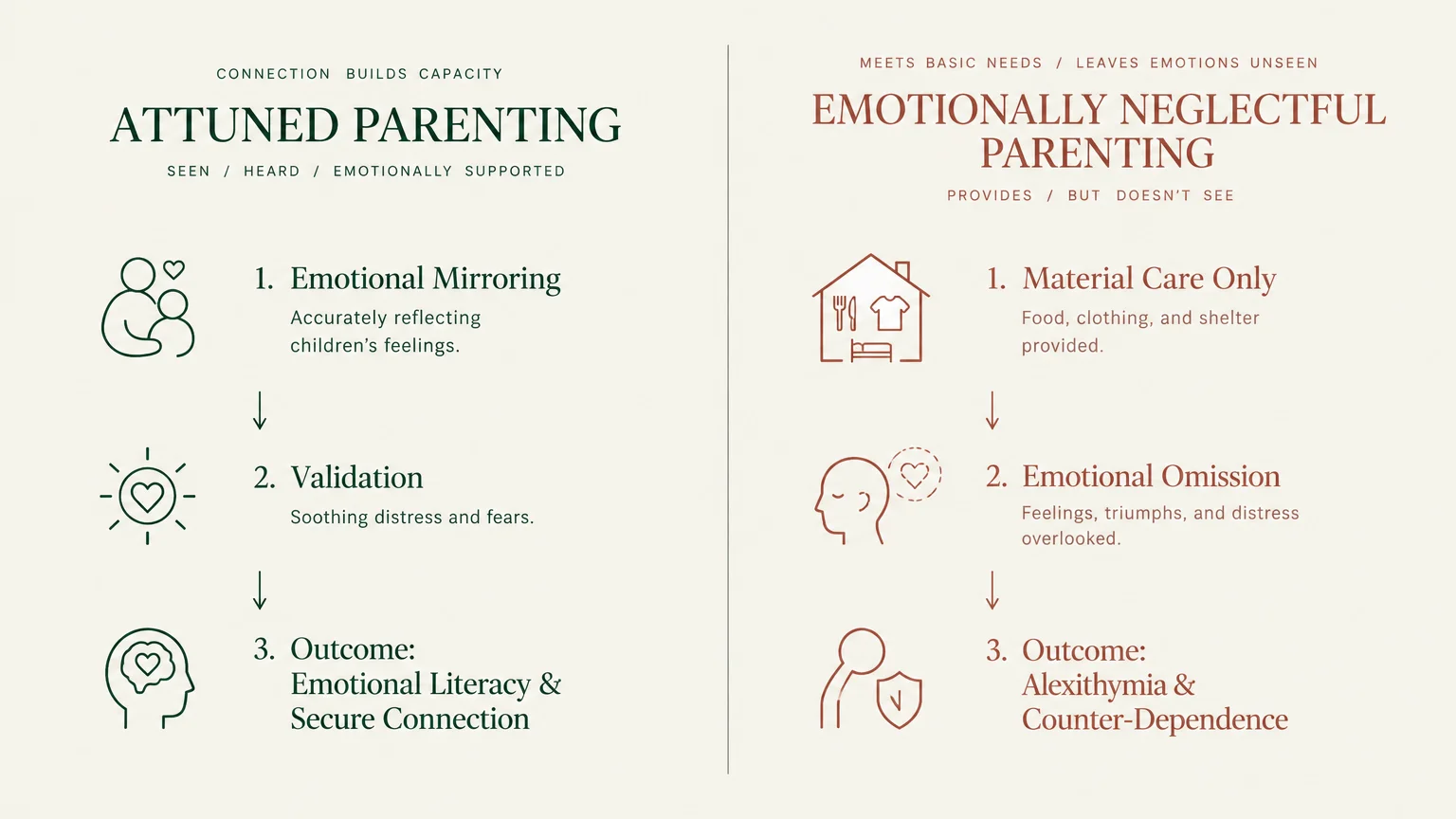
Understanding the contrast between attunement and neglect clarifies why you developed specific coping mechanisms. The table below outlines how contrasting childhood environments shape adult patterns.
| Life Domain | Attuned Caregiving | Emotionally Neglectful Caregiving | Adult Behavioral Consequence |
|---|---|---|---|
| Handling Childhood Distress | Caregivers validate sorrow and soothe fear directly. | Caregivers ignore tears or tell the child to toughen up. | Suppressed feelings, alexithymia, and sudden emotional outbursts. |
| Personal Boundaries | Caregivers respect bodily autonomy and personal opinions. | Caregivers dismiss boundaries or punish resistance. | Compulsive people-pleasing and chronic fear of setting limits. |
| Handling Mistakes | Caregivers frame errors as normal learning opportunities. | Caregivers respond with silent withdrawal or cold indifference. | Toxic shame, perfectionism, and deep-seated fear of failure. |
| Emotional Mirroring | Caregivers reflect the child’s excitement and pride. | Caregivers remain distracted, indifferent, or emotionally flat. | Chronic emptiness and severe discomfort with compliments. |
| Relational Trust | Caregivers provide steady, predictable physical and emotional comfort. | Caregivers leave the child to resolve crises alone. | Counter-dependence and intense fear of romantic vulnerability. |

Common Misconceptions About Emotional Neglect
Many people struggle to identify childhood emotional neglect because several persistent myths cloud the conversation around relational trauma.
Myth 1: “My family provided everything, so I was not neglected.”
Material support and affectionate intentions do not guarantee emotional attunement. Well-meaning parents can pay for elite schooling while remaining completely blind to your emotional struggles.
Myth 2: “Emotional neglect is simply another phrase for emotional abuse.”
Emotional abuse is an active, overt assault on self-esteem through yelling, name-calling, or manipulation. Neglect is silent absence—the critical conversations, comfort, and validation that never took place.
Myth 3: “If I have no dramatic childhood memories, my past does not matter.”
Your brain cannot store memories of events that never occurred. Emotional neglect leaves an invisible void rather than a tangible scar, which makes it harder to identify without clinical insight.
Myth 4: “Emotional neglect is a permanent sentence of unhappiness.”
Childhood experiences shape your neural circuitry, but neuroplasticity allows you to form new emotional habits throughout adulthood. Consistent self-attunement and therapy help you rebuild genuine self-worth.

Practical Steps to Heal from Childhood Emotional Neglect
Healing from emotional neglect requires learning the self-attunement skills your caregivers could not provide. You can rewire your emotional pathways by practicing intentional, actionable strategies.
- Expand your emotional vocabulary: Pause three times daily to check your emotional state. Use an emotion wheel to identify nuanced feelings beyond basic terms like “fine” or “stressed.”
- Conduct somatic check-ins: Notice physical sensations in your jaw, chest, shoulders, and stomach without judgment. Your body processes emotions physically before your conscious mind registers them.
- Practice low-stakes boundaries: Decline minor requests that drain your energy, such as an optional social dinner. Practicing small boundaries builds confidence for larger relational limits.
- Challenge the inner critic: When self-criticism arises, speak to yourself with the warmth you would offer a dear friend. Replacing condemnation with self-compassion dismantles toxic shame.
- Identify your personal preferences: Make low-stakes choices deliberately, from selecting a lunch spot to choosing evening leisure activities. Honoring simple choices reconnects you to your authentic self.
“The curious paradox is that when I accept myself just as I am, then I can change.” — Carl Rogers, Ph.D.
Accepting your current emotional reality allows genuine transformation to occur naturally. Self-acceptance dismantles the habit of silencing your needs.

Finding the Right Professional Help
While self-directed exercises build emotional awareness, professional support accelerates your healing journey. Clinicians provide the steady emotional attunement and relational safety that was missing in childhood.
Consider working with a licensed mental health professional if you notice any of the following patterns:
- Recurrent depressive episodes or emotional numbness that interferes with your work, social life, or physical well-being.
- Chronic relationship distress, including an inability to trust partners, maintain boundaries, or tolerate emotional closeness.
- Persistent alexithymia that leaves you unable to decode bodily tension, chronic stress, or emotional burnout.
- Deep-seated feelings of toxic shame or worthlessness that lead to depressive isolation or chronic imposter syndrome.
Modalities like Emotion-Focused Therapy (EFT), Internal Family Systems (IFS), and Schema Therapy excel at resolving early neglect. The American Psychological Association (APA) highlights these modalities for attachment repair.
If you need low-cost community counseling or support groups, consult the National Alliance on Mental Illness (NAMI) or search licensed providers on Psychology Today.
If emotional distress ever feels overwhelming or leads to crisis, reach out to the 988 Suicide & Crisis Lifeline for immediate, confidential support.
Frequently Asked Questions
How do clinicians evaluate childhood emotional neglect?
Clinicians typically administer validated psychometric instruments like David P. Bernstein’s Childhood Trauma Questionnaire (CTQ). The CTQ features a dedicated subscale that assesses emotional neglect by measuring childhood emotional support and family belonging.
Is emotional neglect related to Complex PTSD (C-PTSD)?
Yes, chronic childhood emotional neglect can contribute to Complex PTSD. When emotional abandonment occurs repeatedly across childhood development, it impairs self-concept, affects emotional regulation, and strains interpersonal relationships.
Can well-intentioned parents cause emotional neglect?
Yes, many emotionally neglectful parents love their children and provide excellent material support. However, parents who never learned to manage their own emotions cannot attune to their children’s feelings.
How does emotional neglect affect adult physical health?
Neglect dysregulates the autonomic nervous system and chronic stress response systems. The landmark CDC ACE study linked childhood neglect to elevated lifetime risks of chronic inflammation, autoimmune issues, and sleep disturbances.
Recovering from childhood emotional neglect does not mean blaming your parents indefinitely. It means taking active responsibility for your present emotional well-being and honoring your authentic needs.
Start small by acknowledging your feelings without judgment and allowing yourself to take up emotional space. Each moment of self-validation repairs the foundation that neglect eroded.
This article provides general educational information about psychology and relationships. It is not a substitute for professional therapy or medical advice. Everyone’s situation is unique—if you’re struggling, please reach out to a licensed mental health professional.
Last updated: February 2026. Psychology research evolves continuously—verify current findings with professional sources.








Leave a Reply