

Carrying guilt that isn’t yours drains your mental energy, blurs your personal boundaries, and traps you in a cycle of solving problems you never caused. When you grow up in an emotionally volatile environment, experience early parentification, or navigate relationships with manipulative personalities, your nervous system learns to absorb collective distress as personal fault. You end up treating other people’s disappointment, emotional dysregulation, and life choices as evidence of your own moral failure. Recognizing where your genuine responsibility ends and another person’s accountability begins is the first step toward emotional freedom, letting you reclaim clarity, rebuild self-worth, and establish healthy boundaries without remorse.

The Psychology of Borrowed Guilt: Why We Absorb Blame
Guilt serves an evolutionary purpose. In healthy relational dynamics, adaptive guilt acts as an internal moral compass; it alerts you when your actions violate your personal ethics or harm another person, motivating restorative behavior. However, clinical research highlights a critical distinction between adaptive remorse and unearned, misplaced guilt.
Misplaced guilt—frequently referred to in family systems theory as inherited or vicarious guilt—develops when an individual assumes responsibility for events, emotional states, or consequences outside their direct sphere of control. According to research published through the American Psychological Association, chronic interpersonal guilt frequently stems from early childhood conditioning where love, stability, or emotional safety were contingent on peacekeeping.
When a child realizes that an adult caregiver cannot regulate their own emotions, the child unconsciously adopts a survival strategy: self-blame. Believing that you are at fault provides an illusion of control. If a parent’s rage, sadness, or neglect is your fault, then modifying your behavior might keep you safe. As an adult, this survival mechanism crystallizes into chronic hyper-responsibility, leaving you burdened by misplaced guilt signs across your romantic partnerships, workplace dynamics, and friendships.
“Guilt is just as powerful, but its influence is positive, while shame’s is destructive. When we apologize for something we’ve done, make amends, or change a behavior that doesn’t align with our values, guilt—not shame—is most often the driving force.” — Brené Brown, Ph.D., MSW
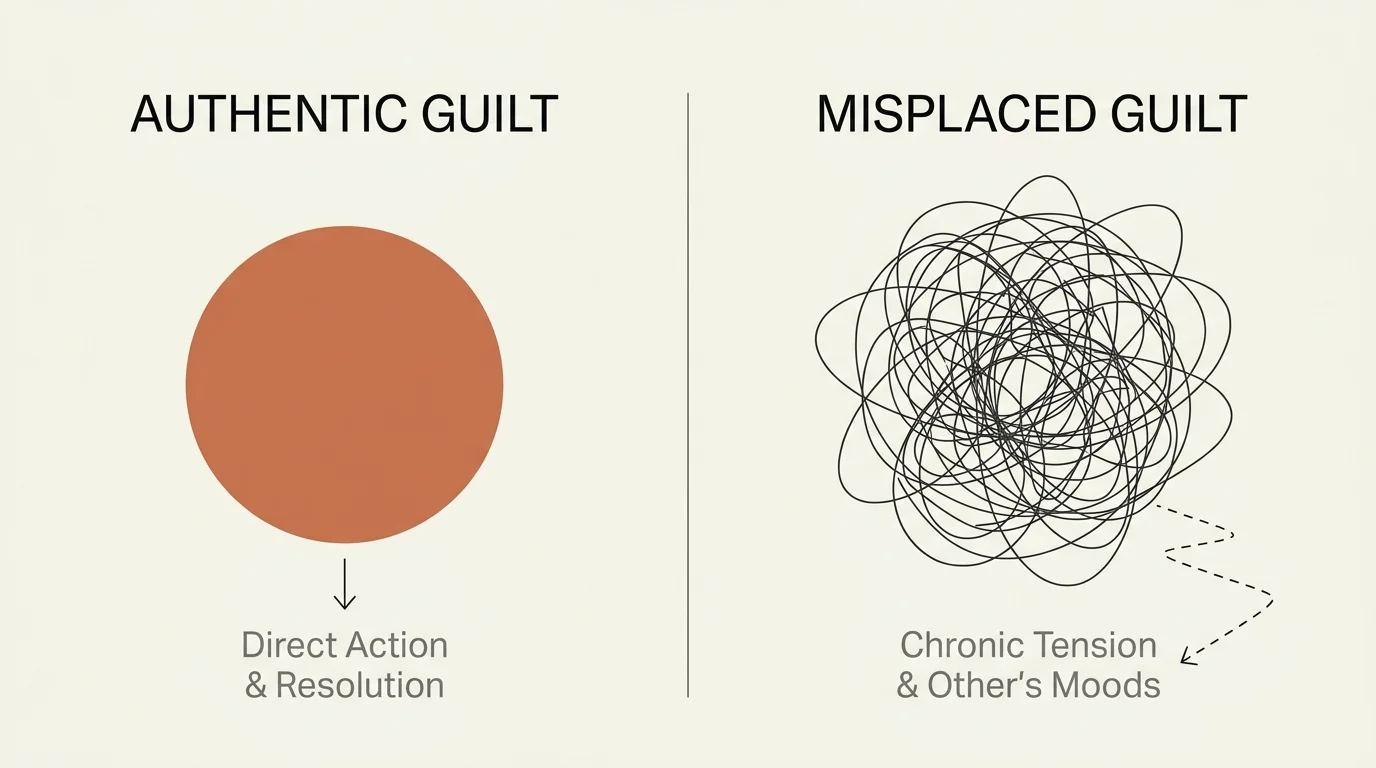
Authentic Guilt vs. Misplaced Guilt: How to Tell the Difference
Distinguishing genuine ethical accountability from unearned emotional weight requires objective evaluation. The table below outlines how authentic guilt contrasts with unearned, inherited guilt across core psychological dimensions.
| Dimension | Authentic Guilt (Constructive Remorse) | Misplaced / Inherited Guilt (False Responsibility) |
|---|---|---|
| Root Cause | A direct, voluntary action or inaction that violated your core values or caused verifiable harm. | Another person’s bad mood, unreasonable expectations, systemic family dysfunction, or circumstances beyond your control. |
| Internal Sensation | Specific, situational, and focused on a discrete event (“I made a mistake”). | Diffuse, chronic, somatic tension and pervasive unworthiness (“I am a burden; everything is my fault”). |
| Behavioral Reaction | Direct amends, sincere apology, behavior modification, and subsequent emotional release. | Over-apologizing, compulsive people-pleasing, self-silencing, and hypervigilance. |
| Relational Dynamics | Fosters mutual repair, emotional maturity, and deeper intimacy. | Enables toxic behavior, breeds underlying resentment, and creates unbalanced, codependent bonds. |
| Path to Resolution | Direct reparative action and values realignment. | Boundary establishment, cognitive reframing, and letting go of guilt not your own. |

9 Signs You’re Carrying Guilt That Isn’t Yours
Unearned guilt operates quietly in daily interactions. If you have internalized the responsibility for other people’s well-being, watch for these nine unmistakable signs of inherited guilt.
1. You Apologize Constantly for Natural Human Limitations
You find yourself saying “I’m sorry” when someone bumps into you, when the weather ruins an outdoor plan, or when you simply take a few hours to return a non-urgent text message. This reflex reflects an unconscious belief that your existence inconveniences those around you. You apologize not because you committed an offense, but because you feel responsible for managing everyone’s baseline comfort.
2. You Feel Accountable for Adult Family Members’ Life Choices
If an estranged parent struggles financially, a sibling makes poor relationship choices, or a relative battles addiction, you feel a visceral knot in your stomach. You may catch yourself thinking, “If I called more often or gave them more financial support, their lives wouldn’t be falling apart.” This dynamic frequently originates from childhood parentification—a phenomenon documented extensively in clinical literature via Psychology Today, where children are forced to step into the role of emotional caregiver for their parents.
3. Personal Success and Happiness Provoke Uncomfortable Remorse
When you secure a promotion, buy a home, enter a loving relationship, or achieve financial stability, you feel an immediate wave of dread rather than unadulterated joy. Known in psychoanalytic frameworks as “survivor guilt,” this occurs when you internalize the unhealed suffering of your family of origin. You subconsciously worry that thriving betrays those who remain stuck in hardship.
4. You Hyper-Scan Environments for Unspoken Tension
The moment you enter a room, your nervous system evaluates micro-expressions, sighs, and changes in tone. If your partner or colleague seems quiet or withdrawn, you instantly assume you triggered their state. You replay your recent interactions on an obsessive loop, attempting to uncover what you did wrong, even when their mood has everything to do with work stress or physical exhaustion.
5. Setting a Reasonable Boundary Feels Like an Act of Cruelty
Saying “no” to an unreasonable work demand, declining a social invitation when exhausted, or telling a friend that you cannot lend them money makes your pulse race. Rather than viewing boundaries as necessary tools for self-preservation, you equate setting limits with intentional harm. You obsess over the possibility that your healthy boundary will devastate the other person.
6. You Ruminate Over Past Conflicts Where You Had No Agency
You spend emotional energy wishing you had handled childhood divorces, family disputes, or historical traumas differently—events that occurred when you were a dependent minor without cognitive maturity or legal autonomy. You carry the adult weight of events where you were merely a vulnerable bystander.
7. You Absorb Generational Dreams and Sacrifices as an Unpayable Debt
Immigrant families, marginalized communities, and households that endured significant economic hardship often pass down an implicit narrative: “We suffered so you could succeed.” While intended to inspire gratitude, this can morph into toxic inherited guilt. You feel you have no right to choose your own career path, rest, or express discontent because doing so dishonors the sacrifices made before you.
8. You Shield Irresponsible People from Natural Consequences
When a partner, adult child, or friend neglects their obligations, you immediately step in to finish their work, pay their overdue bills, or make excuses to mutual acquaintances. You fear that allowing them to experience discomfort or failure makes you neglectful. In reality, carrying this burden enables dysfunctional patterns and robs others of natural learning opportunities.
9. You Confuse Empathy with Compulsory Problem-Solving
Healthy empathy allows you to sit with someone’s pain and offer supportive presence. Misplaced guilt, however, convinces you that merely witnessing another person’s sadness mandates that you resolve it. If you cannot fix their distress, you judge yourself as inadequate or cold-hearted.
“The curious paradox is that when I accept myself just as I am, then I can change.” — Carl Rogers, Ph.D.

The Physical and Psychological Toll of False Responsibility
Carrying guilt that isn’t yours is not simply a cognitive distortion; it exerts a measurable physiological toll on your body. Chronic emotional stress activates the sympathetic nervous system, maintaining an elevated release of cortisol and adrenaline. Insights from Harvard Health Publishing demonstrate that long-term psychological stress contributes significantly to systemic inflammation, sleep disturbances, digestive disorders, and chronic muscle tension.
Psychologically, chronic unearned guilt fuels emotional exhaustion and relational resentment. When you spend years over-functioning for others, you inevitably experience bitterness toward the very people you are attempting to rescue. This creates a painful internal conflict: you resent their demands, feel guilty for feeling resentful, and redouble your efforts to appease them.

Releasing Guilt That Belongs to Someone Else: A 4-Step Framework
Releasing guilt that belongs to someone else requires conscious rewiring of your cognitive patterns and nervous system responses. Implement these four clinical strategies to dismantle false responsibility.
- The Cognitive Responsibility Pie Chart: When an overwhelming sense of guilt strikes, draw a circle on a sheet of paper. List every factor that contributed to the distressing situation (e.g., external circumstances, other people’s decisions, historical dynamics, systemic barriers, and your direct actions). Assign a realistic percentage to each. You will quickly observe that your actual slice of accountability rarely exceeds a small fraction of the total picture.
- Somatic Boundary Grounding: When unearned guilt triggers physical tightness in your chest or stomach, pause before reacting. Place one hand on your chest and take three slow, diaphragmatic breaths. Remind your nervous system: “Their distress is theirs to navigate; I can offer kindness without carrying their load.”
- Shift from Apology to Appreciation: Replace reflexive apologies with statements of gratitude. Instead of saying, “I’m so sorry I’m late; traffic was terrible,” say, “Thank you so much for your patience while I navigated traffic.” This shifts the relational dynamic from self-subjugation to mutual respect.
- Differentiate Between Being Hurtful and Causing Disappointment: Understand that disappointing someone is not identical to harming them. Setting a healthy boundary may disappoint someone who preferred your self-sacrifice, but honoring your capacity is an act of integrity, not malice. As researchers at The Gottman Institute emphasize, sustainable relationships require partners to voice authentic needs rather than quietly harbor resentment.
What Can Go Wrong (Misconceptions About Letting Go of Guilt)
As you begin releasing guilt that belongs to someone else, you may encounter cognitive pitfalls and interpersonal friction. Anticipating these challenges ensures you stay anchored in your growth.
- Mistaking Healthy Boundaries for Narcissism: When you stop over-functioning, the sudden drop in effort can feel shocking. You might worry that refusing to rescue others makes you callous. Differentiating healthy self-regard from apathy is essential: you can care deeply about someone without taking ownership of their life outcomes.
- The “Extinction Burst” Guilt Spike: When you first stop accommodating unearned guilt, the people who benefited from your lack of boundaries may intensify their guilt-tripping tactics. They may accuse you of changing or being selfish. Expect this temporary surge in tension; it confirms that your boundaries are working, not that you made a moral error.
- Demanding Immediate Validation from Others: Do not expect the individuals who deposited their guilt onto you to validate your newfound autonomy. Waiting for their permission or understanding will keep you tethered to the very cycle you are trying to break. Reclaiming your peace is an internal decision.

When to Seek Professional Support
While self-guided boundary work is powerful, deeply entrenched inherited guilt often requires specialized psychological support. Consider reaching out to a licensed mental health professional if you recognize any of the following patterns:
- Persistent Somatic Symptoms: You experience unyielding insomnia, panic attacks, tension headaches, or chronic gastrointestinal upset tied to interpersonal stress.
- Severe Scrupulosity or Obsessive Rumination: You engage in compulsive moral checking, catastrophic thinking, or obsessive mental replays of normal daily interactions.
- Complex Developmental Trauma: Your misplaced guilt stems from childhood abuse, severe neglect, or acute narcissistic parenting that left you with distorted core beliefs about your basic right to exist.
- Paralyzing Relational Paralysis: You find yourself unable to end abusive, exploitative, or deeply unhappy relationships due to terror over how the other person will survive without you.
Evidence-based modalities such as Cognitive Behavioral Therapy (CBT), Acceptance and Commitment Therapy (ACT), Internal Family Systems (IFS), and Eye Movement Desensitization and Reprocessing (EMDR) can assist you in safely discharging borrowed trauma and establishing healthy individuation.
Frequently Asked Questions
How do I know if the guilt I feel is legitimate or borrowed?
Legitimate guilt is tied to a specific action you took that violated your values or directly injured someone, and it resolves once you make appropriate amends. Borrowed guilt is chronic, vague, tied to other people’s moods or reactions, and remains unresolved no matter how much you apologize or accommodate them.
Why do I feel guilty when good things happen to me?
This often stems from survivor guilt or generational trauma. If your family of origin struggled with chronic adversity or if you were conditioned to believe that someone else’s suffering takes precedence over your joy, your nervous system associates personal success with abandonment of your loved ones.
How should I respond when a family member tries to guilt-trip me?
Use clear, calm, non-defensive communication. Acknowledge their feeling without accepting responsibility for it: “I understand that you are frustrated that I can’t attend this weekend, but my schedule won’t allow it.” Avoid over-explaining, making excuses, or apologizing for having limitations.
Can childhood parentification cause chronic guilt in adulthood?
Yes. When a child is expected to fulfill the emotional or practical responsibilities of an adult, they internalize the belief that other people’s well-being rests entirely on their shoulders. In adulthood, this manifests as chronic misplaced guilt, difficulty relaxing, and compulsive caretaking.
Reclaiming your life requires setting down burdens that were never yours to carry. As you practice discerning genuine accountability from borrowed obligation, you create the emotional space necessary for authentic relationships, self-compassion, and lasting peace of mind.
This is educational content based on psychological research and general principles. Individual experiences vary significantly. For personalized guidance, consult a licensed therapist, psychologist, or counselor.
Last updated: February 2026. Psychology research evolves continuously—verify current findings with professional sources.








Leave a Reply