

You can usually sense when a partner, friend, or colleague conceals what they truly feel. Subtle emotional dishonesty quietly destabilizes communication and breeds persistent relationship trust issues.
Emotional dishonesty occurs when someone deliberately or unconsciously masks their authentic emotions behind artificial compliance and evasive reactions. You end up navigating an unspoken distance that leaves you second-guessing your own instincts.
Recognizing the quiet signs of emotional dishonesty enables you to address relational disconnects with clarity rather than confusion. Here are seven evidence-backed patterns to help you distinguish authentic vulnerability from emotional avoidance.

What Is Emotional Dishonesty?
Emotional dishonesty involves concealing or falsifying internal psychological states rather than concrete, external facts. Someone might insist they support your choices while secretly harboring deep resentment.
According to clinical literature highlighted by Psychology Today, people often adopt these protective behaviors as defense mechanisms. They mask their true needs to prevent anticipated abandonment, judgment, or interpersonal conflict.
Unlike overt deception, emotional dishonesty signs often fly under the radar because the speaker appears calm, cooperative, and polite. Over time, however, this facade degrades intimacy and fosters intense relationship trust issues.

7 Subtle Signs of Emotional Dishonesty
1. Incongruence Between Spoken Words and Nonverbal Signals
When verbal statements contradict bodily cues, your nervous system usually notices the mismatch immediately. A partner may utter “Everything is fine” with rigid posture, clenched jaws, and averted gaze.
Research from the American Psychological Association emphasizes that authentic emotional expressions engage involuntary facial muscles that are difficult to counterfeit. When someone forces a smile during tense moments, their emotional incongruence reveals unacknowledged distress.
Pay close attention when someone’s tone of voice sounds flat while their words express excitement or warmth. That acoustic and physical disconnection frequently points to repressed ambivalence or unspoken frustration.
2. Chronic Use of Deflective Positivity
Persistent optimism can sometimes serve as an impenetrable psychological barrier. If someone swiftly answers every vulnerable question with cheery platitudes, they may be dodging genuine emotional contact.
This behavior differs from healthy resilience because it invalidates real challenges and stifles uncomfortable conversations. The individual uses forced cheerfulness to deflect discussions about stress, grief, or friction before they even start.
Notice whether they routinely change the subject whenever you invite them to explore deeper emotional territory. Deflective cheerfulness keeps conversations comfortably shallow, insulating them from the vulnerability they desperately fear.
3. Weaponized Agreeableness and Phantom Commitments
People pleasers frequently commit to plans or boundaries they secretly dislike just to maintain temporary harmony. They offer an enthusiastic “yes” in the moment, but their follow-through consistently falls apart.
This pattern represents emotional dishonesty because the individual hides their actual hesitation or resentment. Instead of declining an invitation directly, they make excuses at the last minute or harbor unvoiced irritation.
Such repeated discrepancies make detecting lies in relationships challenging because the behavior looks like harmless forgetfulness. In reality, weaponized agreeableness conceals a stubborn refusal to share authentic personal limits.
4. Intellectualizing Vulnerable Topics to Evade Feeling
Some individuals analyze interpersonal issues with clinical detachment rather than emotional engagement. When you share hurt feelings, they respond with abstract theories, debates, or strategic problem-solving instead of personal empathy.
According to psychodynamic theory, intellectualization acts as a sophisticated psychological defense against threatening feelings. By turning visceral emotional experiences into purely logical puzzles, the speaker protects themselves from experiencing painful vulnerability.
When someone refuses to express how an event actually felt, they deny you reciprocal emotional depth. You receive an eloquent lecture instead of a genuine human connection.
5. Sudden Oscillations Between Intimacy and Cold Withdrawal
Sharing a deeply meaningful conversation only to be met with sudden emotional distance the next day can be disorienting. This sudden retreat often reflects an internal panic over genuine closeness.
Avoidant attachment strategies often drive individuals to withdraw after moments of heightened vulnerability. They may pretend nothing happened or fabricate sudden obligations to re-establish emotional distance.
Rather than communicating that intimacy triggers anxiety, they withdraw behind emotional stonewalling. This behavioral swing leaves you confused and destabilizes emotional safety within the partnership.
6. Micro-Omissions of Personal Needs and Resentments
Emotional dishonesty frequently manifests through what someone chooses to withhold rather than direct falsifications. Small grievances are quietly swallowed until they curdle into passive-aggressive comments or chronic cynicism.
The individual might claim they do not care which restaurant you pick, yet display silent resentment throughout dinner. By omitting their genuine preferences, they maintain a martyr identity while subtly punishing you for not guessing correctly.
These micro-omissions are classic signs of emotional dishonesty that erode trust over extended periods. Open relationships require partners to state their basic needs directly without fear of mild friction.
7. Performative Empathy Lacking Somatic Attunement
Performative empathy occurs when someone recites validating therapy language without any authentic emotional resonance. They say all the “correct” therapeutic phrases, yet their engagement feels detached, mechanical, or scripted.
The relationship researchers at The Gottman Institute observe that meaningful connection requires genuine emotional attunement. Without attunement, rehearsed statements of validation fall flat and fail to comfort a distressed partner.
If someone uses empathy solely as a conversational exit strategy, they are being emotionally dishonest. They mimic compassionate presence to quickly end conflict without ever truly listening to your experience.
“Vulnerability is not winning or losing; it’s having the courage to show up and be seen when we have no control over the outcome.” — Brené Brown, Ph.D., LMSW
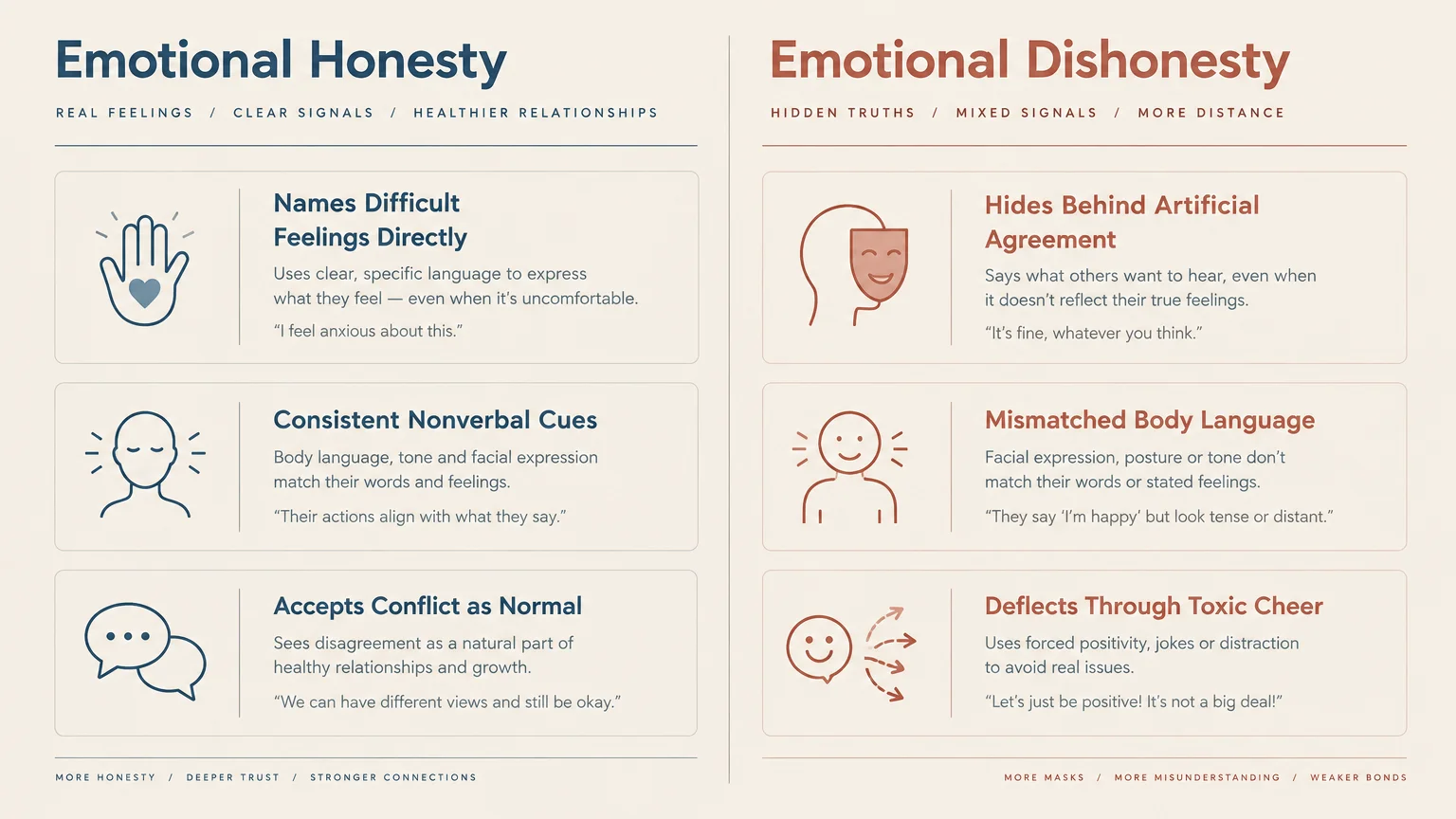
Emotional Honesty vs. Emotional Dishonesty: Key Differences
Distinguishing between authentic emotional expression and evasive emotional posturing helps you evaluate relational dynamics objectively. The following comparison highlights how these communication styles diverge in daily interactions.
| Interaction Dynamic | Emotionally Honest Behavior | Emotionally Dishonest Behavior |
|---|---|---|
| Conflict Resolution | Addresses core tensions directly, even when awkward. | Deflects through humor, toxic positivity, or silence. |
| Stating Personal Needs | Clearly communicates limits and preferences. | Agrees externally while feeling resentful internally. |
| Verbal & Nonverbal Alignment | Body language matches spoken statements. | Smiles or acts calm while signaling tension physically. |
| Handling Vulnerability | Acknowledges difficult emotions with humility. | Retreats into cold intellectualization or withdrawal. |
| Accountability | Owns behavioral mistakes without defensiveness. | Offers rehearsed apologies without true attunement. |
Tracking these distinct patterns clarifies whether your relationship fosters authentic transparency or subtle emotional evasion. Observing these behaviors systematically prevents you from misinterpreting defensive reactions as personal rejection.

Common Misconceptions
Pop psychology often oversimplifies how people conceal their feelings, leading to inaccurate assumptions and unnecessary paranoia. Clarifying these misconceptions helps you interpret complex interactions with grounded nuance.
Misconception 1: Emotional dishonesty is always motivated by malice. In truth, most people hide their feelings out of shame, fear, or conflict avoidance rather than cruel calculation.
Misconception 2: Emotional honesty requires sharing every fleeting thought. Healthy intimacy requires thoughtful discretion and emotional regulation, not impulsive verbal venting without consideration for context.
Misconception 3: You can spot dishonesty through simple body language cues. Research from the American Psychological Association confirms that universal behavioral signs someone is lying do not exist.
Relying on rigid cues like eye contact or arm posture often leads to false accusations. Baseline behavioral shifts and sustained emotional incongruence provide far more reliable insights than isolated gestures.

Practical Steps to Address Emotional Dishonesty
Confronting emotional dishonesty with accusations usually triggers intense defensiveness and deeper concealment. You can foster greater authenticity by shifting how you initiate vulnerable dialogues.
- Establish psychological safety: Validate that sharing difficult emotions will not lead to retaliation, contempt, or immediate conflict.
- Reflect observed discrepancies gently: Use non-blaming language such as, “You mention you’re fine, but your tone sounds exhausted and distant.”
- Reward candid honesty: When someone risks expressing an unpopular opinion or uncomfortable feeling, express appreciation for their openness.
- Clarify personal boundaries: Explain that you value uncomfortable honesty far more than soothing, performative compliance.
Practicing these steps consistently demonstrates that your connection can withstand candid emotional realities. Over time, mutual safety replaces the perceived need for defensive emotional masks.

Finding the Right Professional Help
Navigating entrenched relationship trust issues can feel overwhelming without structured external guidance. Qualified mental health professionals provide safe containers to unpack complex relational barriers.
Consider seeking guidance from a licensed marriage and family therapist (LMFT) or psychologist in the following specific scenarios:
- Chronic stonewalling during conflict: One partner consistently refuses to speak, leaves abruptly, or denies obvious emotional tension for days at a time.
- Persistent reality distortion and gaslighting: You repeatedly question your own emotional sanity because your partner habitually denies stated events and feelings.
- Unresolved resentment eroding intimacy: Emotional distance has replaced verbal and physical warmth, creating an atmosphere of chronic cynicism or detached cohabitation.
- Severe avoidance rooted in attachment trauma: Past relational injuries prevent either individual from taking emotional risks or expressing basic vulnerabilities.
Evidence-based approaches like Emotionally Focused Therapy (EFT) and the Gottman Method offer proven roadmaps for rebuilding relational security. According to clinical guidance from Harvard Health, couples therapy helps partners identify underlying emotional blocks before patterns become irreversible.
Frequently Asked Questions
What is the difference between privacy and emotional dishonesty?
Privacy involves intentionally keeping personal thoughts sacred while maintaining an authentic relationship. In contrast, emotional dishonesty deliberately distorts or conceals relevant emotional truths that directly affect the shared connection.
Can emotional dishonesty ruin a relationship?
Yes, chronic emotional dishonesty slowly erodes relational intimacy and psychological safety. When partners cannot trust each other’s emotional expressions, pervasive anxiety and emotional detachment eventually destroy the partnership.
How can you tell if someone is lying about their feelings?
Look for persistent mismatches between their verbal declarations and their daily behaviors or physical presence. True emotional honesty shows consistent alignment between what someone claims to feel and how they act over time.
Can a person stop being emotionally dishonest?
People can unlearn emotional dishonesty when they develop distress tolerance, self-awareness, and emotional regulation skills. Professional therapy often accelerates this transformation by addressing the deep fears that drive avoidance.
Cultivating Authentic Connection
Unlearning patterns of emotional concealment requires conscious patience, mutual vulnerability, and consistent boundary setting. As you practice honoring emotional truth, your relationships will develop genuine resilience.
This is educational content based on psychological research and general principles. Individual experiences vary significantly; for personalized guidance, consult a licensed therapist, psychologist, or counselor.
Last updated: February 2026. Psychology research evolves continuously—verify current findings with professional sources.









Leave a Reply