
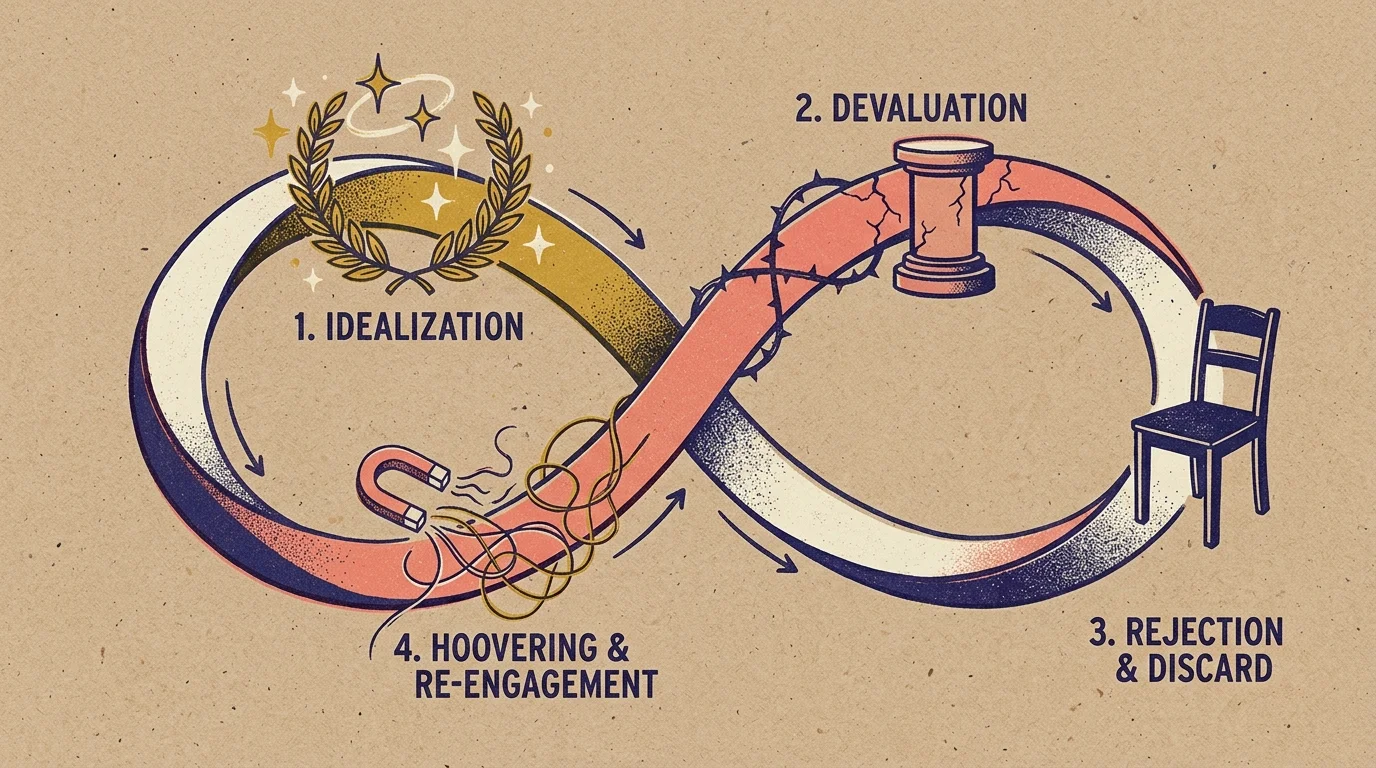
The Cycle of Narcissism in Relationships
Relationships marked by high narcissism rarely stay stable; instead, they follow an exhausting, repetitive cycle that destabilizes the other partner.
Understanding this progression allows you to recognize where you currently stand in the relationship and anticipate future behavior.
Phase 1: Idealization
Your partner places you on a pedestal, mirroring your interests, values, and dreams to manufacture deep, instant intimacy.
You feel uniquely seen and adored, which establishes a powerful emotional baseline that you will later strive to regain.
Phase 2: Devaluation
As soon as you express independent needs or minor flaws, the idealization abruptly ends. Your partner introduces subtle put-downs, passive-aggressive remarks, and constant comparisons.
You begin questioning your worth and walking on eggshells to prevent sudden shifts in their mood.
Phase 3: Discard or Rejection
When you demand accountability or no longer provide unquestioning admiration, your partner may suddenly withdraw affection or terminate the relationship abruptly.
They often treat the separation with callous indifference, leaving you feeling disposable and profoundly confused.
Phase 4: Hoovering
If you attempt to move on, the partner frequently returns with apologies, dramatic promises of change, or manufactured crises.
Named after the vacuum cleaner brand, hoovering pulls you back into the cycle to re-establish control and emotional supply.








Leave a Reply